Astrology Journal
Mercury Return Chart: Calculation and Interpretation
A Mercury return chart is cast when transiting geocentric Mercury reaches the same zodiacal longitude it held at birth, sometimes in a three-pass retrograde cluster.
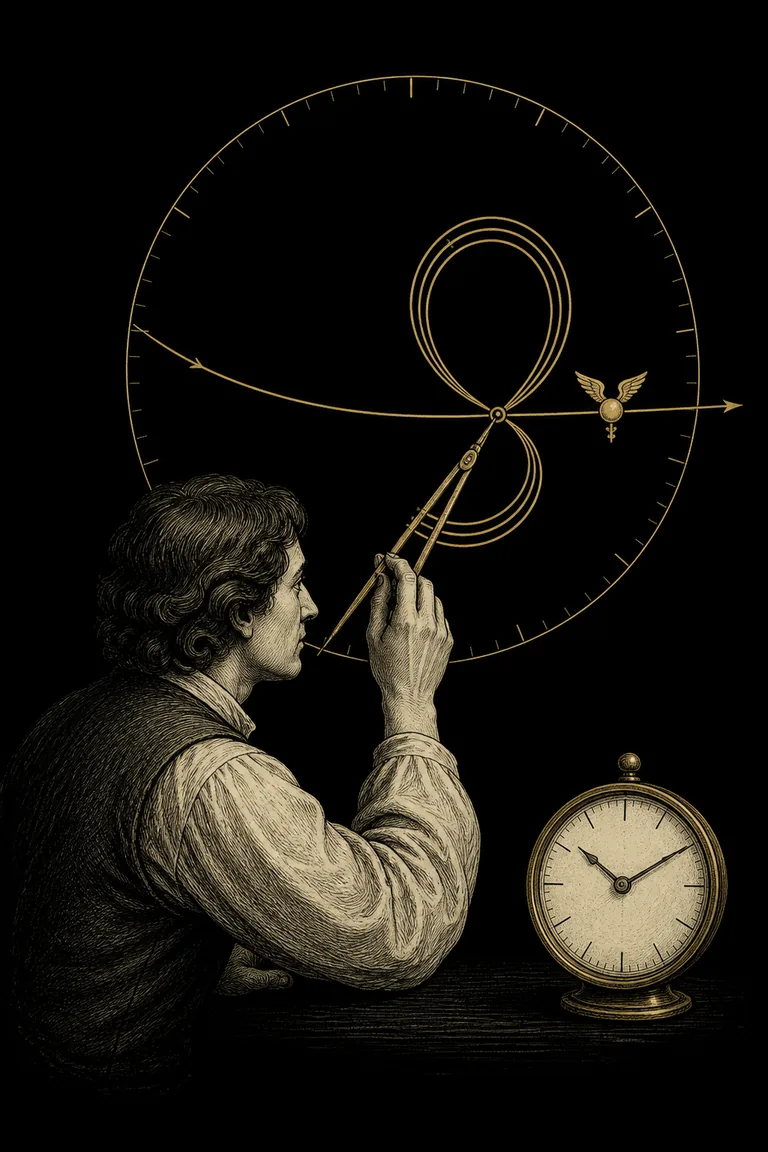
A Mercury return is an exact longitude event, not simply Mercury entering your natal Mercury sign. Calculate the natal planet with a declared tropical or sidereal zodiac, search for every later crossing of that longitude, refine each timestamp, and preserve whether Mercury is direct, stationary, or retrograde. A nearby retrograde loop can create three returns within one compact window.
The chart is then erected for a declared location and compared with the natal chart. Astrologers use it as a symbolic frame for attention, learning, writing, negotiation, travel, tools, and exchange, but it is not a scientifically validated forecast. Keep all calculations reproducible and do not use the chart to assume another person's thoughts or promise a specific message, contract, diagnosis, or event.
Take the next insight with you
Explore personalized Astrology guidance in Veritas, available for iOS and Android.
 Scan with your phone
Mercury return chart at a glance
What a Mercury return chart is
The calculation begins with Mercury's apparent geocentric ecliptic longitude at birth. A return occurs when moving Mercury reaches that same longitude in the chosen zodiac. Degree, minute, and second notation is only a display format for one circular coordinate. Sign alone is too broad: Mercury may spend days in the same sign while the exact conjunction occurs at one refined instant.
Calculate the exact return
Use one ephemeris and one zodiac setting for both natal and transiting positions. Search a wide date range, calculate the wrapped angular difference from the natal target, and locate each interval where that difference crosses zero. Refine the interval with repeated interpolation or a root finder. The algorithm must handle the 359-to-0 degree boundary and changes in direction near stations.
Refine a six-hour bracket around the natal longitude
Natal Mercury longitude = 173.750 degrees
10:00 UTC transiting Mercury = 173.500 degrees
16:00 UTC transiting Mercury = 174.100 degrees
(173.750 - 173.500) / (174.100 - 173.500) = 0.4167 of the bracket
0.4167 x 6 hours = 2.5 hours, so first estimate = 12:30 UTC
The sample assumes direct motion and rounded teaching values. Recalculate Mercury at 12:30 UTC and iterate until the longitude difference meets the declared tolerance. Near a station, linear interpolation becomes less reliable because speed approaches zero and reverses. A robust search samples finely, identifies tangencies as well as sign changes, and confirms signed speed at every solution.
Why the return is not every 88 days
Mercury completes a heliocentric orbit around the Sun in about 88 Earth days. A natal chart, however, uses Mercury's apparent position from Earth against the zodiac. Earth is moving too, and Mercury never appears far from the Sun. The geocentric longitude pattern therefore returns to a natal Mercury degree roughly annually, not after every heliocentric orbit. Apparent retrograde motion can repeat the same degree within that annual passage.
Handle direct, retrograde, and final direct passes
If Mercury crosses the natal longitude, stations beyond it, moves backward across it, stations again, and crosses forward a third time, save all three exact returns. Do not discard the chart that looks difficult or nominate a favorite without a rule declared in advance. A responsible approach treats the first direct, retrograde, and final direct charts as one return window with distinct timestamps and motion states.
Choose a rule for the return cycle
Astrological schools differ on whether each exact pass begins a separate chart, whether the first pass opens one continuous cycle, or whether the final direct pass carries special weight. No astronomical calculation resolves that interpretive convention. State the rule before reading the charts, keep every pass available, and avoid extending a short Mercury cycle into a rigid promise about the entire year.
Birth data and natal Mercury precision
An exact recorded birth time gives the cleanest natal target and reliable natal houses. Mercury usually moves slowly enough that a modest time error changes longitude less dramatically than it changes the Ascendant, but the effect is not constant. Near an ingress, station, or exact aspect, minutes and motion state can matter. With an unknown time, calculate a documented noon or range and avoid exact return angles or house claims.
Choose the return location explicitly
The return instant is determined by Mercury's longitude and does not depend on the observer's city. The Ascendant, Midheaven, and houses do depend on coordinates and time zone. Practitioners variously use birthplace, residence, or actual location at the instant. Record the chosen rule before opening the chart and never relocate afterward merely to obtain preferred houses.
Audit a Mercury return calculator
- Save the natal target
Record full Mercury longitude, zodiac, UTC birth time, ephemeris, and motion state.
- Search every crossing
Use a wide window and inspect stations so retrograde passes are not silently missed.
- Verify the solution
Recalculate transiting Mercury at each reported UTC timestamp within a stated tolerance.
- Record motion and place
Save signed speed, direct or retrograde status, coordinates, local time, and location rule.
- Freeze interpretation settings
Declare houses, aspects, orbs, natal overlay, and the rule for multiple passes.
A practical interpretation order
Begin with return Mercury by house only when the return location and time are reliable. Note its sign, signed speed, proximity to a station, major applying and separating aspects, and angularity. Then examine the return Ascendant and ruler, planets close to angles, and the natal house receiving the return Ascendant. Keep the list short enough that a later review can identify misses.
Read Mercury's condition before making a story
Mercury returns to its natal sign and longitude by definition, so the most variable information lies in house, motion, aspects, angular distance, and the rest of the return chart. A slow Mercury near a station may symbolize revision or sustained attention in some traditions, but it does not cause messages to fail. An exact aspect can focus reflection without guaranteeing an external event.
Compare the return with the natal chart
A biwheel can show which natal houses receive return planets and which return planets make close contacts to natal points. Separate return-to-return aspects from return-to-natal aspects in your notes. Use the same aspect family and orbs chosen before reading. If the birth time is uncertain, omit natal angles and house cusps rather than giving them false precision.
Save every return crossing
Use Veritas to record the natal target, longitude bracket, exact UTC and local times, signed motion, return location, settings, all retrograde passes, interpretations, alternatives, misses, and review date.
Mercury return versus Mercury transits
The return is one exact conjunction of transiting Mercury with natal Mercury and may be used to cast a complete chart. Mercury transits include its movement through every natal house and aspect throughout the year. A return chart freezes one instant; it does not mean all contacts shown in that chart perfect simultaneously or remain active until the next return.
Mercury return versus solar and lunar returns
A solar return matches the natal Sun and is tied closely to the tropical year. A lunar return matches the natal Moon about every 27.3 days. Mercury's apparent motion is less regular because it repeatedly stations and retrogrades from Earth's viewpoint. Each technique therefore needs its own exact target and timestamp rather than a date copied from another return.
Review the cycle fairly
Before the return window, write no more than three specific themes, the chart factors behind them, alternative explanations, and evidence that would count against each interpretation. Review at a declared date. Include ordinary communications, unfinished work, silence, changed choices, ambiguous cases, and clear misses. Do not search private messages or reinterpret every typo as confirmation.
Limits and responsible use
A Mercury return chart cannot read minds, guarantee contact, diagnose neurological or mental health conditions, prove deception, predict a contract, certify travel safety, choose medical treatment, or replace legal, financial, technical, or professional advice. Apparent retrograde motion is an astronomical perspective effect, while return interpretation belongs to a symbolic tradition. Use verified information and qualified help for consequential decisions.