Astrology Journal
Applying and Separating Aspects in Astrology
An aspect is applying when its distance from exactness is shrinking and separating when that distance is growing. Actual signed motion decides the phase, especially near retrogrades and stations.
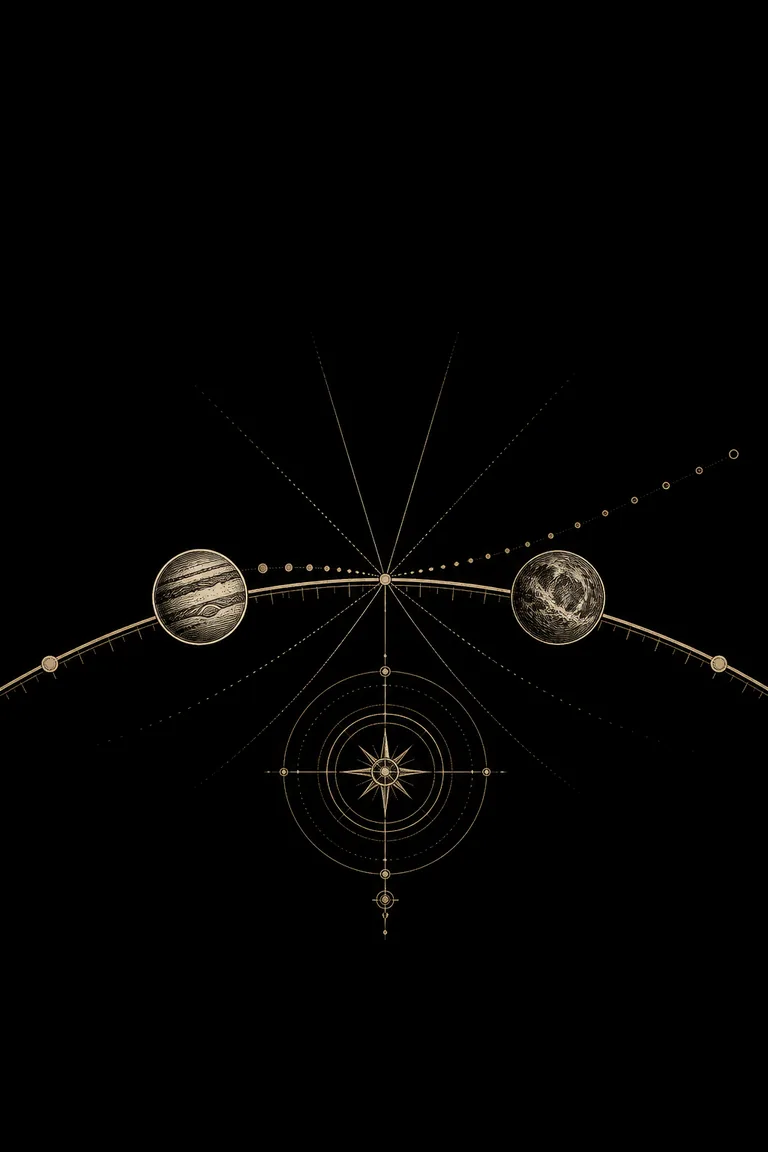
In astrology, an applying aspect is moving toward its exact angle, while a separating aspect has passed exactness and is moving away. If the orb of a square falls from 3 degrees to 2 degrees, the square is applying. If the orb rises from 2 degrees to 3 degrees, it is separating. Exactness is the zero-orb moment between those phases.
Do not classify the aspect only by which planet is usually faster or which one appears earlier in zodiac order. Retrograde motion, stations, loops around 0 Aries, and changing speed can reverse the expected result. The most reliable test compares exact longitudes at two nearby timestamps and asks whether distance from the target angle is shrinking or growing.
Take the next insight with you
Explore personalized Astrology guidance in Veritas, available for iOS and Android.
 Scan with your phone
Applying vs separating aspects: the short answer
What do orb and exactness mean?
The aspect angle is the target. A conjunction targets 0 degrees, a sextile 60, a square 90, a trine 120, and an opposition 180. The orb is the absolute distance between the current relationship and that target. A planetary pair separated by 87 degrees is 3 degrees from an exact square. Applying and separating describe how that 3-degree distance is changing, not whether the aspect is considered favorable, difficult, strong, or weak.
Worked conjunction example
Compare the conjunction orb across one day
Day 1: Mercury 14°20′ Gemini; Venus 17°00′ Gemini
Day 1 conjunction orb: 2°40′
Day 2: Mercury 15°40′ Gemini; Venus 18°00′ Gemini
Day 2 conjunction orb: 2°20′
The orb shrank by 0°20′, so the conjunction is applying during this interval.Mercury is moving faster in this example, but that is evidence from the actual positions, not a permanent rule. If Mercury slowed before stationing while Venus continued forward, the gap could stop shrinking. The conjunction would be exact only if the longitudes actually meet. A smaller orb tomorrow supports application now, but a longer ephemeris window is needed to confirm eventual perfection.
How to calculate the phase of any aspect
- Record exact positions
Use the same coordinate system, zodiac, reference frame, timestamp standard, and ephemeris for both bodies.
- Choose the aspect target
State the tested angle and maximum orb before interpreting the result.
- Measure the current orb
Normalize the angular separation around 360 degrees, then find its shortest distance from the exact target.
- Advance a short interval
Use a second ephemeris timestamp appropriate to the planets’ speed, retaining signed motion and precision.
- Compare the two orbs
Shrinking means applying, growing means separating, and a direction change signals a station or near miss that needs closer sampling.
- Check future perfection
Continue far enough to see whether the orb reaches zero before a sign or motion change relevant to the chosen tradition.
Worked square example
Mars at 8 degrees Taurus and Saturn at 11 degrees Aquarius are 87 degrees apart by the shorter arc, so the pair is 3 degrees from an exact square. Suppose the next day Mars is at 8 degrees 36 minutes Taurus and Saturn is at 11 degrees 06 minutes Aquarius. The shorter separation becomes 87 degrees 30 minutes, leaving a 2-degree-30-minute orb. Because the distance from 90 degrees decreased, the square is applying. Zodiac sign order alone would not show this reliably.
Why the usual speed order can fail
The Moon is usually the fastest body used in chart interpretation, followed broadly by Mercury, Venus, the Sun, Mars, and the outer planets. That order is a starting expectation, not the calculation. Apparent geocentric speeds vary. Mercury or Venus can station, an outer planet can be retrograde, and two bodies can move in the same or opposite directions. Use signed longitude change per unit time rather than a memorized ranking.
Retrograde motion and stations
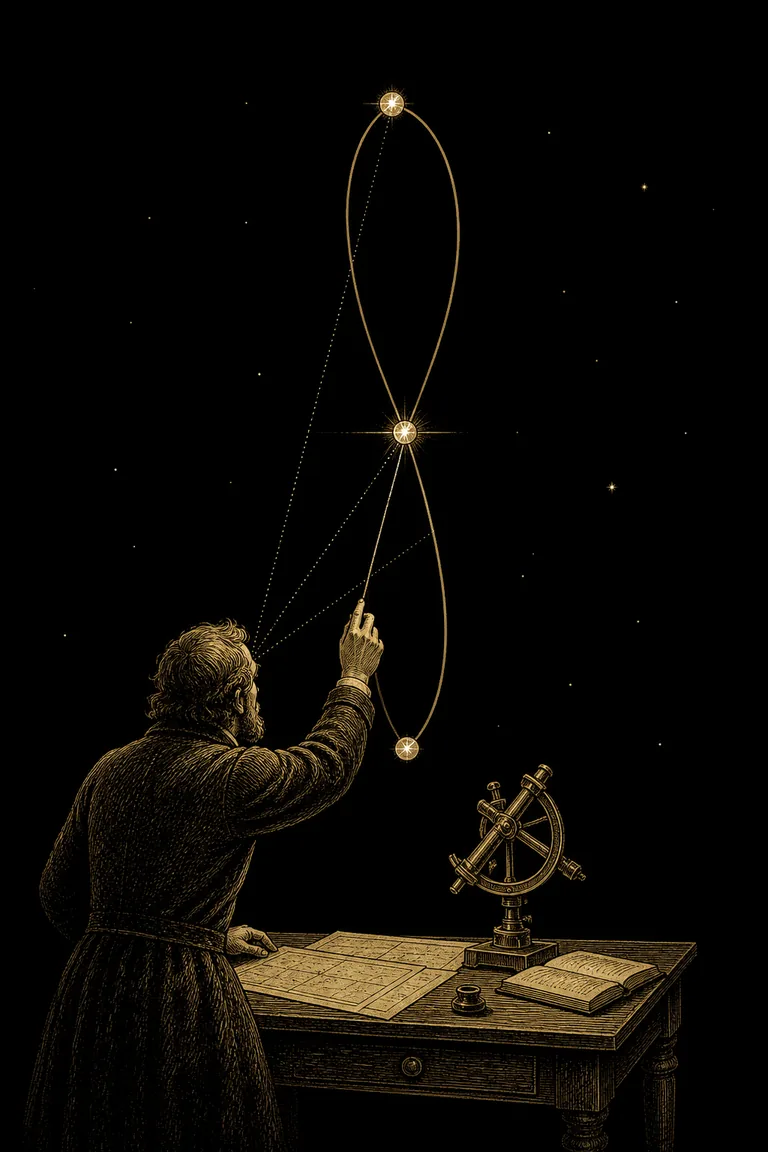
A retrograde planet moves backward in apparent zodiac longitude, so a relationship that looks like it should separate may apply again. Near a station, the orb can shrink, pause above zero, then grow without ever becoming exact. Later, a second station can produce another application and an eventual pass. This is why a slow transit may have one, two, or three exact contacts. Label each applying, exact, and separating interval rather than treating the entire season as one phase.
Can an applying aspect fail to perfect?
Yes. Application describes current direction, not guaranteed completion. A planet may station before exactness or change speed enough for the orb to widen. In strict horary traditions, a sign change, prohibition by another planet, refranation, or other intervening condition may prevent the promised perfection. Natal and transit software may still display the bodies inside a geometric orb. State whether you are reporting geometry alone or applying a specific traditional judgment rule.
Applying is not the same as waxing
Waxing and waning describe phase around an entire synodic cycle, often by whether the faster body is moving from conjunction toward opposition or from opposition back toward conjunction. Applying and separating describe movement toward or away from one exact aspect at the current moment. A waning square can be applying to exactness, and a waxing trine can be separating from exactness. Keep the two labels in separate fields.
Applying and separating aspects in a natal chart
A natal chart freezes a moving relationship at the birth timestamp. Some astrologers give applying aspects more immediacy or developmental emphasis and separating aspects a more established or inherited quality. These are interpretive conventions, not measurements of personality strength. Exactness, planets, houses, rulerships, dignity, sect, repetition, and the full chart remain important. An applying square does not prove future conflict, and a separating trine is not inactive.
Applying and separating transits
For a transit to a natal planet or angle, application is the approach to the exact natal degree and separation is the departure. The natal point itself does not move in this comparison. Track the transiting body’s signed position, the selected orb, exact timestamps, and retrograde passes. A transit can be symbolically useful for scheduling reflection, but its applying phase does not guarantee an event and its separating phase does not prove that a problem is over.
Synastry and moving charts
In ordinary natal synastry, two birth charts are compared as fixed snapshots, so applying or separating labels refer to each person’s natal planetary motion at birth, not to the relationship moving toward an outcome. If current timing matters, calculate transits or progressions separately. Do not use an applying synastry aspect to claim that two people are destined to meet, reconcile, marry, or consent to contact.
Horary use
Horary astrology places special weight on whether significators apply to a relevant aspect and whether that aspect perfects. Separating contacts may describe a condition or encounter already past. The judgment also depends on house assignment, reception, dignity, speed, sign boundaries, collection, translation, prohibition, and the question’s context. One applying aspect should not be isolated from the method or used to override direct evidence and safety.
Save motion, not only the aspect label
Use Veritas to record both longitudes, signed speeds, timestamps, target angle, orb at each sample, applying or separating phase, station risk, expected perfection, zodiac setting, and ephemeris source.
Why software can disagree
Programs may use different ephemerides, rounding, timestamps, topocentric or geocentric positions, true or mean nodes, aspect sets, orb rules, or definitions for stationary motion. Some classify application from instantaneous signed speed; others sample positions or assume a conventional faster planet. Compare raw longitudes and speeds first. If those match but the label differs, inspect the phase algorithm and whether the software tests future perfection.
A reproducible aspect record
Store the two bodies, exact UTC time, longitudes to at least arc-minute precision, signed daily motion, aspect target, allowed orb, current orb, a second sample, and the predicted exact time if one exists. Then verify the prediction against the ephemeris. This record distinguishes a true application, a separation, and a near miss without relying on a screenshot label that may hide settings.
Limits of interpretation
Applying and separating phases are calculable from apparent motion once the coordinate system and aspect rule are declared. Their astrological meanings are interpretive and are not scientifically validated predictors of personality or events. They cannot diagnose health, prove private feelings, establish guilt, guarantee timing, or replace medical, legal, financial, or mental health guidance.