Astrology Journal
Moon Phase at Birth: Meaning and Calculation
Your Moon phase at birth describes where the Sun-Moon cycle stood on your birth date. A useful result keeps lunar age, illumination, phase category, timing precision, and symbolic interpretation separate.
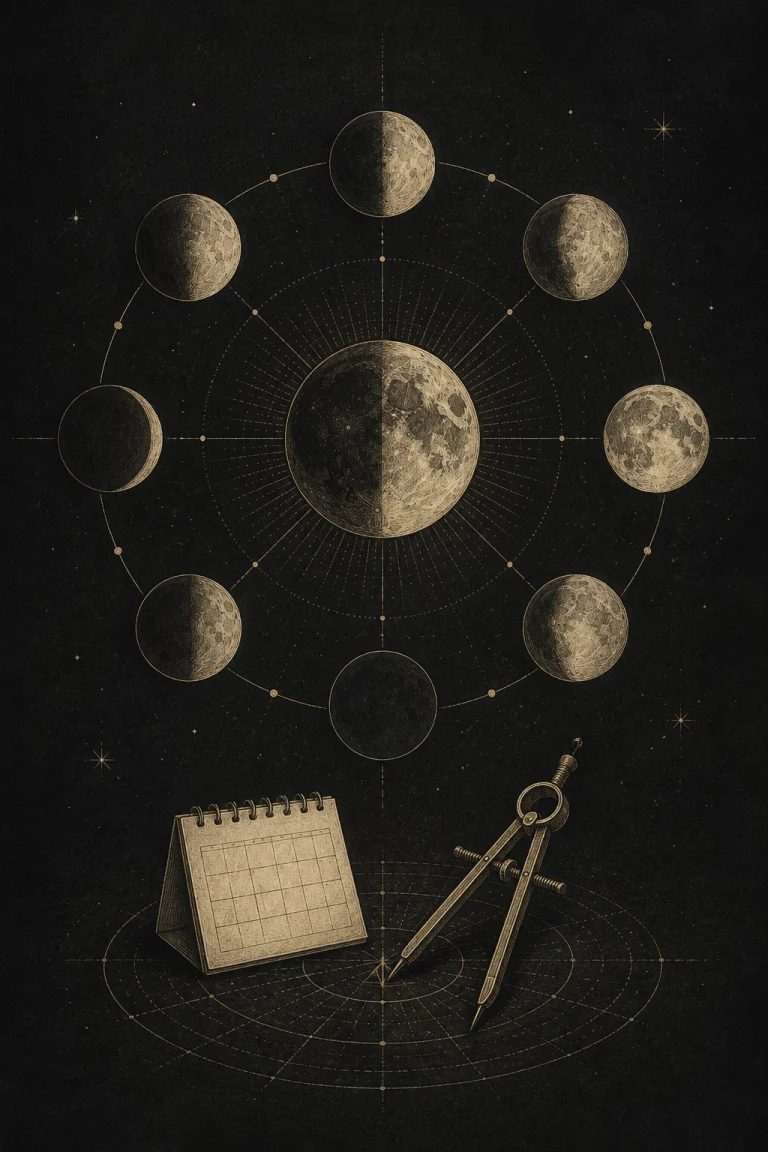
Moon phase at birth is the phase of the lunar cycle at the moment, or in a date-only estimate, the day you were born. It is determined by the angular relationship between the Sun and Moon. New Moon begins the cycle near conjunction, Full Moon occurs near opposition, and the waxing and waning phases describe the movement between those points.
The calculation can be astronomical even when the interpretation is symbolic. A date-only calculator can estimate mean lunar age and illumination without a birth place, but it cannot promise the exact phase near a boundary. Astrology may use the result as a rhythm for reflection; it does not establish personality, emotional health, fertility, destiny, or future events.
Take the next insight with you
Explore personalized Astrology guidance in Veritas, available for iOS and Android.
 Scan with your phone
Moon phase at birth at a glance
What determines a lunar phase?
The visible phase comes from Sun-Moon geometry, not from the Moon changing shape. As the Moon orbits Earth, the angle between the Sun and Moon changes and we see a different fraction of the illuminated hemisphere. Astronomers often describe this with elongation, phase angle, illuminated fraction, and time since conjunction. A phase name such as Waxing Gibbous is a category applied to a continuous cycle.
The eight Moon phases
How the Veritas date-only estimate works
- Standardize the date
Veritas evaluates the entered calendar date at 12:00 UTC so a date-only input has one reproducible reference instant.
- Convert to Julian day
The UTC instant is expressed on the continuous Julian-day scale used for astronomical time calculations.
- Measure from a reference New Moon
The elapsed time is compared with Julian day 2451550.26, a reference near the January 2000 New Moon.
- Wrap through the mean cycle
Elapsed days are reduced modulo the mean synodic month of 29.530588853 days to estimate lunar age.
- Estimate illumination and category
A cosine model estimates the illuminated fraction; the cycle fraction is then grouped into one of eight equal phase sectors.
Reproducible date-only model
lunar age = (Julian day − 2451550.26) mod 29.530588853
cycle fraction = lunar age ÷ 29.530588853
illumination ≈ (1 − cos(2π × cycle fraction)) ÷ 2
This mean-cycle model is transparent and useful for an everyday estimate. It is not a substitute for an exact ephemeris because the real lunation length varies, the Moon changes speed, and a calendar date covers 24 hours. The calculator rounds illumination for readability and tells you when its category may be sensitive to a boundary.
Date only versus exact birth time
Most dates remain in the same eight-phase category for many hours, so a noon-UTC estimate will often be stable. The risk rises when an exact New Moon, quarter, or Full Moon occurs on the birth date. Then local clock time, time zone, and the precise lunation timestamp can move the result across a category boundary. Use an ephemeris with the recorded birth time when exactness matters, and report uncertainty when the time is unknown.
Does birth location change the phase?
The geocentric Sun-Moon phase is essentially shared worldwide at one instant, so location is not required for a broad date-only phase estimate. Location matters when converting a local civil birth time to UTC and can matter for a topocentric calculation, Moon altitude, houses, or the appearance of the Moon from a particular horizon. Those are additional questions, not a different basic synodic phase.
Moon phase is not Moon sign
Moon sign asks where the Moon was along the zodiac. Moon phase asks how far the Moon was from the Sun in their shared cycle. Two people can share a Moon sign and have different phases, or share a phase while the Moon occupies different signs. Do not infer one from the other. A natal interpretation can compare them only after both calculations are made independently.
Moon phase is not the prenatal syzygy
The birth phase describes the cycle at the birth moment. The prenatal syzygy is the previous exact New Moon or Full Moon before birth. A person born at First Quarter has a First Quarter birth phase, while the preceding New Moon is the prenatal syzygy. Traditional techniques may use the earlier lunation degree or ruler; that does not change the phase category at birth.
A grounded symbolic reading
If you use astrology for reflection, begin with cycle verbs rather than personality labels. New and Crescent phases can ask what is beginning or needs protection. Quarter phases can ask where action meets friction. Gibbous phases can ask what needs refinement or sharing. Full Moon can ask what has become visible. Waning phases can ask what should be integrated, revised, released, or rested. Test the question against a real situation instead of turning it into a permanent identity.
Common mistakes
Common errors include confusing phase with Moon sign, treating illumination alone as waxing or waning, assuming exactly 50 percent illumination always names a quarter, ignoring the UTC conversion, claiming birth location is needed for every estimate, or presenting one date-only category as exact near a boundary. Interpretation mistakes include calling one phase more evolved, assigning fixed gender traits, predicting fertility, or using a symbolic phase to explain mental or physical health.
Calculate first, interpret second
Use the free Moon Phase at Birth calculator below to see the mean lunar age, estimated illumination, phase category, and method note before choosing one observable reflection question.
A practical observation exercise
- Save the result
Record the phase, lunar age, illumination, input precision, and calculation method.
- Choose one cycle verb
Beginning, building, deciding, refining, revealing, integrating, releasing, or resting is enough.
- Name one current situation
Apply the verb to one bounded project, conversation, habit, or decision.
- Collect contrary evidence
Notice where the phase language does not fit so it cannot become a self-sealing identity story.
- Review after one cycle
Return after about a lunar month and compare the prompt with what was actually observed.
Limits and responsible use
A Moon phase at birth is not scientifically validated as a personality test or predictive tool. It cannot diagnose illness, determine fertility, prove compatibility, explain trauma, or replace professional advice. Birth dates are personal information; obtain permission before calculating for someone else and avoid publishing identifying data. Use the astronomical result as context and any symbolic meaning as optional reflection.
FREE CALCULATOR · PRIVATE BY DESIGN
Moon Phase at Birth Calculator
Estimate the lunar age, illumination, and eight-phase category for your date of birth with a visible astronomical method.