Astrology Journal
What Is a Moon Sign? Emotional Needs in the Birth Chart
Your Moon sign describes emotional rhythm, instinct, memory, and the conditions that help you feel secure. Its house and aspects show where and how those needs operate.
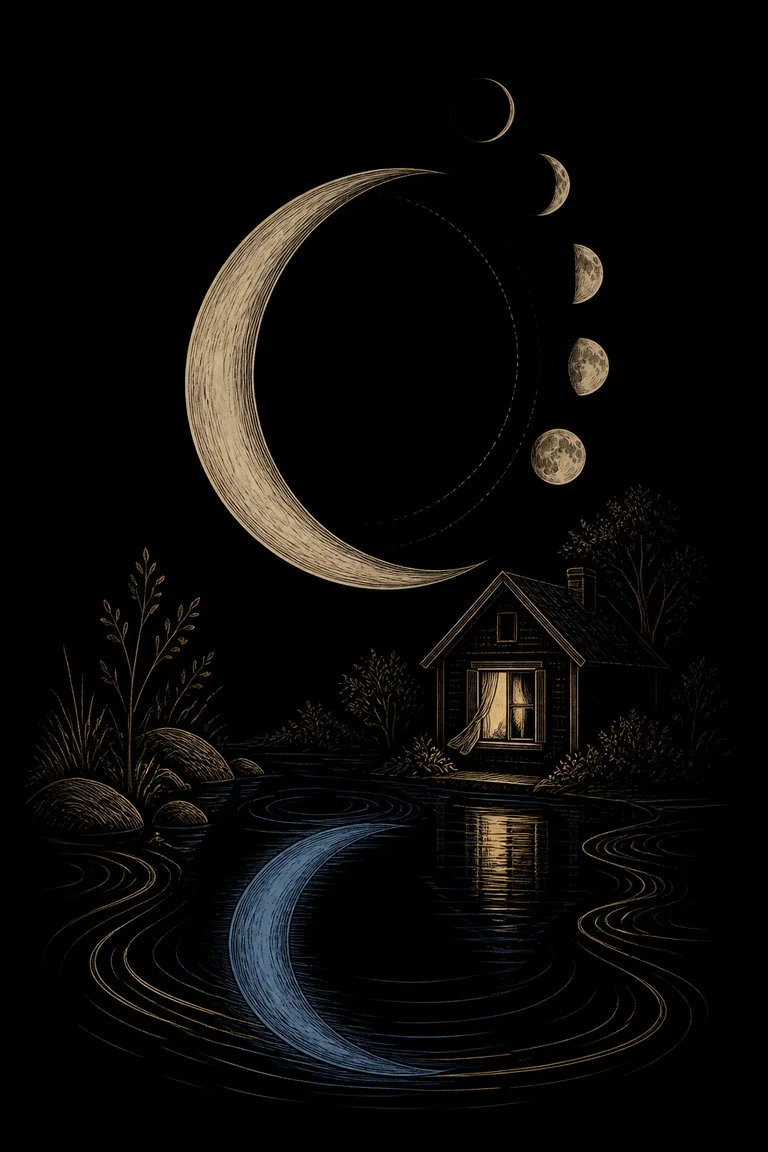
Your Moon sign is the zodiac sign occupied by the Moon at the time of your birth. In natal astrology, it describes emotional needs, familiar reactions, memory, attachment, and the private rhythm through which you recover after the outside world has asked something of you.
A Moon sign is not a fixed mood or a list of habits you must display. It shows what the emotional system tends to seek and how it processes experience. The house of the Moon locates those needs in life, while aspects show how easily they cooperate with identity, thought, desire, and responsibility.
Take the next insight with you
Explore personalized Astrology guidance in Veritas, available for iOS and Android.
 Scan with your phone
What does your Moon sign represent?
The Moon concerns the part of life that operates before deliberate explanation. It is associated with bodily rhythm, caregiving, belonging, habit, memory, and the responses that appear when you are tired, stressed, safe, or deeply familiar with someone. It often becomes clearer in private than in a public role.
Calling the Moon your emotions is accurate but incomplete. Everyone experiences every emotion. The sign describes a preferred way of meeting feeling and the conditions that make regulation easier. A fire Moon may need movement and direct expression, while an earth Moon may need time, continuity, and sensory grounding.
How to find your Moon sign
- Use your complete birth date
The Moon changes signs about every two and a half days, so the correct date is essential.
- Add the most accurate birth time available
On a day when the Moon changes signs, the time can decide between two different results.
- Enter the birth location
Place allows the calculator to apply the correct historical time zone and place the Moon in a house.
- Read sign, house, and aspects together
The sign describes style, the house shows the life area, and aspects reveal relationships with other planets.
Moon sign meanings for all 12 signs
Aries Moon
Processes feeling through immediacy, movement, and direct response. Emotional honesty can be refreshing; patience and space between impulse and action create maturity.
Taurus Moon
Seeks steadiness, sensory comfort, reliable affection, and time to settle. Consistency restores, though familiar conditions can be held long after change is needed.
Gemini Moon
Processes emotion through words, questions, variation, and mental connection. Naming a feeling may create space, but explanation can also become a way to avoid inhabiting it.
Cancer Moon
Seeks belonging, privacy, memory, and responsive care. Strong emotional perception can nurture others, while boundaries help prevent every atmosphere from becoming a personal responsibility.
Leo Moon
Needs warm recognition, play, creative expression, and wholehearted affection. Generosity grows when appreciation is mutual rather than constantly required as proof of worth.
Virgo Moon
Finds steadiness through practical care, order, usefulness, and small improvements. Discernment supports wellbeing when it does not turn every vulnerable feeling into a problem to fix.
Libra Moon
Seeks reciprocity, calm exchange, beauty, and relational fairness. Peace becomes more durable when disagreement can be named instead of postponed to preserve a pleasant surface.
Scorpio Moon
Processes feeling with depth, privacy, loyalty, and sensitivity to trust. Emotional courage is a strength; testing others or holding pain in secrecy can intensify what needs honest contact.
Sagittarius Moon
Needs movement, candor, perspective, learning, and room to imagine a wider future. Optimism restores when it includes grief and detail rather than escaping them.
Capricorn Moon
Seeks reliability, competence, dignity, and emotional structure. Responsibility can become a form of care, but receiving support matters as much as being the dependable person.
Aquarius Moon
Processes emotion through observation, ideals, friendship, and enough distance to see the pattern. Independence works best when detachment does not replace vulnerable participation.
Pisces Moon
Needs imagination, compassion, quiet, and permeable contact with meaning. Sensitivity becomes sustainable through rest, discernment, and boundaries around what belongs to other people.
Find the Moon inside your full birth chart
Create your natal chart in Veritas and explore your Moon sign together with its house, aspects, and relationship to your Sun and Ascendant.
Why the Moon’s house changes the meaning
The Moon sign describes how emotional needs are met; the house shows where they repeatedly become active. A Gemini Moon in the Third House may regulate through conversation, study, local movement, and frequent exchange. The same Moon in the Eighth House may use language to investigate trust, loss, intimacy, and shared resources.
A Moon near a house cusp deserves careful calculation, especially if the birth time is rounded. House systems can also place the same planet differently. Rather than searching for the placement that sounds best, use one method consistently and compare its symbolism with sustained observation.
Moon aspects show emotional relationships
An aspect describes the angular relationship between the Moon and another planet. Moon conjunct Venus may align comfort with affection and aesthetics. Moon square Saturn may describe tension between vulnerability and control, or an early habit of earning care through competence. The aspect is not good or bad; it shows a relationship that develops through experience.
Use the tightest major aspects first. Then ask what each planet needs and whether those needs cooperate, compete, or alternate. A Moon-Mars trine can support fast emotional action, but ease does not guarantee wise action. A Moon-Mercury opposition can create tension between feeling and explanation while also developing unusual skill in translating between them.
Moon sign versus Sun sign and rising sign
The Sun describes conscious vitality and identity. The Ascendant describes entry into experience and begins the houses. The Moon describes emotional rhythm and instinctive restoration. If the three signs contrast, you are not reading the chart incorrectly. Different parts of life can require different strategies.
A Leo Sun with a Scorpio Moon may seek visible creative expression while keeping emotional trust private and selective. A Gemini rising can make the first interaction light and verbal. The useful portrait comes from the relationship among these placements, not from deciding which one is the real personality.
What if you do not relate to your Moon sign?
Verify whether the Moon changed signs on your birth date, then inspect its house and aspects. A Taurus Moon closely opposed by Uranus may experience more disruption than a simple Taurus description suggests. A Cancer Moon in the Tenth House may express care through public responsibility rather than obvious domesticity.
Culture, family, trauma, health, gender, and present circumstances shape emotional expression. Astrology is a symbolic interpretive tradition and is not scientifically validated as a diagnostic or predictive method. Use Moon symbolism for reflection, never as a replacement for mental health care or as proof of another person’s inner state.
A practical way to work with your Moon
For several weeks, note what restores you after strain, what happens before you become reactive, and what kind of support you can receive without losing agency. Compare those observations with the sign, house, and strongest Moon aspect. Keep what improves recognition and discard what requires you to distort experience.
The goal is not to satisfy a Moon sign stereotype. It is to understand your emotional rhythm well enough to care for it responsibly. A need can be honored without allowing every habitual response to make the decision.
FREE CALCULATOR · PRIVATE BY DESIGN
Sun Moon Rising Calculator
Calculate your Sun, Moon, and Rising signs from exact birth time and place using a local astronomical engine and historical timezone rules.