Astrology Journal
Prenatal Syzygy in Astrology: Meaning and Calculation
The prenatal syzygy is the exact New Moon or Full Moon immediately before birth. Traditional methods use its event, degree, or ruler in different ways, so calculation and doctrine must stay separate.
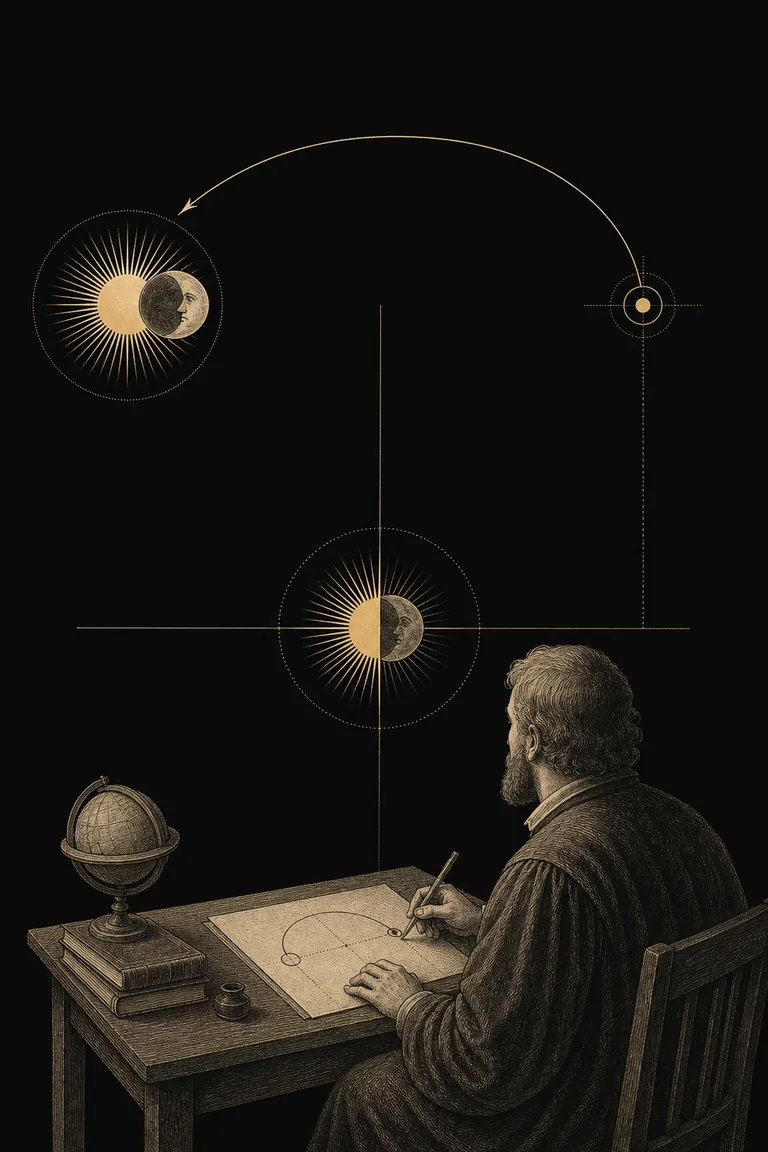
In astrology, the prenatal syzygy is the most recent exact conjunction or opposition of the Sun and Moon before a birth. A conjunction is a New Moon and an opposition is a Full Moon. Finding it is an astronomical lookup: calculate backward from the birth time and select whichever exact lunation occurred last.
Interpretation is less universal. Hellenistic, medieval, and later authors assign the preceding lunation different roles in Hyleg selection, dignity judgments, rectification, and natal doctrine. A reproducible reading records the event time, zodiacal positions, chosen degree, source, and ruler rules. It does not turn an old vitality technique into a lifespan or medical forecast.
Take the next insight with you
Explore personalized Astrology guidance in Veritas, available for iOS and Android.
 Scan with your phone
Prenatal syzygy at a glance
What does syzygy mean?
Syzygy is a term for alignment. In this traditional astrological context it usually refers to the preceding conjunction or opposition of the luminaries. The event can be called the prenatal lunation or preceding syzygy. It is not automatically an eclipse. An eclipse requires the lunation to occur near the lunar nodes, while most New and Full Moons do not meet that condition.
New Moon or Full Moon before birth
Do not choose the New Moon merely because it sounds like a beginning. Compare the exact conjunction and opposition before birth and take the later event. A person born during the waxing half of a lunation usually follows a New Moon; a person born during the waning half usually follows a Full Moon. Near exact phase boundaries, use event times rather than a visual estimate or a calendar label.
How to calculate the prenatal syzygy
- Standardize the birth moment
Record date, clock time, location, time zone, daylight-saving rule, and confidence in the record.
- Search backward
Use a reliable ephemeris to find the last exact Sun-Moon conjunction and opposition before that moment.
- Select the later event
The conjunction or opposition closest in time before birth is the prenatal syzygy.
- Save both longitudes
Record exact tropical or sidereal positions, zodiac choice, event time, and ephemeris.
- Apply one source rule
Only then determine which degree, ruler, dignity table, or eligibility test the chosen doctrine requires.
Which degree should you use?
At a New Moon, the two longitudes coincide apart from tiny calculation tolerances, so one conjunction degree is available. At a Full Moon, there are two opposite positions. Some methods emphasize one luminary's position, the degree above the horizon, an axis, or a ruler selected by additional rules. Do not collapse these conventions into one universal answer. Preserve both positions first, then cite the rule that chooses between them.
The ruler of the prenatal syzygy
A phrase such as lord of the prenatal syzygy can mean the domicile ruler of the selected degree, but other procedures compare several essential dignities or identify an almuten. Those are different operations. State whether the method uses domicile, exaltation, triplicity, bounds, face, a weighted score, sect, or testimony. A ruler label without the degree and table cannot be audited.
Connection with the Hyleg
Some traditional length-of-life procedures include the prenatal syzygy degree or its lord among Hyleg candidates, but candidate order and eligibility vary by author. The preceding lunation is therefore an input, not automatically the Hyleg. If it enters a Hyleg procedure, show why earlier candidates failed, which places qualify, and what aspect or dignity testimony the source demands. The historical logic can be studied without producing an age or death prediction.
Prenatal syzygy, almuten, and Alcocoden
The syzygy is an astronomical event and its recorded zodiacal point or axis. An almuten is a dignity-score winner at a declared degree. The Alcocoden is a later method-dependent planetary role related to a selected Hyleg. One workflow may connect all three, but they are not synonyms. Keeping each stage separate reveals where two astrologers actually diverge.
A worked method audit
Suppose birth follows an exact Full Moon by two days. Record the Full Moon event time and both opposite longitudes. Next, consult the chosen text to learn whether it uses the Sun degree, Moon degree, a horizon condition, or another selection rule. List dignity rulers at the accepted degree and apply only the stated tests. A different authority may choose a different point. The audit should report that fork rather than pretending one software label resolves the tradition.
Rectification and birth-time limits
Some traditional rectification methods relate the preceding lunation or its ruler to an angle. Such procedures are source-specific and are not independent proof of a birth time. A proposed time can easily be favored because it produces a desired symbolic fit. Preserve the original record, test a plausible range, disclose the method, and seek documentary evidence before changing a time. A syzygy calculation can often locate the lunation without a precise birth time, but horizon-based degree selection and house judgments may still depend on it.
Common calculation mistakes
Frequent errors include selecting the previous New Moon when a Full Moon was closer, using the calendar date rather than exact time, confusing a phase with an eclipse, mixing tropical and sidereal longitudes, rounding across a sign or bound boundary, and letting software hide its ephemeris or ruler convention. Save enough data for another reader to reproduce the result.
Preserve the event before interpreting it
Use Veritas to record the birth-data source, exact lunation time, Sun and Moon longitudes, ephemeris, zodiac, selected degree, ruler rule, source, and unresolved uncertainty.
A prenatal syzygy worksheet
- Data record
Keep the original birth record, time zone, location, and confidence level.
- Event record
Save whether the event is a conjunction or opposition and its exact timestamp.
- Position record
Write both luminary longitudes before selecting a working degree.
- Doctrine record
Cite the author, translation, degree convention, dignity table, houses, and aspect rules.
- Boundary record
List method sensitivity and refuse health, lifespan, fertility, or safety conclusions.
Ethics and evidence
Astrology is not scientifically validated for predicting lifespan, diagnosing illness, measuring vitality, proving conception time, or establishing a safe birth-time correction. Study the prenatal syzygy as astronomical context and historical technique. For medical, reproductive, legal, or safety decisions, use qualified professionals and current evidence.