
Tarot Journal
Destiny Card by Birthday: Cardology Calculation and Meaning
A Destiny Card by birthday is a playing-card result from a declared month-and-day mapping. Veritas shows the arithmetic, deck order, Joker boundary, and interpretation rules so Cardology does not get confused with Tarot.
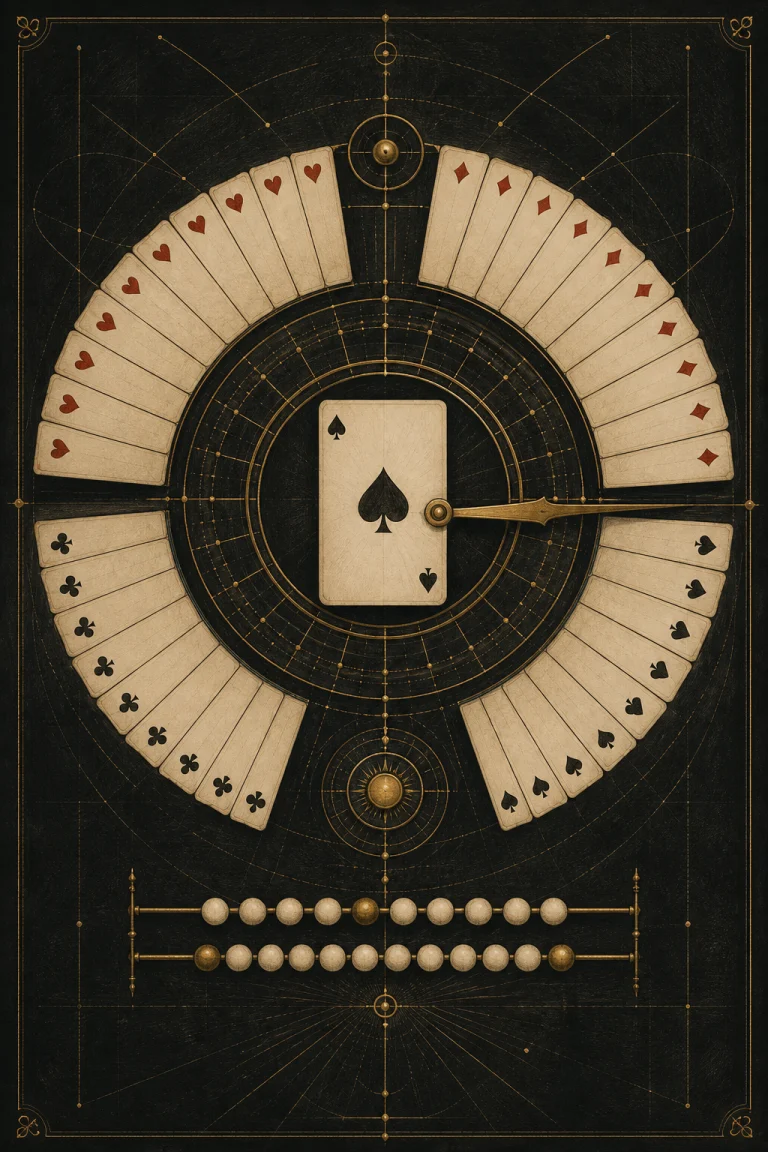
A Destiny Card is a standard playing card assigned to a calendar birthday through a Cardology formula. The Veritas method uses the birth month and day, creates a solar value, converts that value into one position in a fixed 52-card sequence, and reserves dates outside that sequence for the Joker. The birth year does not change the result.
Cardology is a modern symbolic practice with multiple mapping systems. It is not the same as a Tarot birth card, which reduces the full birth date into Major Arcana numbers. A reproducible result must name the exact formula and deck order before interpreting rank and suit. The card can support reflection, but it does not establish personality, fate, compatibility, or future events.
Take the next insight with you
Explore personalized Tarot guidance in Veritas, available for iOS and Android.
 Scan with your phone
Destiny Card at a glance
The Veritas Destiny Card formula
- Write month and day as numbers
January is 1 and December is 12; use the calendar day from 1 through 31.
- Find the solar value
Multiply the month by 2, then add the day: solar value = month × 2 + day.
- Convert to a deck index
Subtract the solar value from 55. Valid results from 1 through 52 select a playing card.
- Read the fixed sequence
Count Ace through King within Hearts, Clubs, Diamonds, then Spades.
- Apply the Joker boundary
If the converted index falls outside 1 through 52, Veritas returns the Joker rather than forcing a standard card.
Worked example: April 17
(4 × 2) + 17 = 25
55 − 25 = 30
card 30 in the Veritas sequence = Four of Diamonds
The sequence is auditable: positions 1–13 are Ace through King of Hearts, 14–26 are Clubs, 27–39 are Diamonds, and 40–52 are Spades. Position 30 is therefore the fourth rank inside Diamonds. Another Cardology source may use a printed birthday table or a different order and produce another card. That disagreement reflects method, not a hidden second birthday.
Why the birth year does not change the card
In this method the card belongs to the recurring month-and-day position in the solar calendar, so people who share a birthday share the same result even when born in different years. Veritas still requests a valid full date to reject impossible dates and handle February 29 correctly. The year can matter in other symbolic systems, but silently adding it here would create a different formula.
How the Joker appears
The largest month-and-day values occur late in December. When month × 2 + day reaches 55, the converted card index becomes 0; that lies outside the 52-card deck, so Veritas returns the Joker. This is an explicit boundary rule, not evidence that a person is uniquely chosen, exempt from ordinary limits, or destined for an unconventional life. Read it with the same caution and accountability as every other result.
Ranks: the action pattern
Veritas treats rank as a function. Aces initiate; Twos coordinate; Threes develop expression; Fours create structure; Fives test change; Sixes organize responsibility; Sevens examine and refine; Eights work with power and consequence; Nines complete; Tens bring a cycle into visible result. Jacks develop skill and carry messages, Queens steward a field through inner authority, and Kings take external responsibility. These are prompts, not fixed traits.
Suits: the field of experience
How to combine rank and suit
Read the rank function inside the suit field. The Four of Diamonds can ask how structure operates in resources, work, or exchange. A useful interpretation names a resource, a possible shadow, and one mature experiment: define ownership, write the standard, and review whether the structure supports the intended value. It should not conclude that every Four of Diamonds person is practical, wealthy, rigid, or suited to one career.
Destiny Card versus Tarot birth card
A Veritas Destiny Card uses month × 2 + day and a standard playing-card sequence. A Tarot birth card adds or reduces the full birth date and matches the result with Major Arcana numbers. The first may return the Four of Diamonds; the second may return a pair such as The Lovers and The Devil. The decks, inputs, formulas, and interpretive languages are different. Do not use the names Destiny Card and Tarot birth card interchangeably.
Destiny Card versus ordinary cartomancy
In a cartomancy reading, cards are shuffled and drawn for a question or spread position. A birthday card is calculated and remains stable under the chosen system. Drawing the Four of Diamonds today and calculating it from a birthday are different operations even if the same image appears. Keep the selection method visible so a random reading is not presented as a permanent identity card.
Common calculation mistakes
Frequent errors include adding the birth year, reducing month and day as numerology, forgetting the 55-minus conversion, starting suits in another order, treating Jack, Queen, and King as 11, 12, and 13 after the deck index has already been resolved, or forcing a December boundary date into the last standard card. If a source gives a different result, compare formulas and deck orders before comparing meanings.
Common interpretation mistakes
A symbolic card should not be used to rank maturity, diagnose a condition, infer trauma, assign sexuality, choose a career, prove compatibility, excuse harmful behavior, or claim privileged spiritual status. Positive-only readings are also misleading: every resource needs a boundary and every shadow needs evidence. Describe a possible pattern, look for a real example and counterexample, then choose a proportionate action.
Reveal the card and keep the method visible
Use the free Destiny Card calculator below to see the selected playing card, the Veritas formula, and a rank-through-suit reflection without sending your birth date in the page URL.
A five-part Destiny Card reflection
- Save the arithmetic
Record the month, day, solar value, converted index, deck order, and result.
- Name the rank function
Use one verb such as initiate, coordinate, structure, revise, complete, or lead.
- Name the suit field
Choose the relevant domain: emotional exchange, communication, resources, or disciplined effort.
- Find evidence and a counterexample
Record one place the combination fits and one place it does not.
- Choose a bounded experiment
Turn the card into one observable action with an owner, limit, and review date.
Privacy and responsible use
A birth date is personal information. Calculate another person’s card only with permission, do not publish their date without consent, and avoid using a symbolic result to make decisions about them. Cardology is not scientifically validated as a personality or predictive system. Use records, direct communication, qualified advice, and evidence for consequential choices; keep the card as an optional reflection tool.
FREE CALCULATOR · PRIVATE BY DESIGN
Destiny Card Calculator
Use the Veritas cardology method to select one of 52 playing cards—or the Joker—from your birth month and day.