Tarot Journal
Tarot Birth Cards: Calculate Your Major Arcana Pair
Tarot birth cards use a declared birth-date reduction to identify a Major Arcana root family for long-term study, not a fixed personality or forecast.
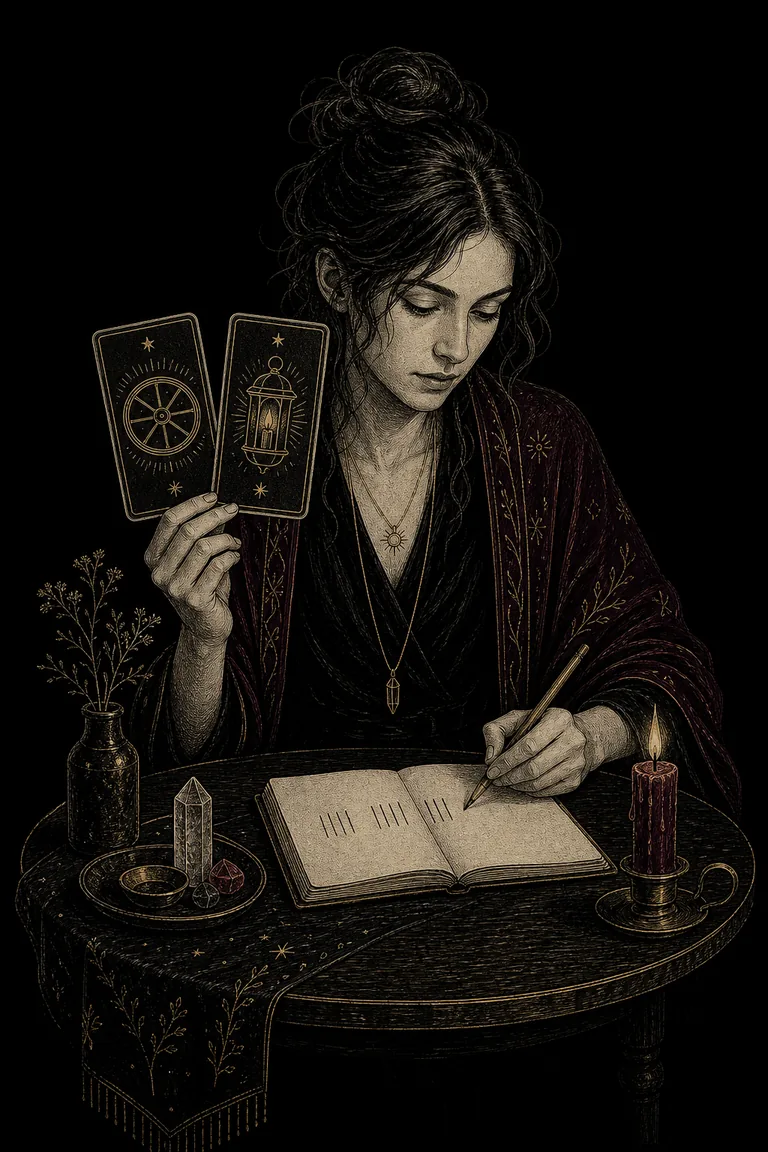
Tarot birth cards are Major Arcana cards connected with the numerical reduction of a birth date. A common modern method adds every date digit, reduces the total to a number from 1 to 9, and studies the Major Arcana cards that share that digital root. For example, root 7 connects The Chariot, card VII, with The Tower, card XVI, because 1 + 6 also equals 7.
There is no single universal birth-card convention. Some readers keep one final card, some use a two-card family, and some preserve a three-card 19/10/1 family. The Fool may be treated as 0 or 22. Choose and record the method before calculating, then use the result as a study lens rather than proof of identity, destiny, compatibility, talent, or future events.
Take the next insight with you
Explore personalized Tarot guidance in Veritas, available for iOS and Android.
 Scan with your phone
Tarot birth cards at a glance
Choose a calculation convention first
Birth-card instructions differ because modern Tarot authors reduce dates in different stages and assign the resulting number to cards differently. This guide uses a root-family method: add all visible digits in the birth date, reduce to 1 through 9, then collect numbered Major Arcana cards with the same root. Another book may add month, day, and year as three numbers or stop at a value from 10 through 22. Neither output should be presented as the only historical rule. Record the source and stay consistent.
How to calculate Tarot birth cards
- Write the full date
Use the complete month, day, and four-digit year so no century digits disappear.
- Add every digit
Treat the date as arithmetic, not as one large calendar number.
- Reduce the total
Add the digits of the sum until the result is between 1 and 9.
- Build the root family
Match that root with Major Arcana numbers that reduce to it, following the deck numbering you actually use.
- Record exceptions
State how your method treats The Fool, 10/1, 19/10/1, Strength, and Justice before interpretation.
A worked birth-card example
Add the visible date digits, then reduce
0 + 4 + 1 + 7 + 1 + 9 + 9 + 2 = 33
3 + 3 = 6
Under the root-family method, root 6 connects The Lovers, VI, with The Devil, XV, because 1 + 5 = 6. The pair is not a good-card and bad-card label. It can frame a sustained inquiry into values, consent, attachment, choice, appetite, responsibility, and the difference between a bond and a bind. A method that stops at another intermediate total may produce a different named result, which is why the written arithmetic matters.
The nine Major Arcana root families
Using Rider-Waite-Smith numbering, the basic families are 1 with I and X and sometimes XIX; 2 with II, XI, and XX; 3 with III, XII, and XXI; 4 with IV and XIII; 5 with V and XIV; 6 with VI and XV; 7 with VII and XVI; 8 with VIII and XVII; and 9 with IX and XVIII. This grouping follows digital roots, not a claim that the cards are identical. Decks that exchange Strength VIII and Justice XI change which image sits in the 8 and 2 families, so name the deck tradition.
Why 10/1 and 19/10/1 need a note
Some systems preserve The Wheel of Fortune, X, as a bridge to The Magician, I. Others also keep The Sun, XIX, because 1 + 9 = 10 and 1 + 0 = 1. This creates a three-card 19/10/1 family. A single-root method may simply group all three from the start. None of these conventions makes one person more advanced or gives a stronger card. The extra layer only adds material for comparison.
What about The Fool, 0 or 22?
The Fool is commonly unnumbered, numbered 0, or placed as 22 for a particular sequence. Zero does not enter a 1-to-9 digital-root family in the same way as the numbered trumps. Some birth-card systems attach 22 to root 4 because 2 + 2 = 4; others exclude The Fool from date calculation and use it as an open companion to every path. Choose one rule explicitly. Do not insert The Fool only when it makes the result feel more appealing.
How to read a birth-card pair
Begin with contrast rather than personality adjectives. Note what each image initiates, protects, reveals, risks, or completes. For the VII/XVI family, The Chariot can organize competing forces around direction, while The Tower exposes a structure that cannot hold. A grounded question might be, "What kind of control is useful here, and what evidence says the structure needs revision?" The cards supply a vocabulary for inquiry, not an explanation for everything that happens.
Birth cards are not year cards
A birth card is calculated once from the full birth date and normally remains stable under the chosen system. A Tarot year card adds the birth month and day to a selected calendar year, so it changes as the year changes. The year-card practice is a separate reflection method, not a transit and not a forecast guarantee. Label the calculation so a temporary annual theme is not confused with the long-term birth-card family.
Common calculation and interpretation mistakes
Frequent errors include dropping a zero or century digit, changing reduction rules midway, mixing Strength and Justice numbering, silently turning 0 into 22, and copying an online result without its method. Interpretation errors include reducing a person to flattering traits, using a pair to rank spiritual maturity, declaring relationship compatibility, or treating difficult imagery as a prediction of crisis. Recheck the arithmetic and keep conclusions proportional.
Build a study record, not a label
Use Veritas to save the date format, calculation convention, arithmetic, deck numbering, card observations, one real example, a counterexample, and a review question.
A practical birth-card study
- Describe each image
Write visible actions, posture, objects, and direction before reaching for keywords.
- Name the tension
Identify where the cards differ in pace, control, exposure, relationship, or responsibility.
- Find one example
Connect the pair with a specific decision or habit that can be observed.
- Find a counterexample
Record evidence that does not fit so the cards do not become a self-sealing personality story.
- Write one question
Turn the contrast into a prompt that supports choice, communication, or review.
Limits and responsible use
Tarot birth cards cannot diagnose a condition, prove trauma, determine sexuality, predict death, certify compatibility, assign a career, or establish another person's character. A birth date is also personal information, so ask permission before calculating for someone else and avoid publishing it. Use direct communication, records, qualified advice, and safety planning for consequential decisions. The cards can support reflection while leaving identity and agency with the person.
FREE CALCULATOR · PRIVATE BY DESIGN
Tarot Birth Card Calculator
Reduce the digits in your birth date to reveal a linked sequence of Major Arcana cards and reflective themes.