
Tarot Journal
Tarot Reading vs Psychic Reading: What Is the Difference?
Tarot uses a visible card system to structure a question. A psychic reading is a broader service label that may rely on claimed intuitive impressions, with or without tools.
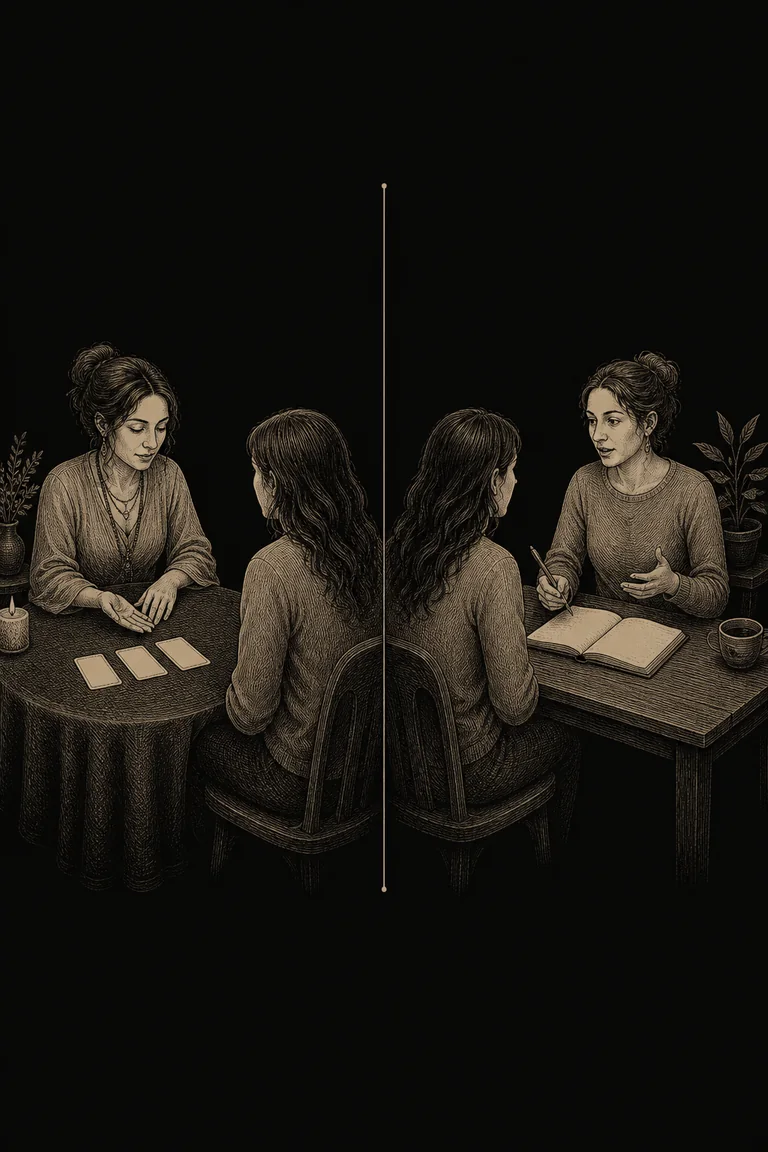
The practical difference between a Tarot reading and a psychic reading is the method you can expect. Tarot begins with a deck, a draw, and usually a spread whose positions organize the question. “Psychic reading” is a less standardized label. A practitioner may describe receiving impressions through intuition, clairvoyance, clairaudience, mediumship, energy reading, or another claimed ability, and may use no physical tool at all.
The categories overlap because some psychic readers use Tarot and some Tarot readers describe their interpretation as intuitive. Before choosing, ask what will actually happen, what information you must provide, what claims the reader makes, what the full service includes, and how uncertainty will be communicated. The label alone cannot establish accuracy, ethics, or value.
Take the next insight with you
Explore personalized Tarot guidance in Veritas, available for iOS and Android.
 Scan with your phone
Tarot reading vs psychic reading: the short answer
A Tarot reading interprets selected cards in relation to a defined question and layout. The client can see the cards, record their order, and revisit the symbolism later. A psychic reading is usually presented as information perceived directly by the reader rather than derived from a fixed symbolic system. In practice, providers use these labels differently, so the useful comparison is the stated procedure rather than the job title.
Define the service before you book
Use Veritas to save your question, the reader's method, price, length, deliverable, privacy terms, follow-up limit, and any claim you will not authorize.
Where the two services overlap
A reader may combine card meanings with spontaneous impressions, astrology, numerology, or conversation. Another practitioner may read Tarot as a learned visual language without claiming psychic access. Neither usage is automatically more legitimate. Ask which parts come from the cards, which come from the reader's inference, and which are ordinary facts you supplied. A clear practitioner can distinguish those sources without making the session sound less meaningful.
A side-by-side comparison
Which questions suit Tarot?
Tarot gives a question visible structure. It is useful when you want to compare options, identify assumptions, examine a relationship dynamic, or turn a broad concern into named positions such as context, obstacle, resource, and next action. Questions beginning with “what,” “how,” or “which factor” usually create more room for reflection than demands for a guaranteed date or outcome. The cards do not verify hidden facts or remove the need for real evidence.
What an open psychic reading may offer
An open reading may let the practitioner begin without a detailed question and report themes or impressions as they arise. Some clients prefer that format because they do not want to direct the conversation. The tradeoff is that scope and source can be harder to audit. Agree on the life areas that are in bounds, the topics that are off limits, and whether the reader will ask clarifying questions before interpreting an impression.
A Tarot reader, psychic, and medium are not identical labels
A medium specifically claims communication with people who have died, while “psychic” can cover many claimed forms of perception. Tarot is a tool and interpretive practice. A person can use more than one label, but the services should not be blended without consent. Grief can increase vulnerability to certainty, dependency, and escalating fees. No practitioner can prove identity merely by offering broad statements, and no reading should replace grief care or mental health support.
Online and in-person sessions use the same decision test
Video, phone, chat, email, and in-person readings differ in pacing and documentation, not in whether the service deserves clear terms. For remote Tarot, ask how cards are selected and whether you receive the spread. For any format, confirm identity, total price, timing, recording consent, delivery, cancellation, privacy, and follow-up. An online reader does not need remote access to your device, banking codes, identity documents, or private account passwords.
How to compare evidence and accuracy
Write the original question and any factual claims before discussing whether a reading “felt accurate.” Separate information you disclosed from details the reader introduced. Mark specific, time-bound claims and review them on a set date, including misses and ambiguous statements. Tarot symbolism can be reviewed against the recorded spread; intuitive claims can only be reviewed against the exact statement. Neither method has been scientifically validated as a reliable way to predict individual future events.
Questions to ask a reader before paying
- Name the method
Ask whether the session uses Tarot, another tool, open impressions, mediumship, coaching, or a disclosed combination.
- Set the scope
Agree on the question, life areas, third-party boundaries, high-stakes topics, and what the reader will decline.
- Confirm the complete price
Get the length, format, delivery, taxes or fees, cancellation terms, and follow-up cost in writing.
- Ask how uncertainty is stated
A responsible answer should allow doubt, alternative interpretations, and your right to make the final decision.
- Choose the record
Decide whether you receive card names, notes, an email summary, or a consensual recording so the session can be reviewed.
Red flags apply to both formats
Leave if a reader creates a frightening emergency, guarantees reconciliation or profit, diagnoses illness, claims a curse only they can remove, demands secrecy, asks for irreversible payment, or keeps inventing paid obstacles. Also pause when the provider discourages medical, legal, financial, or mental health advice. Those behaviors are not made safer by Tarot cards, a psychic title, testimonials, or a polished social account.
Example: choosing for a career decision
If you are comparing two job offers, a Tarot spread can assign visible positions to compensation, learning, workload, values, risk, and the next fact to verify. An open intuitive session might instead report broad impressions about each environment. In either case, return to the written offers, budget, commute, references, and contract. The reading can generate questions, but it cannot inspect terms you have not checked or guarantee success.
Example: choosing during relationship uncertainty
Tarot can examine your observations, needs, boundaries, and possible conversations without pretending to read another person's private mind. A psychic service may offer to reveal what someone “really feels,” but that claim cannot substitute for consent or communication. Choose a format that keeps attention on information you can obtain and decisions you control. Avoid repeated sessions used only to relieve uncertainty for a few hours.
Review claims after the session
In Veritas, separate cards or method, facts you supplied, reader claims, your interpretation, one action you control, and a dated evidence review.
How to choose without treating one method as superior
Choose Tarot if a visible symbolic framework, defined positions, and a reviewable spread help you think. Choose an open reading only if you understand the claimed method and are comfortable with less structure. A mixed session can work when each layer is identified. The best fit is the service whose process, scope, uncertainty, price, and boundaries you can understand before payment.
Limits of this comparison
Provider labels and laws vary by location. This guide compares common service descriptions and does not certify a practitioner or validate paranormal claims. Tarot and psychic readings should not replace evidence, direct communication, emergency help, or qualified medical, legal, financial, and mental health guidance.