Tarot Journal
How to Read Tarot Cards: A Grounded Beginner’s Guide
You do not need perfect intuition or a photographic memory to read Tarot well. You need a clear question, a close look at the card, and enough patience to let meaning develop before you reach for a fixed answer.
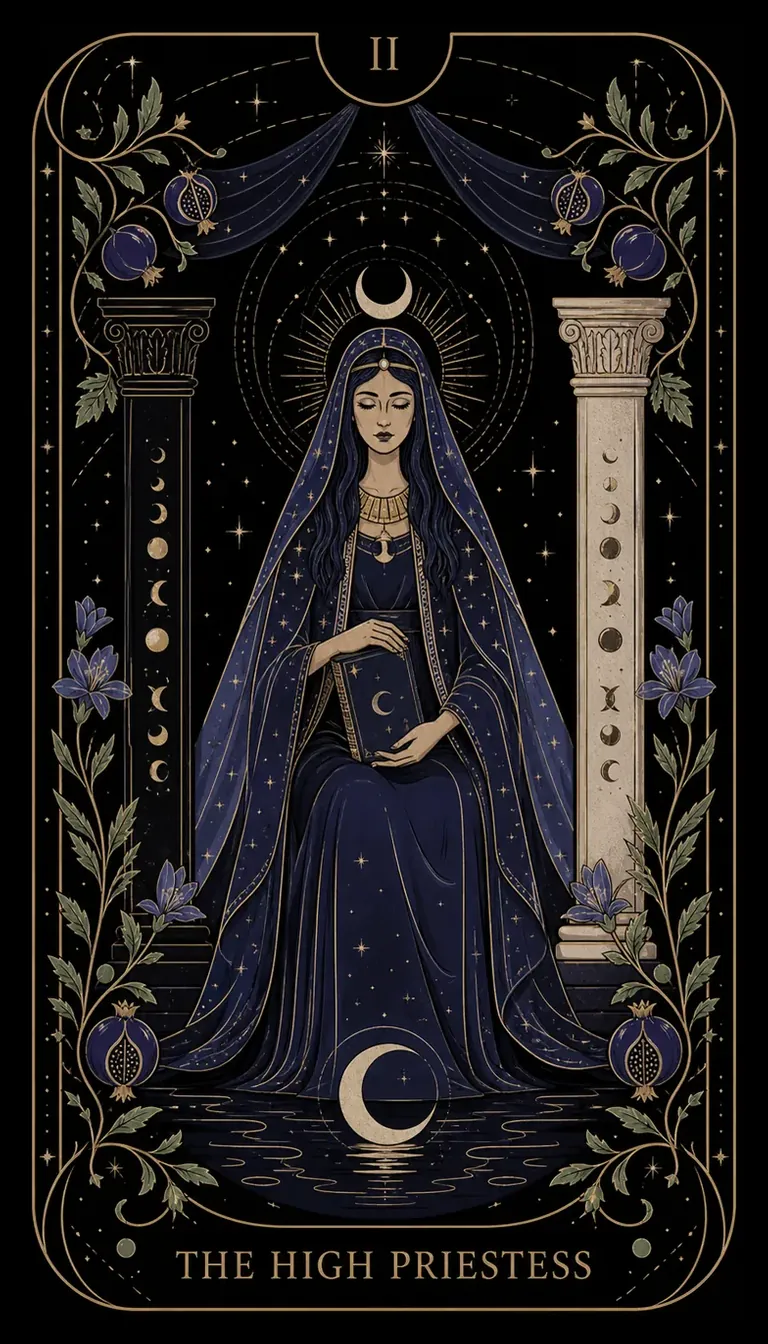
A first Tarot deck can feel like a beautiful object with an impossible amount of information inside it. There are seventy-eight cards, four suits, court cards, elemental associations, numbers, symbols, and reversals. Many beginners respond by trying to memorize everything at once. That usually makes a reading feel more like an exam than a conversation.
A more useful approach is to read in layers. Begin with what is visibly happening, add the traditional meaning, connect it to the card’s position, and only then relate it to the question. This method gives intuition something solid to work with. It also keeps a dramatic card from becoming a dramatic conclusion before you have considered the full spread.
Take the next insight with you
Explore personalized Tarot guidance in Veritas, available for iOS and Android.
 Scan with your phone
What a Tarot reading is actually doing
Tarot is best treated as a symbolic language for reflection. A reading can reveal the shape of a situation, the tensions inside it, and the choices that deserve attention. It does not remove uncertainty, and it should not replace professional medical, legal, or financial advice. Its value lies in helping you notice what you may already sense but have not yet put into words.
This distinction changes the quality of the questions you ask. “Will I get the job?” invites a brittle yes or no. “What would help me present my strengths clearly in this interview?” opens a useful line of thought. The second question gives the cards room to show an attitude, an obstacle, or a practical next step.
A strong Tarot question gives you somewhere to stand and somewhere to move.
Start with a question that belongs to you
Keep the focus on your own choices, boundaries, and understanding. Questions about another person’s private thoughts often tempt a reader to invent certainty. You will usually get a more honest reading by asking what you need to understand about the connection or how you can respond to what is actually happening.
Good questions are specific without demanding one predetermined outcome. Try “What am I overlooking in this decision?”, “What energy am I bringing into this relationship?”, or “What would make this next month feel more intentional?” Write the question down before you shuffle. That small act gives the reading a center.
A five-layer method for reading any card
- Notice your first response
Before checking a guidebook, name the feeling the card creates. Calm, pressure, distance, warmth, caution, and momentum are all useful observations. Your response is not the final meaning, but it is part of the reading.
- Describe the scene
Look at posture, direction, color, weather, objects, and empty space. Ask what has just happened and what might happen next. Description keeps intuition connected to evidence inside the image.
- Add the traditional meaning
Now bring in the card’s established themes. The Hermit may suggest solitude, searching, or inner guidance. The Three of Pentacles may point to craft, cooperation, and being seen for your contribution.
- Respect the spread position
A card in “what helps” behaves differently from the same card in “what complicates.” Position is grammar. It tells you what role the card is playing in the sentence of the spread.
- Return to the question
Finish by translating the symbolism into plain language that answers what was asked. If you cannot connect the interpretation back to the question, you may still be describing the card rather than reading it.
How Major and Minor Arcana work together
The twenty-two Major Arcana often describe larger turning points, enduring lessons, or forces that feel bigger than the day’s details. A spread with several Major cards may suggest that the question touches identity, direction, or a meaningful transition. That does not automatically make the outcome fated. It means the experience carries weight.
The fifty-six Minor Arcana bring the reading closer to daily life. Wands tend to concern energy, desire, and action. Cups speak through feeling and relationship. Swords engage thought, language, and conflict. Pentacles connect to the body, resources, work, and what can be built over time. Court cards can describe people, social roles, or a way of approaching the situation.
Read the spread before you read each card alone
Once you have considered the individual cards, step back. Repeated suits show where the reading is concentrated. Repeated numbers can reveal a shared stage of development. Figures looking toward or away from one another create relationships across the table. A quiet card between two intense cards may function as a pause, a refuge, or an avoidance.
Pay attention to movement. Does the spread seem to travel from confusion toward structure, or from control toward openness? This is often more useful than producing three separate definitions. A spread is a composition. The cards modify one another just as words do in a sentence.
Practice with a reading that keeps the full picture in view
Veritas helps you explore the cards, their positions, and the relationship between them without turning the reading into a pile of disconnected keywords.
Should beginners use reversed cards?
You can learn with reversals, but you do not need them to produce nuanced readings. Every upright card already contains a range. Strength can be steady courage or an attempt to control feeling through force. The Four of Cups can show thoughtful withdrawal or disengagement. Context tells you where on that range the card is operating.
If you include reversals, avoid treating them as simple opposites. A reversed card may suggest blocked energy, an inward process, excess, delay, or a theme that needs attention. Choose one reversal framework and use it consistently for several weeks. Consistency teaches more than switching systems whenever a card feels difficult.
What to do when a card makes no sense
Confusion is part of reading. First, repeat the spread position aloud. Then describe the card without interpretation. Look for the simplest connection to the question. If the card still feels opaque, draw no more than one clarification card and state exactly what it is clarifying. Pulling card after card usually buries the original message under anxiety.
It is also acceptable to leave a card unresolved. Record the reading and return later. A detail that seemed irrelevant can become clear after a conversation, a decision, or a change in mood. Tarot practice improves when you review what you actually saw, not when you remember only the parts that seemed accurate.
Build skill through a small repeatable ritual
A daily one-card practice is enough. Ask a grounded question such as “What quality would help me today?” Write your first impression, two visual details, the traditional theme, and one practical action. At the end of the day, add a sentence about how the card appeared in real life. This turns intuition into a record you can evaluate.
Over time, your relationship with the deck becomes personal without becoming arbitrary. You may notice that a certain card repeatedly appears around a specific behavior or feeling. Keep that lived association alongside the traditional meaning. The richest readings usually come from both, not from choosing one over the other.
The measure of a useful reading
A useful reading does not need to sound mystical. It should leave you with a clearer understanding of the situation and a more conscious way to meet it. If the interpretation increases fear, claims certainty about someone else, or makes you feel powerless, pause and reframe the question.
Read slowly enough to remain honest. Let the image speak before the guidebook, let context shape the definition, and let your final interpretation return to real life. That is how Tarot stops being a collection of meanings and becomes a language you can genuinely use.