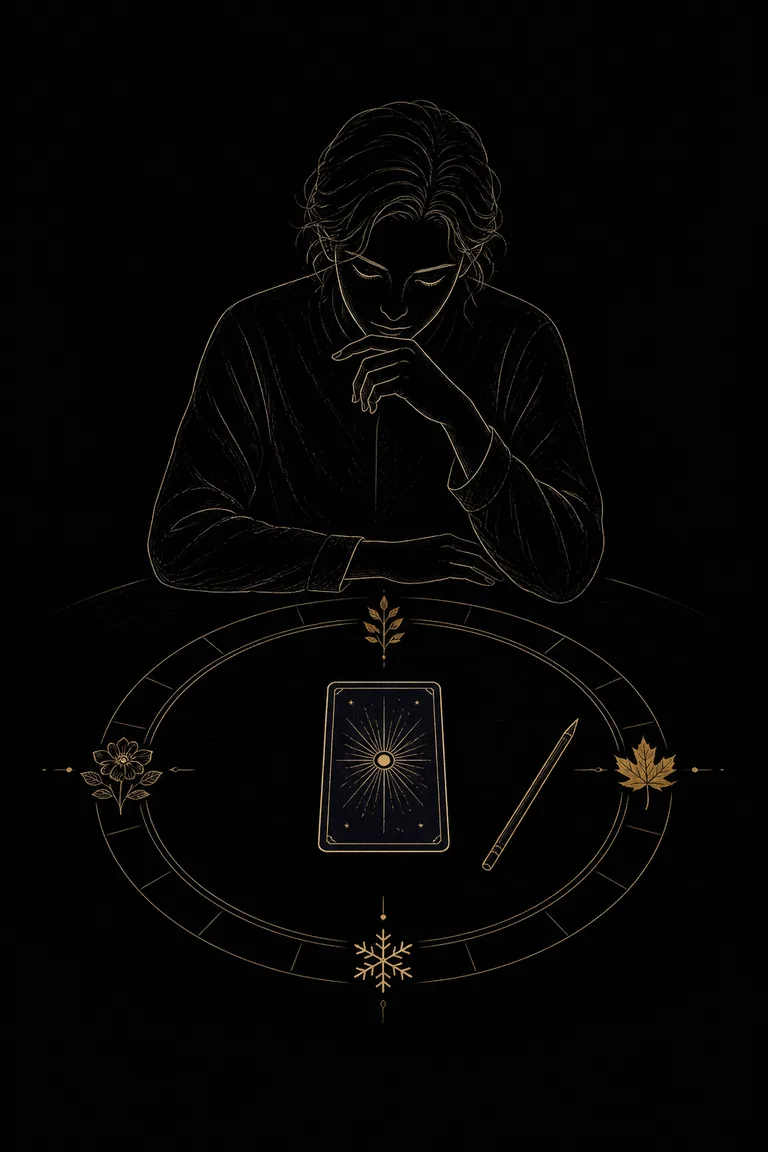
Tarot Journal
Tarot Season Card: How to Draw and Review One
A Tarot season card gives one image a fixed three-month observation window, with declared dates, three scheduled reviews, and a closing audit instead of a seasonal forecast.

A Tarot season card is one card drawn for a clearly defined season and held as a reflection prompt until that interval ends. The season may follow equinoxes and solstices, local meteorological months, or another written calendar convention. The card does not predict the weather or assign an event to every week. It keeps one question stable while plans, relationships, work, and ordinary conditions change around it.
The method works best when its boundaries are visible before the draw: name the convention, record the start and end dates, ask one durable question, translate the image into observable language, and schedule three brief reviews. At the close, preserve both matches and misses. A season card cannot guarantee love, money, health, travel, conflict, or a personal transformation.
Take the next insight with you
Explore personalized Tarot guidance in Veritas, available for iOS and Android.
 Scan with your phone
Tarot season cards at a glance
Choose what season means before you shuffle
There is no single calendar shared by every reader. An astronomical season begins at an equinox or solstice. A meteorological season groups three whole months, such as September through November in the Northern Hemisphere. Local climates may use wet, dry, monsoon, fire, or harvest periods instead. Choose the system that fits the purpose, write its dates, and do not move the ending because the card seems unfinished.
Northern and Southern Hemisphere dates differ
March begins spring in common Northern Hemisphere calendars and autumn in the Southern Hemisphere. Generic suit-to-season charts often assume one hemisphere without saying so. A season card does not need a fixed suit correspondence, but it does need local dates. If you are traveling, decide whether the practice follows your home calendar or the place where you will spend the interval. Record that choice once.
How to draw a Tarot card for the season
- Name the convention and dates
Write the season label, location if relevant, first day, and final day.
- Ask one durable question
Choose an approach or condition you can observe across several months.
- Set the reading rules
Decide whether reversals apply and whether the practice permits any clarifier.
- Draw one card
Describe visible details before choosing one working interpretation.
- Schedule the reviews
Place three check-ins and a closing date on the calendar immediately.
Ask a question that remains useful for three months
A durable question might be "What quality should I practice while this project develops?" or "Which condition deserves honest attention this season?" A question such as "Will I meet my future partner this summer?" asks the card to promise an external event and encourages constant scanning. Keep the question within your agency, identify the setting, and state what would count as useful evidence.
Translate the card into an observable theme
Suppose Temperance appears. Instead of treating it as a promise of harmony, define a testable theme such as combining two processes without losing the limits of either. Evidence could include a schedule that protects both work and recovery, or a collaboration with clearly divided responsibilities. A counterexample could be a compromise that hides a real incompatibility. Specific language keeps the card from explaining everything after the fact.
Use three reviews, not constant checking
Schedule one review near each third of the interval. At every check, record one relevant example, one weak or contrary example, and one proportionate action. Keep the original question and first interpretation visible. Do not redraw after a quiet month or a dramatic day. Frequent checking lets the latest event take over the whole season and makes a broad symbol impossible to evaluate fairly.
What if the season card is reversed?
If reversals belong to your regular method, decide that before shuffling. Test one meaning such as delay, internalization, excess, shortage, or blocked expression. Do not stack all possible reversed meanings together. If you do not normally use reversals, turn the card upright and note the convention. A reversed card does not mean the season will be bad, unlucky, or unsafe.
How to handle a difficult card over a long window
The Tower, Death, Ten of Swords, or Five of Pentacles can feel overwhelming when placed across several months. Narrow the card to a controllable question about unstable assumptions, endings, recovery, or access to support. Never use it to predict disaster, illness, bereavement, betrayal, or financial loss. If the draw leads to fear, avoidance, or repeated checking, close the practice and return to concrete plans and qualified support.
Season card versus year, month, and week cards
You can use more than one cadence, but give each record a separate job. The season card can hold a broad practice question while a week card tests one immediate behavior. Do not count the same event as automatic confirmation for the week, month, season, and year. Separate records make it possible to see which interval actually improved reflection.
Season card versus Tarot timing correspondences
A season card is defined by the dates you choose. Tarot timing systems instead assign seasons or relative speed to suits, ranks, or astrological correspondences. Those correspondences vary between traditions and do not establish a calendar fact. Drawing a Wands card for winter does not mean the card failed or that winter will arrive early. Keep the observation window separate from any symbolic timing vocabulary.
One card or a seasonal Tarot spread?
One season card offers continuity. A seasonal spread gives several cards distinct positions, such as context, resource, friction, and response. Use a spread when the positions answer separate questions. Use one card when the aim is to study how one image changes through time. If a detail is unclear, first describe it and consult the guidebook. Repeated clarifiers can quietly replace the original method with an unplanned spread.
Keep one seasonal theme accountable
Use Veritas to save the convention, location, dates, question, card, reversal rule, observable theme, three reviews, counterexamples, chosen actions, and final assessment.
A seasonal review worksheet
- Opening: define the test
Write one observable theme and one condition that would challenge it.
- First third: notice the baseline
Record what was already present before claiming a new pattern.
- Second third: test one action
Apply the useful side of the card in one choice you control.
- Final third: look for limits
Note where the interpretation helps and where it becomes too broad.
- Closing: release the card
Summarize matches, misses, practical learning, and what will not carry forward.
Limits and responsible use
A Tarot season card cannot predict weather, disasters, illness, fertility, another person's feelings, travel safety, market results, employment, or relationship outcomes. It should not replace calendars, climate guidance, medical care, contracts, budgets, or direct communication. Treat it as an optional journaling practice, preserve counterevidence, respect consent, and stop if it creates fear or dependency.