Tarot Journal
The Devil Tarot Meaning: Attachment, Power, and Choice
The Devil reveals an attachment that gains power through appetite, avoidance, leverage, or a bargain whose real cost has not been named.
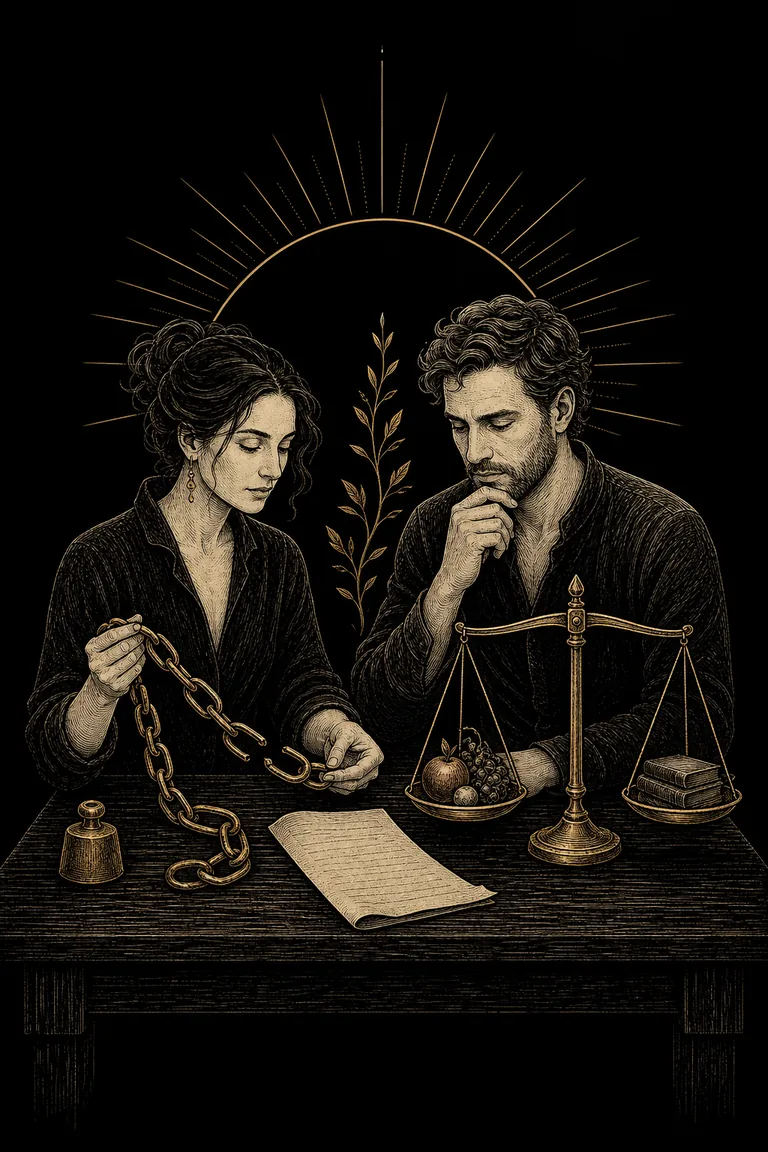
The Devil is the fifteenth card of the Major Arcana. Traditional imagery shows two people loosely chained near a commanding figure. The scene can look frightening, yet the loose chains are crucial: the card is less a sentence than an examination of what binds, what rewards the bond, and which part of the arrangement can still be changed.
In a reading, The Devil may describe compulsion, shame, secrecy, dependency, material pressure, control, or pleasure separated from consequence. It does not prove that someone is evil, addicted, abusive, or unfaithful. Its practical question is sharper: what keeps this pattern in place, who benefits, what does it cost, and what support would make a freer choice possible?
Take the next insight with you
Explore personalized Tarot guidance in Veritas, available for iOS and Android.
 Scan with your phone
The Devil Tarot meaning at a glance
The Devil can point to attachment, appetite, temptation, dependency, secrecy, leverage, control, shame, avoidance, materialism, obsession, and a bargain with hidden costs. In a constructive position, it may bring an honest encounter with desire or reveal the mechanism of a pattern clearly enough to change it.
Name what has leverage
Open a Tarot reading in Veritas to examine the reward, cost, boundary, and next choice inside a pattern that feels difficult to change.
Why the chains matter
A chain represents a repeated connection between action and consequence. Sometimes it is internal, such as using distraction whenever discomfort appears. Sometimes it is structural, such as debt, a contract, housing dependence, workplace power, or fear of losing community. The loose collar in familiar versions of the card suggests agency, but it should not be used to blame people for constraints they cannot safely remove alone. Freedom may require money, information, treatment, legal advice, shelter, or trusted support.
The Devil upright
Upright, The Devil often makes the reinforcing loop visible. A behavior offers immediate relief, pleasure, approval, certainty, or access, while its later cost is delayed or hidden. The card asks for an accurate ledger. Name both the real benefit and the real price. Denying pleasure makes the reading moralistic; denying consequence makes it evasive.
The Devil reversed
Reversed, the card can indicate recognition, loosening, withdrawal from a bargain, or a first attempt to interrupt the loop. It can also show denial after the pattern has been exposed, or a cycle of dramatic vows followed by the same conditions. Progress is more credible when access, triggers, support, and alternatives change, not only intention.
Desire is not the same as compulsion
The Devil is not a demand to reject pleasure, ambition, sex, money, or strong preference. Desire can be informed, mutual, bounded, and compatible with other values. Compulsion narrows choice: the person cannot pause, revise, tolerate refusal, or account for impact. Ask whether the desire can coexist with consent, proportion, honesty, and an acceptable aftermath.
Love and relationships
In relationship readings, The Devil may highlight intense attraction, jealousy, secrecy, dependency, bargaining, or a bond organized around fear of loss. It cannot diagnose abuse or prove betrayal. Look at observable behavior: Can each person say no? Is privacy different from deception? Are money, housing, status, sex, or access being used as leverage? If safety is uncertain, prioritize qualified support and a practical safety plan over confrontation prompted by a card.
Career, power, and work
At work, the card can describe golden handcuffs, overwork rewarded with identity or status, an opaque incentive, or a manager who controls information. Write down compensation, hours, ownership, exit conditions, and the consequence of refusing extra labor. A useful reading distinguishes a demanding but chosen season from a system that depends on silence and unlimited availability.
Money and material pressure
For money questions, The Devil asks what a purchase, debt, investment story, or lifestyle promise is selling emotionally. Urgency and shame can hide fees, risk, or lack of liquidity. Check statements, terms, renewal dates, and independent advice. Tarot cannot determine whether a financial product is safe, approve a contract, or replace regulated debt, tax, or legal guidance.
Habit, coping, and addiction concerns
A card cannot diagnose addiction or measure medical risk. If alcohol, drugs, gambling, food, sex, self-harm, or another behavior feels uncontrollable or dangerous, seek evidence-based professional help and urgent services when needed. As reflection, The Devil can help map the loop: cue, action, immediate reward, later cost, and the conditions that make a safer response more available.
The Devil as advice or obstacle
As advice, The Devil says to stop pretending the incentive is absent. Put the appetite and leverage on the table, then negotiate from reality. As an obstacle, it may show shame, secrecy, fatalism, or the belief that one difficult urge defines the whole person. Accountability is useful when it increases choice and repair, not when it becomes humiliation.
The Devil with other cards
With The Lovers, a choice requires explicit values and consent. With Justice, terms and consequences need documentation. With Temperance, change may depend on reducing exposure and building a workable substitute rather than demanding instant purity. With The Tower, an unstable arrangement may lose its protective story. With The Star, recovery needs honest hope, time, and support.
A practical Devil reading
- Describe the chain
State the repeated link between cue, behavior, reward, and consequence without using a character judgment.
- Locate the leverage
Identify the money, access, approval, relief, secrecy, fear, or power that makes refusal difficult.
- Check what is movable
Separate a preference you can revise from a constraint that requires resources, protection, or outside help.
- Restore one degree of choice
Delay, document, limit access, contact support, or create a safer alternative that can be used before the next trigger.
A question The Devil asks
Ask: “What reward keeps this attachment alive, what is its full price, and what would give me one more real option?”
Tarot is a symbolic reflective practice, not a factual verdict or scientifically validated forecasting method. The Devil cannot diagnose addiction or abuse, prove another person's motives, guarantee release, or replace medical, mental health, legal, financial, workplace, relationship, or emergency support.