Astrology Journal
Cazimi in Astrology: Meaning, Orbs, and Chart Use
Cazimi places a planet extremely close to the Sun by zodiacal longitude. In traditional astrology it can describe unusual solar support, but only under a declared orb and within the full condition of the chart.
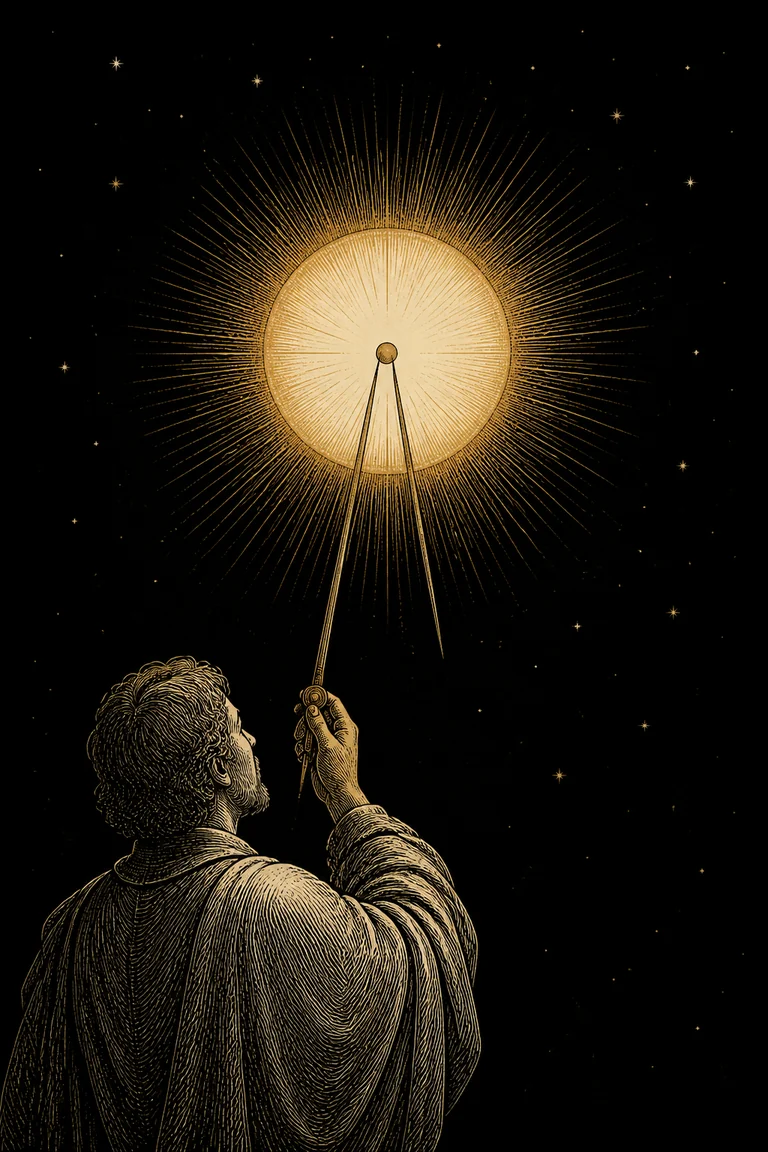
A planet is cazimi when it is at the heart of the Sun, traditionally within 17 arcminutes of the Sun's exact zodiacal longitude. Measure the shortest longitudinal distance, not merely whether both bodies occupy the same sign or degree label. At 10 degrees 12 minutes Leo, for example, a planet is 14 arcminutes from a Sun at 10 degrees 26 minutes Leo and meets the traditional threshold.
Cazimi is not a general synonym for a Sun conjunction. Outside the narrow cazimi orb, traditional practice may classify a planet as combust or under the beams, depending on distance and doctrine. Some modern astrologers use a wider one-degree cazimi orb. Either method can be studied, but it must be named before interpretation rather than changed to fit a desired conclusion.
Take the next insight with you
Explore personalized Astrology guidance in Veritas, available for iOS and Android.
 Scan with your phone
What does cazimi mean in astrology?
Cazimi comes through an Arabic expression commonly translated as in the heart of the Sun. Medieval and early modern astrologers treated this extremely close placement as distinct from the weakness associated with ordinary combustion. The metaphor suggests admission to the center of solar authority. It does not erase the planet's sign, house, rulerships, sect, motion, aspects, or real-world context, and it is not a rank assigned to the person.
Measure before naming the condition
In Veritas, save the Sun and planet longitudes, exact separation, chosen cazimi orb, chart type, and the specific planet topics you plan to judge.
The traditional 17-arcminute orb
A widely used traditional rule sets cazimi at no more than 17 arcminutes from the Sun. One zodiac degree contains 60 arcminutes, so this is less than one third of a degree. Software that displays only whole degrees can conceal the difference between cazimi and combustion. Record degrees and minutes, and include seconds when the placement sits near the boundary. If your source uses a different limit, cite and preserve that method.
How to calculate cazimi by longitude
- Record both positions
Write the Sun and planet sign, degree, minute, and second from the same chart and zodiac.
- Convert across signs if needed
Treat each sign as a 30-degree segment so positions near a sign boundary can be compared correctly.
- Find the shortest distance
Subtract the longitudes and use the smaller separation around the 360-degree circle.
- Convert the remainder
Multiply any decimal degree by 60 to express the distance in arcminutes.
- Apply the declared orb
Use 17 arcminutes for the common traditional test or clearly label another convention.
Cazimi across a sign boundary
The Sun and planet do not need to display the same sign name if they are close across a boundary. A Sun at 29 degrees 55 minutes Aries and Mercury at 0 degrees 07 minutes Taurus are 12 arcminutes apart, so they meet a 17-minute longitude rule. Some astrologers require bodily conjunction in the same sign for specific traditional techniques. State whether sign boundaries affect your doctrine instead of assuming the software label answers the question.
Cazimi versus combustion
Combustion describes a planet close enough to the Sun to be overwhelmed or hidden, but outside cazimi. A common traditional boundary extends combustion to roughly 8 degrees 30 minutes, although historical sources and applications vary. The sharp change from a narrow central privilege to surrounding concealment is part of the doctrine. Do not blend the terms into stronger and weaker versions of the same positive trait.
Cazimi versus under the beams
Under the beams usually describes a wider zone of solar obscuration beyond combustion, often up to about 15 or 17 degrees from the Sun under different sources. These thresholds are not universal constants. Visibility also depends on the planet, elongation, latitude, season, and observing conditions. A clear report names the distance categories it uses and avoids pretending that one modern software setting represents all traditional authors.
Applying and separating from the Sun
Determine whether the faster body is moving toward exact conjunction or away from it. An applying cazimi can describe a condition becoming exact; a separating cazimi can describe one just completed. The distinction may matter strongly in horary and electional work. Check daily motion, retrogradation, stations, and the exact time of conjunction rather than inferring application from the order of two static positions.
Superior and inferior conjunctions
Mercury and Venus can conjoin the Sun on the far side of the Sun from Earth, called a superior conjunction, or between Earth and the Sun, called an inferior conjunction. Both can be cazimi by longitude. Their synodic phase and apparent motion add context that a distance label alone cannot supply. An inferior conjunction often occurs during retrograde motion, while a superior conjunction occurs during direct motion.
Mercury cazimi
Mercury cazimi may focus attention on speech, calculation, testimony, trade, learning, messages, or decisions, depending on the houses Mercury rules and occupies. It does not prove genius, honesty, perfect memory, or persuasive power. Examine Mercury's sign, sect relationship, phase, motion, reception, house, and relevant aspects. A narrow condition can concentrate a function without making every expression of it wise or effective.
Venus cazimi
Venus cazimi may highlight agreements, attraction, art, pleasure, valuation, friendship, or reconciliation in the chart topics Venus signifies. It is not a guarantee of beauty, marriage, popularity, money, or relational safety. The conjunction can expose what receives value and solar authorization, while the surrounding chart shows whether consent, reciprocity, resources, and practical conditions support the matter.
Mars, Jupiter, and Saturn cazimi
The superior planets also form exact solar conjunctions. Mars may bring action, conflict, severing, or effort into a concentrated solar agenda; Jupiter may emphasize judgment, growth, counsel, law, or faith; Saturn may emphasize limits, endurance, exclusion, land, age, or responsibility. These are starting topics, not promised outcomes. The planet's rulerships and the question determine what the condition actually modifies.
Cazimi and essential dignity
Cazimi is a solar condition, not one of the five essential dignities. A cazimi planet can be in domicile, exaltation, triplicity, bound, or face, or it can lack all dignity of its own. Keep the testimonies separate. Essential dignity describes zodiacal resources or authority within a named method, while cazimi describes a very exact relation to the Sun. Neither alone completes the judgment.
Cazimi and accidental condition
House placement, angularity, sect, speed, direction, visibility doctrine, reception, and aspects determine how a planet can act in the chart. A cazimi planet in a cadent house may have a different field of action from one on an angle. A station near the conjunction can change timing and capacity. Add the condition to an accidental dignity analysis instead of using it as an automatic maximum score.
Cazimi in a natal chart
In natal astrology, connect cazimi to the planet's concrete functions and house topics. Look for repeated patterns in choices, environments, skills, constraints, and feedback. Avoid telling a person that the placement makes them chosen, invincible, famous, spiritually superior, or destined for leadership. A responsible interpretation can describe where solar identity and a planetary function are tightly joined while leaving room for development and contradiction.
Cazimi in horary astrology
Horary astrologers may read a cazimi significator as received into the king's heart, protected, authorized, or made unusually central. The specific meaning depends on who or what the planet signifies, application, reception, house position, and the rest of the perfection or prohibition. It is not proof that a person is truthful, safe, legally protected, or certain to prevail. Real evidence remains necessary for consequential decisions.
Cazimi in electional astrology
An election can use a relevant planet's exact conjunction with the Sun when the symbolism fits the action and the rest of the chart is workable. Because the 17-minute window is brief, calculate the exact interval rather than selecting an entire day. Do not sacrifice legal, financial, medical, logistical, or safety requirements for a narrow astrological moment. A usable election must work in ordinary time as well as symbolic time.
Does planetary latitude matter?
Most chart programs label cazimi from ecliptic longitude alone. Some historical discussions and contemporary practitioners also consider latitude or actual visual proximity to the center of the solar disk. These methods can disagree when a planet has substantial latitude. State whether your rule is longitude-only or uses another spatial criterion. Do not quietly mix a longitude definition for one chart with a visual-disk definition for another.
Worked example: inside the traditional orb
Suppose the Sun is at 18 degrees 42 minutes Gemini and Mercury is at 18 degrees 31 minutes Gemini. The separation is 11 arcminutes, so Mercury is cazimi under a 17-minute longitude rule. Next determine whether Mercury is applying or separating, direct or retrograde, which houses it rules, and how Gemini, the occupied house, and other aspects shape the judgment. The label is the start of interpretation.
Worked example: same degree, outside cazimi
Suppose the Sun is at 6 degrees 02 minutes Virgo and Venus is at 6 degrees 41 minutes Virgo. A chart wheel may print both as 6 Virgo, yet the separation is 39 arcminutes. Venus is not cazimi under the 17-minute rule. A practitioner using a disclosed one-degree modern convention may classify it differently. The example shows why rounded degree labels and unstated orb settings create false agreement.
A reliable cazimi workflow
- Name the doctrine
Choose the source, cazimi orb, combustion boundary, beam boundary, and treatment of sign crossings.
- Verify chart data
Use one zodiac and record accurate date, time, place, and uncertainty.
- Calculate separation
Compare exact ecliptic longitudes rather than rounded sign-degree labels.
- Check phase and motion
Record application, separation, station, retrogradation, and superior or inferior conjunction where relevant.
- Judge the planet
Add sign, dignity, sect, house, rulerships, reception, and aspects.
- Limit the conclusion
Describe one chart topic without converting a narrow condition into a promise or identity.
Keep solar conditions auditable
Use Veritas to save the exact separation, orb source, motion, phase, dignity, house, rulerships, supporting testimony, uncertainty, and final bounded interpretation.
Common cazimi mistakes
Do not call every Sun conjunction cazimi, rely on whole-degree display, hide a one-degree orb inside a traditional claim, ignore sign boundaries or phase, confuse cazimi with essential dignity, or assume it cancels every weakness. Avoid promises of genius, fame, wealth, protection, spiritual election, legal victory, or harmlessness. Precision in calculation should produce precision in language, not exaggerated certainty.