Astrology Journal
Planets in Astrology: What Each Planet Represents
Planets describe what acts in a birth chart. Learn the function of the Sun, Moon, Mercury, Venus, Mars, Jupiter, Saturn, Uranus, Neptune, and Pluto.
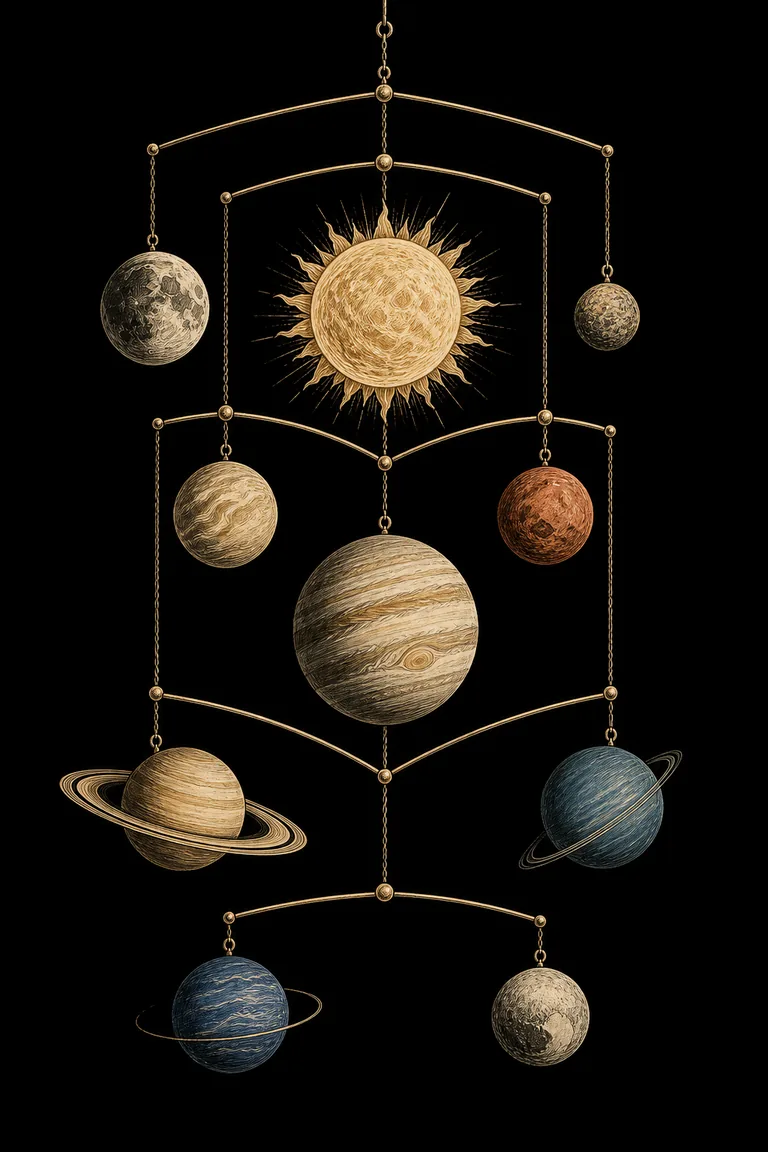
In astrology, planets describe the functions that act within a birth chart. The Sun organizes identity and vitality, the Moon responds through instinct and memory, Mercury interprets, Venus values, Mars acts, Jupiter expands, and Saturn defines limits. Uranus, Neptune, and Pluto describe slower collective processes that become personal through house placement and aspects.
A planet is not interpreted alone. Its sign shows how it operates, its house shows where it becomes active, and its aspects show how it relates to other planetary needs. This simple grammar prevents a placement from becoming a generic personality label.
Take the next insight with you
Explore personalized Astrology guidance in Veritas, available for iOS and Android.
 Scan with your phone
What do planets mean in astrology?
Astrologers use the word planet broadly. The Sun is a star and the Moon is Earth’s satellite, but both are treated as chart bodies because they have central symbolic functions. The Ascendant and lunar nodes are important points, not planets, and should be read differently.
The faster personal planets describe needs and behaviors that are easier to recognize day to day. Jupiter and Saturn connect individual development with society and time. The outer planets move slowly, so everyone born within a period may share their sign; house and aspect make them more individual.
Planet meanings in the birth chart
Sun: vitality and conscious identity
The Sun describes purpose, confidence, visibility, and the qualities through which a person develops a coherent direction. Its house shows where that identity seeks active expression.
Moon: instinct and emotional rhythm
The Moon describes memory, attachment, bodily rhythm, caregiving, habit, and what helps the emotional system recover. It becomes especially visible in private and under stress.
Mercury: mind and communication
Mercury describes perception, language, learning, movement, categorization, and exchange. Its placement shows how information is gathered and how thought becomes speech or skill.
Venus: value and attraction
Venus describes pleasure, relationship, aesthetics, agreement, money choices, and what feels worth approaching. It shows both receiving and the standards used to choose.
Mars: action and assertion
Mars describes drive, anger, desire, competition, boundaries, and the way effort is mobilized. Its mature expression acts directly without treating force as the only form of strength.
Jupiter: growth and meaning
Jupiter describes expansion, belief, opportunity, teaching, confidence, and the search for a larger frame. Its shadow includes excess, certainty, and promises larger than reality can support.
Saturn: limits and mastery
Saturn describes time, responsibility, fear, structure, consequence, and authority earned through sustained contact with difficulty. Limits can restrict or make real skill possible.
Uranus: disruption and liberation
Uranus describes innovation, rupture, independence, awakening, and changes that break an established pattern. Personal relevance grows when it contacts an angle or personal planet.
Neptune: imagination and permeability
Neptune describes ideals, dreams, compassion, art, spiritual longing, diffusion, and the loss of clear boundaries. It can inspire or obscure, often doing both.
Pluto: power and deep transformation
Pluto describes compulsion, elimination, hidden power, survival, and processes that permanently change the relationship with control. Its work is slow and often collective.
See every planet in its actual chart context
Create your natal chart in Veritas and explore each planet through sign, house, aspects, and its role in the larger pattern.
Personal, social, and outer planets
The Sun, Moon, Mercury, Venus, and Mars are commonly called personal planets because they move relatively quickly and describe immediate functions. Jupiter and Saturn are social planets, linking growth and responsibility with education, institutions, belief, and generational timing.
Uranus, Neptune, and Pluto remain in a sign for years and describe broad generational conditions. A Pluto sign alone says little about an individual personality. A tight Pluto aspect to the Moon or a placement on the Ascendant makes the symbolism more personally concentrated.
Sign, house, and aspect change the planet
Mars describes action. Mars in Libra may act through negotiation and comparison, while Mars in Capricorn may organize effort toward a long-term result. In the Third House, action enters speech and learning; in the Tenth, it enters vocation and public responsibility.
An aspect adds relationship. Mars square Saturn may describe tension between urgency and restraint, while Mars trine Jupiter may make confidence and action move easily together. Ease is not automatically wise, and tension is not automatically failure. Both require conscious use.
Planetary rulers and chart rulership
Planets rule zodiac signs and carry the concerns of houses whose cusps begin in those signs. If Gemini is on the Second House cusp, Mercury becomes the ruler of that house. Mercury’s sign, house, and aspects connect communication or learning with resources and value.
Traditional rulership assigns Mars to Aries and Scorpio, Jupiter to Sagittarius and Pisces, and Saturn to Capricorn and Aquarius. Modern astrology often adds Pluto, Neptune, and Uranus as rulers of Scorpio, Pisces, and Aquarius. State which system you use and remain consistent.
Dignity does not make a planet good or bad
Essential dignity describes how readily a planet can use the resources of a sign according to a traditional system. A planet in rulership may operate with familiarity, while one in detriment may need translation or adaptation. Dignity does not measure moral worth, happiness, or guaranteed success.
Read condition alongside house, aspects, sect, and the whole chart. A dignified planet can be overused or heavily pressured. A planet in a difficult dignity can become highly skilled through practice and support.
What retrograde planets mean
A natal retrograde planet appears to move backward from Earth’s perspective. Astrologers often interpret it as more internal, reflective, irregular, or delayed in expression. It does not mean the function is broken or cursed.
Astrology is a symbolic interpretive tradition and is not scientifically validated as a diagnostic or forecasting method. Use planetary meanings to organize observation, not to prove personality, predict health, or replace qualified advice.