Astrology Journal
How to Read a Birth Chart: Planets, Signs, and Houses
A birth chart looks complicated because it shows many relationships at once. Read it in the right order and it becomes a coherent map: planets describe what is happening, signs describe how, houses describe where, and aspects show which parts of the chart cooperate or pull against each other.
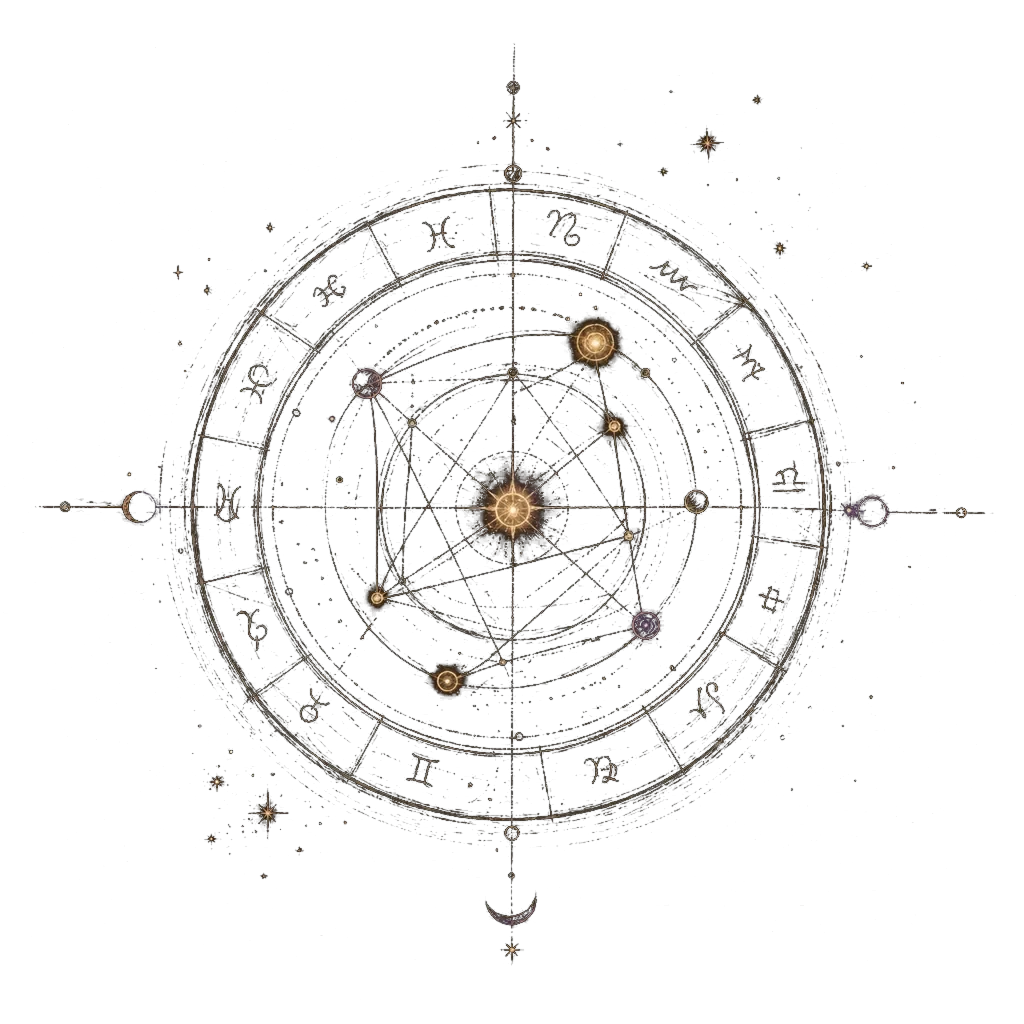
The first time you open a natal chart, the circle can seem crowded with symbols, lines, numbers, and divisions. It is tempting to click every placement and collect a long list of descriptions. That approach gives you information, but it rarely gives you a portrait. A chart becomes meaningful when you notice which themes repeat and which placements shape the rest.
Start with the chart’s strongest anchors, then move toward detail. You do not need to interpret every asteroid or minor aspect in one sitting. The Sun, Moon, Ascendant, chart ruler, personal planets, houses, and major aspects already provide enough material for a thoughtful first reading.
Take the next insight with you
Explore personalized Astrology guidance in Veritas, available for iOS and Android.
 Scan with your phone
Before you interpret anything, check the birth data
A natal chart is calculated for a specific date, time, and place. The birth time matters because it determines the Ascendant and house cusps, both of which move through the zodiac during the day. If the recorded time is uncertain, the Moon and planetary signs may still be useful, but the rising sign and houses should be treated cautiously.
Use the location of birth rather than the place where someone grew up. A reliable chart calculator handles the geographic coordinates and historical time-zone rules. Once the data is set, keep the same house system while learning so that changing technical settings does not distract from learning the basic language.
The four-part grammar of a birth chart
- Planets show the function
The Sun concerns identity and vitality. The Moon describes emotional needs and instinctive responses. Mercury relates to thought and communication. Venus speaks to attraction and values, while Mars shows drive, assertion, and desire.
- Signs show the style
A sign changes how a planetary function expresses itself. Mars in Aries may act directly and quickly. Mars in Libra may weigh competing needs and act through negotiation. The planet remains Mars, but its manner changes.
- Houses show the field of life
A house places the planet in lived experience. Venus in the tenth house may connect values and relationships with public life or vocation. Venus in the fourth may bring those themes into home, roots, and private belonging.
- Aspects show the relationship
Aspects describe the geometric relationships between planets. They show where two functions flow together, intensify one another, or require conscious integration.
Planet is the actor, sign is the role, house is the stage, and aspect is the conversation.
Begin with the Big Three
The Sun, Moon, and Ascendant provide the clearest entrance into a chart. The Sun describes the qualities you are learning to inhabit with confidence and purpose. The Moon shows what helps you feel safe, restored, and emotionally understood. The Ascendant describes how you meet unfamiliar life and the style through which the rest of the chart enters the world.
Do not flatten them into three adjectives. Ask how they cooperate. A fiery Sun with an earthy Moon may pair bold direction with a need for predictability. A reserved Ascendant can make an expressive Sun less immediately visible. The contrast is not a flaw in the chart. It often describes a real inner negotiation.
Find the chart ruler
The planet that rules the Ascendant sign is known as the chart ruler. If Gemini rises, Mercury rules the chart. If Taurus rises, Venus does. Its sign, house, and major aspects often describe a route through which the whole chart organizes itself.
Suppose someone has Scorpio rising, making Mars the traditional chart ruler. Mars in the third house could place unusual emphasis on speech, learning, siblings, local movement, or the courage to name what others avoid. This does not override every other placement. It gives you a strong thread to follow.
See the chart as a connected portrait
Create your natal chart in Veritas and explore the Big Three, houses, planetary placements, and major aspects in one coherent reading.
Read the personal planets next
Mercury, Venus, and Mars bring the chart into recognizable daily behavior. Mercury shows how you gather and exchange information. Venus describes what you appreciate, how you create harmony, and what makes connection feel worthwhile. Mars describes pursuit, boundaries, anger, and the way energy becomes action.
Read each planet as a complete phrase. “Mercury in Virgo in the eleventh house” says more than “Virgo Mercury.” It may suggest precise observation and careful language expressed through friendships, communities, or shared projects. Add aspects afterward to see whether that Mercury works easily with other parts of the chart or tends to overwork under pressure.
Understand houses without memorizing twelve rigid boxes
Houses are areas of experience, not personality traits. The first concerns identity and approach. The fourth concerns roots and private foundations. The seventh concerns committed one-to-one relationships. The tenth concerns vocation, reputation, and visible contribution. The remaining houses connect these angular points through resources, learning, creativity, service, shared bonds, belief, community, and inner life.
A house with no planets is not missing or inactive. Look to the sign on its cusp and the planet that rules that sign. That ruling planet carries the house topic elsewhere in the chart. This technique is especially helpful when a major life question seems to point toward an “empty” house.
Use aspects to find the chart’s inner dynamics
A conjunction joins two planetary functions and makes them difficult to separate. An opposition places them across from one another, often creating awareness through contrast or relationship. A square creates friction that demands movement. A trine describes an easy flow of similar energy. A sextile suggests an opportunity that becomes stronger through participation.
Avoid labeling soft aspects good and hard aspects bad. A trine can be a genuine talent, but it can also operate so easily that it remains underused. A square can feel uncomfortable, yet it often develops persistence and skill. The question is not whether an aspect is favorable. Ask how consciously its two planets are working together.
Look for repetition before chasing rare details
Charts become memorable through repeated emphasis. Several planets in water signs may heighten sensitivity, emotional memory, and the need for meaningful bonds. A strong cardinal pattern may prefer initiating and shaping events. Many placements above the horizon can draw energy toward public participation, while a lower-hemisphere emphasis may develop through private foundations and self-directed experience.
Also notice concentrated houses, planets close to the four angles, and one planet involved in several major aspects. When the same idea appears through sign, house, and aspect, it deserves more attention than an isolated placement with an exciting description.
Turn placements into a human sentence
The final step is synthesis. Replace fragments with language that allows complexity. Instead of saying “You are independent but emotional,” you might say, “You move toward life with visible independence, yet your decisions settle only when they also protect emotional trust.” A good synthesis shows how two truths coexist.
Astrology is a symbolic interpretive practice, not a scientifically validated method for predicting personality or events. Use a chart as a framework for reflection, conversation, and pattern recognition rather than as a limit on choice. No placement cancels growth, context, culture, or lived experience.
A chart is meant to be revisited
Your first reading should not attempt to finish the chart. Choose two or three dominant themes and observe how they appear in real life. Return later with a more specific question about work, relationship, creativity, or rest. The same chart can reveal different layers because you bring more experience to the conversation.
Begin with accurate data, move from the Big Three to the chart ruler and personal planets, then add houses and aspects. Most importantly, keep asking what repeats. That is the point where a diagram of placements begins to sound like one whole person.
MAKE THIS PERSONAL
Calculate your own pattern
Use the same transparent method with your details, then return to the article with a result you can examine.