Astrology Journal
Combust Planets in Astrology: Meaning and Orbs
A combust planet is close enough to the Sun to be obscured by its light under a traditional visibility doctrine. Calculate exact longitude, state the orb, and judge the condition with dignity, reception, motion, and house context.
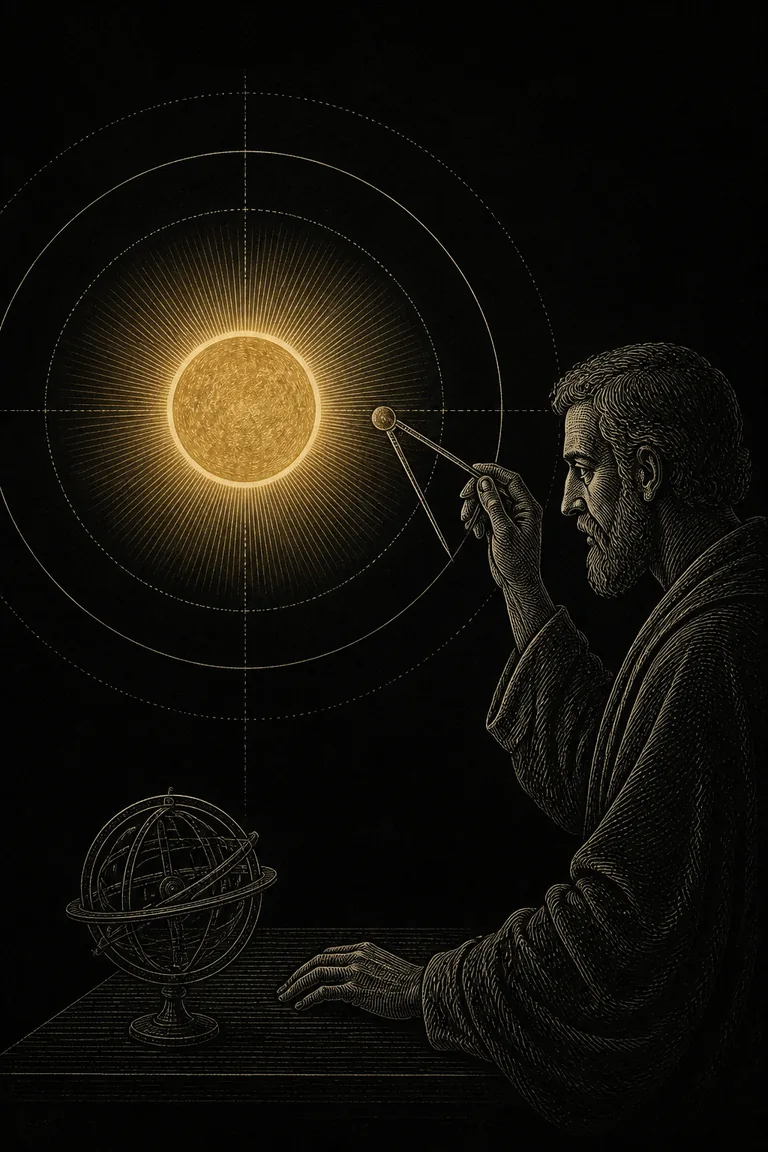
In astrology, a planet is combust when it is very close to the Sun but outside the narrower cazimi condition. A common traditional threshold places combustion within about 8 degrees 30 arcminutes of the Sun by zodiacal longitude, although historical sources and modern practitioners do not all use identical limits. Name the rule before applying it.
Combustion describes a planet's solar visibility and relationship to concentrated solar authority. It does not mean that the person is weak, invisible, dishonest, burned out, or doomed. The planet still has a sign, house, rulerships, dignity, reception, motion, phase, and aspects. A responsible interpretation keeps the technical condition specific and the conclusion proportional.
Take the next insight with you
Explore personalized Astrology guidance in Veritas, available for iOS and Android.
 Scan with your phone
What does combust mean in astrology?
Combust literally evokes burning, but the astronomical basis is visual concealment: a planet near the Sun is difficult or impossible to see in the bright sky. Traditional astrologers often treated this proximity as a serious accidental debility because the planet could not act openly on its own terms. The metaphor may suggest being overwhelmed, enclosed, subordinated, hidden, or absorbed by solar matters. Which meaning fits depends on what the planet signifies in that chart.
Record the visibility rule before interpreting
In Veritas, save the exact Sun and planet longitudes, separation, orb source, phase, motion, dignity, reception, and chart topics under review.
The common 8 degree 30 minute combustion orb
Many traditional practitioners use approximately 8 degrees 30 arcminutes from the Sun as the combustion boundary. This is a distance on the zodiac, not an allowance added separately to each body. Other authorities use nearby values or apply special rules to particular planets. Quote or name the method that governs your judgment. Software defaults are convenient, but a label without its configured threshold cannot be audited.
How to calculate combustion
- Record exact positions
Use the same chart, zodiac, and coordinate system for the Sun and planet.
- Convert to longitudes
Treat each sign as a 30-degree segment when the bodies cross a sign boundary.
- Find the shortest separation
Subtract the positions and use the smaller distance around the 360-degree circle.
- Test cazimi first
Apply your narrow cazimi threshold before calling the wider proximity combust.
- Apply the combustion boundary
Compare the remaining distance with the declared source and record borderline uncertainty.
Cazimi, combustion, and under the beams
These are related but distinct solar conditions. Cazimi is the extremely close heart-of-the-Sun condition, commonly tested at 17 arcminutes or less. Combustion occupies a wider zone outside cazimi, often to about 8 degrees 30 minutes. Under the beams extends farther, commonly to about 15 or 17 degrees depending on doctrine. The boundaries are conventional models of visibility, not three permanent personality types.
Applying and separating from the Sun
A planet applying to combustion is moving toward exact conjunction in zodiacal longitude, while a separating planet has passed the conjunction and is moving away. The distinction can describe entry into concealment versus emergence from it, especially in horary or electional work. Check daily motion and retrogradation rather than guessing from wheel position. A station can complicate the sequence, and Mercury or Venus may change apparent direction close to the Sun.
Superior and inferior conjunctions
Mercury and Venus can conjoin the Sun on the far side of the Sun from Earth, called a superior conjunction, or between Earth and the Sun, called an inferior conjunction. Both can be combust by longitude, but their phases differ. Inferior conjunction is associated with a transition from evening to morning visibility, while superior conjunction moves through another phase of the synodic cycle. Do not treat all Sun conjunctions as identical moments.
Mercury combust
Mercury is frequently close to the Sun because it never travels far from it in the sky. A combust Mercury can describe thought, speech, messages, trade, or technique operating under intense solar priorities, but it does not diagnose poor intelligence or dishonesty. Ask what Mercury rules, whether it is direct or retrograde, its sign dignity, reception from the Sun, house, speed, and observable communication pattern. Frequency does not make the condition meaningless, and proximity alone does not complete the reading.
Venus combust
A combust Venus can bring values, agreements, attraction, aesthetics, pleasure, or resources into a close solar context. It is not proof of low self-worth, hidden love, infidelity, artistic talent, or relationship failure. Consider whether Venus is morning or evening star, applying or separating, direct or retrograde, and what houses it rules. Real relationship judgment still requires consent, behavior, circumstances, and the testimony of the whole chart.
Mars, Jupiter, and Saturn combust
The superior planets can also be combust. Mars topics of action or conflict, Jupiter topics of judgment or expansion, and Saturn topics of limits or endurance may be enclosed by solar priorities or less independently visible. Yet a planet with strong dignity, helpful reception, angularity, or other support may operate differently from one with several constraints. Do not convert the condition into a prediction of illness, danger, failure, authority problems, or moral weakness.
Combustion and sign boundaries
Longitude can place the Sun and planet close across adjacent signs. Some traditional approaches require conjunction by bodily sign and may therefore treat a cross-sign proximity differently. Other approaches emphasize the measured solar distance. State the doctrine instead of switching rules to strengthen a preferred reading. If the Sun is at 29 degrees of one sign and a planet is at 1 degree of the next, a simple same-sign screen would miss their close physical longitude.
Does latitude change combustion?
Most chart software tests combustion by ecliptic longitude only. Actual visual proximity also depends on latitude, atmospheric conditions, and the planet's brightness. Some practitioners include latitude or distinguish a planet that is close in longitude but farther from the ecliptic. This can be a valuable refinement, but it should be disclosed. Do not describe a longitude convention as direct observational certainty.
Combustion and essential dignity
Combustion is an accidental condition, not an essential dignity. A combust planet may be in domicile, exaltation, triplicity, bound, or face, or it may be peregrine. Essential dignity describes resources or authority available through zodiacal position under a named scheme. Combustion describes solar proximity. A dignified planet does not become non-combust, and combustion does not erase every dignity. Keep separate testimonies separate before weighing them together.
Reception from the Sun
Reception can modify how the conjunction is judged. If the Sun occupies a sign where the combust planet has dignity, the planet may receive the Sun. If the planet occupies a solar dignity, the Sun may receive it. Traditional authors vary in how much protection or cooperation reception provides, so avoid a universal cancellation rule. Name the dignity and direction of reception, then test the interpretation against the actual question and other chart conditions.
Combust planets in a natal chart
In natal work, connect the combust planet to specific functions and house rulerships. Look for repeated, observable patterns: where does a solar identity, authority, purpose, visibility, or central commitment absorb the planet's work? Where does the function need privacy or a clearer independent channel? Avoid turning the placement into a fixed psychological defect. People develop strategies, environments change, and one configuration cannot summarize intelligence, worth, health, relationships, or career.
Combust planets in horary astrology
In horary, a combust significator may describe concealment, pressure, incapacity, fear, proximity to authority, or inability to act openly. The specific referent depends on the houses and question. Application, reception, translation, prohibition, and the condition of relevant rulers still matter. Combustion is not proof that someone lies, commits wrongdoing, is unsafe, or will lose. High-stakes claims require real evidence outside the chart.
Combustion in electional astrology
Electional practitioners often avoid combusting a planet that signifies the action, but no chart is perfect. First protect real scheduling, safety, legal, medical, financial, and logistical requirements. Then choose among workable times and identify which planetary function can tolerate concealment or close solar control. A planet emerging from the beams may fit a launch better than one moving deeper into invisibility, but the full election determines whether that symbolism is useful.
Worked example inside the combust zone
Suppose the Sun is at 14 degrees 20 minutes Libra and Venus is at 20 degrees 05 minutes Libra. Their separation is 5 degrees 45 minutes. Venus is outside a 17-minute cazimi orb and inside an 8-degree-30-minute combustion boundary. Next check whether Venus applies or separates, its speed, sect, house, rulerships, dignity, reception, and aspects. The distance establishes the condition, not its complete meaning.
Worked example under the beams but not combust
Suppose the Sun is at 3 degrees 10 minutes Capricorn and Saturn is at 14 degrees 25 minutes Capricorn. The separation is 11 degrees 15 minutes. Under a method using 8 degrees 30 minutes for combustion and 15 degrees for the beams, Saturn is under the beams but not combust. A software label based on a different outer boundary may disagree, so preserve the settings with the chart.
Build a complete solar-condition record
Use Veritas to compare distance, phase, motion, visibility rule, dignity, reception, sect, house, rulerships, aspects, evidence, and uncertainty before writing a bounded judgment.
A reliable combustion workflow
- Choose the doctrine
Name cazimi, combustion, and beam boundaries plus any sign or latitude rule.
- Verify chart data
Use accurate date, time, place, zodiac, and one set of planetary positions.
- Measure the separation
Calculate the shortest exact zodiacal distance, including cross-sign cases.
- Determine phase and motion
Check application, separation, speed, station, retrogradation, and synodic phase.
- Assess planetary resources
Add dignity, reception, sect, house, angularity, rulerships, and aspects.
- Tie meaning to one topic
Describe the relevant function without diagnosing a person or promising an event.
Common combustion mistakes
Do not call every Sun conjunction combust, forget to test cazimi, rely on rounded degree labels, ignore cross-sign distance, hide the chosen orb, or assume reception automatically cancels the condition. Avoid equating invisibility with worthlessness, secrecy with guilt, or heat with literal illness and burnout. Technical precision should narrow the claim. It should not provide a more elaborate route to certainty.