Astrology Journal
Cupido in Astrology: Asteroid 763 and Uranian Cupido
Cupido in astrology can refer to asteroid 763 or to a hypothetical Uranian point, so accurate interpretation begins by identifying which object and system a chart uses.
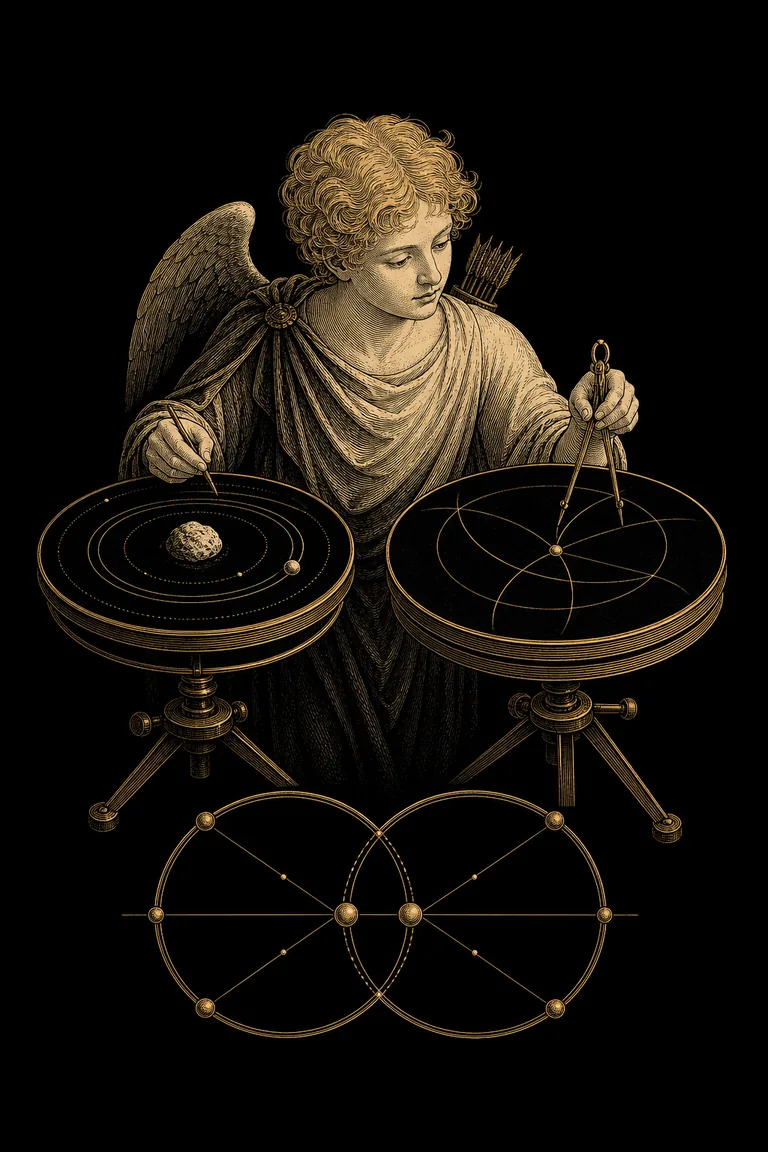
Cupido in astrology has two common meanings that should not be merged. Asteroid 763 Cupido is a physical minor planet used by some modern astrologers as a supplementary relationship symbol. Cupido in the Hamburg School or Uranian astrology is a hypothetical point with its own ephemeris and interpretive tradition, often associated with unions, groups, family, art, and social connection.
Before reading a sign, house, or aspect, inspect the chart label, object number, software documentation, zodiac, and house settings. Neither version replaces Venus, the Moon, relationship houses, chart rulers, or observed behavior. Cupido cannot prove attraction, marriage, artistic talent, compatibility, or another person's feelings.
Take the next insight with you
Explore personalized Astrology guidance in Veritas, available for iOS and Android.
 Scan with your phone
What Cupido means in astrology
For asteroid users, Cupido may add a narrow lens on attraction, relational exchange, courtship, or the image attached to being desired. In Uranian practice, Cupido has a broader technical vocabulary around association, partnership, family units, organizations, aesthetics, and shared culture. These meanings come from different lineages. The same name does not make the two chart factors interchangeable.
Verify the object before the meaning
Open your astrology profile in Veritas, record the chart settings, and compare Cupido themes with Venus, the Moon, relationship houses, and close aspects.
Asteroid 763 and Uranian Cupido are different
Asteroid 763 Cupido was discovered in 1913 and has an astronomical orbit. A chart tool may list it by name and number. Uranian Cupido is one of the hypothetical trans-Neptunian factors used in the Hamburg School; its calculated position belongs to that symbolic framework. If a source does not state which Cupido it uses, its interpretation cannot be reproduced reliably.
How to identify Cupido in your chart
- Read the label
Look for asteroid number 763 or for a Uranian or Hamburg School object list.
- Check the software
Use the program's documentation instead of assuming that every Cupido glyph means the same factor.
- Record the settings
Note zodiac, house system, birth-time source, coordinates, and aspect or midpoint rules.
- Choose one tradition
Interpret the object within its own method before comparing it with another system.
Asteroid Cupido through the signs
If you work with asteroid 763, the sign can describe a style of attraction or relational presentation. Aries may prefer direct pursuit, Taurus tangible consistency, Gemini lively exchange, and Cancer protective familiarity. Leo can make courtship expressive, Virgo attentive, Libra reciprocal, and Scorpio private or intense. Sagittarius seeks shared horizons, Capricorn dependable form, Aquarius spacious association, and Pisces imaginative tenderness. These are prompts, not measures of desirability.
Asteroid Cupido through the houses
The house locates the life area where Cupido themes become noticeable. The first concerns presentation; the second values and resources; the third communication; the fourth home and belonging. The fifth highlights romance or creativity, the sixth daily cooperation, the seventh agreements, and the eighth trust and shared stakes. The ninth connects through learning, the tenth public roles, the eleventh groups, and the twelfth private patterns.
Asteroid Cupido aspects
A close contact with the Sun may connect attraction with identity, while the Moon emphasizes emotional familiarity. Mercury can bring verbal chemistry or projection onto messages; Venus reinforces values and aesthetic exchange; Mars adds pursuit and initiative. Saturn can clarify commitment or inhibition, Uranus independence, Neptune idealization, and Pluto power or intensity. Keep asteroid orbs narrow and prioritize contacts tied to core chart factors.
Cupido in synastry
In synastry, a close asteroid Cupido contact may make courtship, attractiveness, or relational image especially noticeable. A Uranian practitioner may read Cupido contacts or midpoint structures through union, family, group, or artistic themes. Neither method establishes mutual consent, permanence, or safety. Compare both natal charts, the full synastry pattern, and what each person actually communicates and does.
Cupido transits and timing
An asteroid Cupido transit can be used as a reflective prompt when it closely contacts a natal planet or angle, drawing attention to attraction, presentation, or reciprocity. Uranian astrology applies its own techniques, including hard aspects and midpoint pictures. A transit does not schedule a relationship or guarantee a reunion. Define the method before interpreting the timing.
Uranian Cupido in practice
Within the Hamburg School, Cupido is often read through structures of association: couples, families, teams, organizations, artistic circles, and the social forms that join people. Practitioners may use a 90-degree dial, midpoints, and symmetrical planetary pictures rather than a standard sign-only description. Applying isolated asteroid keywords to that work removes the technical context that gives the point meaning.
Turn symbolism into an observable question
Use Veritas to identify one Cupido theme, then ask what shared value, agreement, boundary, or act of reciprocity would confirm it in real life.
Cupido compared with Venus and Amor
Venus is a core planetary function involving values, pleasure, attraction, and relating. Asteroid Amor is commonly used for chosen affection and the manner of care. Asteroid Cupido is narrower and may emphasize attraction, exchange, or relational presentation, while Uranian Cupido belongs to a separate vocabulary of unions and associations. More factors do not automatically make a reading more accurate.
Birth time, orbs, and reproducibility
Without a reliable birth time, Cupido's house and angular contacts may be wrong even when its zodiac position is usable. Asteroid readers often begin with an orb of about one to three degrees, while Uranian methods may use different tight tolerances for dials and midpoint pictures. State the object, ephemeris, zodiac, time source, and orb. If another reader cannot identify the calculation, the claim is too vague.
Common Cupido interpretation mistakes
Do not silently combine asteroid 763 with Uranian Cupido, confuse either with the Roman god as a literal prediction, or use a contact to declare soulmates. Avoid broad orbs, unknown birth times presented as exact houses, and selective chart factors used to override refusal or incompatible behavior. Cupido is useful when careful object identification leads to a bounded question, not a dramatic verdict.
Questions for interpreting Cupido
- Which Cupido is this?
Name asteroid 763 or the Uranian hypothetical point before using any keyword.
- What method applies?
Use signs, houses, aspects, dials, or midpoints only as the chosen tradition defines them.
- What is being associated?
Identify the relationship, group, aesthetic, value, or social form suggested by the context.
- What confirms it?
Look for consent, reciprocity, agreements, sustained behavior, and the rest of the chart.