Astrology Journal
Astrology Aspects Explained: Conjunctions, Squares, Trines, and More
Astrology aspects describe the angles between planets in a birth chart. Learn how conjunctions, oppositions, squares, trines, and sextiles connect planetary functions.
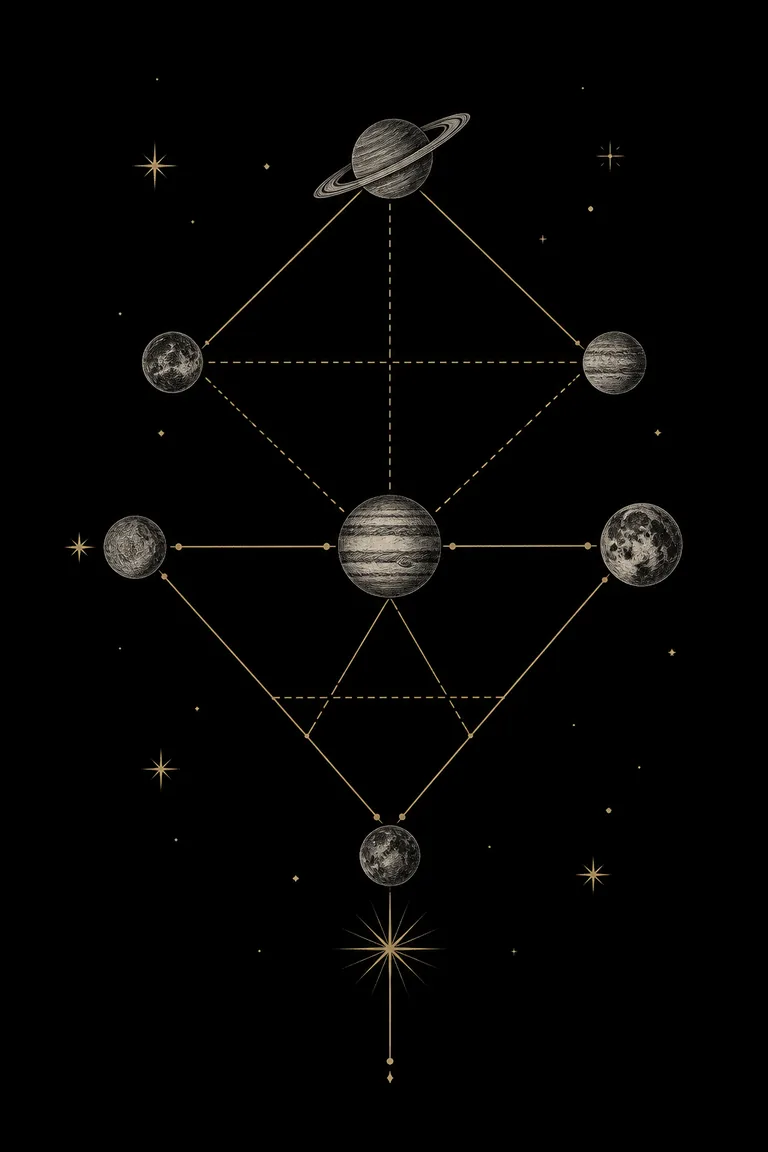
Astrology aspects are angular relationships between planets. They show whether two planetary functions merge, confront one another, create friction, or cooperate with relative ease. Aspects turn a list of placements into a connected chart.
The five major aspects are the conjunction, opposition, square, trine, and sextile. None is simply good or bad. A flowing aspect can become passive, while a tense aspect can produce skill through repeated effort. The planets involved tell you what is interacting.
Take the next insight with you
Explore personalized Astrology guidance in Veritas, available for iOS and Android.
 Scan with your phone
What is an aspect in astrology?
A chart places planets around a 360-degree circle. When two planets are separated by a meaningful angle, astrologers call that relationship an aspect. A Sun at 10 degrees Aries and Moon at 10 degrees Libra are about 180 degrees apart, forming an opposition.
The angle gives the relationship a structure. The planets name the needs or functions involved, the signs show how each function acts, and the houses show where the pattern becomes visible in life.
The five major astrology aspects
Conjunction
Two planets occupy nearly the same place and act as a combined unit. Their functions intensify and can be difficult to separate. Compatibility depends on the planets involved.
Opposition
Two planets face each other across the chart. The aspect asks for awareness, negotiation, and balance between needs that may first be projected onto other people.
Square
The planets push from conflicting directions. Friction demands action and adjustment, often building competence because the issue cannot be ignored.
Trine
The functions support one another through signs of the same element. Talent and ease are available, though conscious use is still required.
Sextile
The planets offer a workable opening between compatible elements. Opportunity grows through participation rather than operating entirely on its own.
See the conversations inside your chart
Create your birth chart in Veritas and trace how its planets connect through major aspects, signs, and houses.
How to read an aspect step by step
- Name both planets
Translate each planet into a function. Venus relates to attraction and values; Saturn relates to limits, time, and responsibility.
- Describe the angle
A square creates friction, a trine facilitates flow, and an opposition requires integration across a polarity.
- Add signs and houses
Signs describe the style of each planet. Houses locate the life areas where their relationship repeatedly appears.
- Write one complete sentence
For Venus square Saturn, attraction and connection may meet caution, standards, or fear of rejection, creating work around trust and commitment.
Conjunctions amplify a shared location
A Mercury-Mars conjunction combines thought and assertion. It can produce direct speech, quick decisions, and argumentative speed. A Moon-Jupiter conjunction enlarges emotional response, generosity, and the need for meaning. The conjunction itself is neutral; the planetary pair defines its character.
Squares and oppositions create productive tension
Squares often feel internal and immediate. Sun square Moon can describe tension between conscious direction and emotional habit. Oppositions are easier to experience through relationships. Venus opposite Uranus may alternate between closeness and freedom until both needs receive a place.
Tense aspects do not condemn a chart. They identify a recurring problem that can become a practiced capacity. The goal is not to remove the tension but to make more conscious choices within it.
Trines and sextiles need participation
A Mercury-Jupiter trine may support synthesis, teaching, and broad perspective, but ease can become overconfidence. A Mars-Saturn sextile can support disciplined action when the person chooses a plan and follows it. Flow is a resource, not a guarantee of results.
What is an orb?
An orb is the distance from an exact aspect. If two planets are 93 degrees apart, their square has a three-degree orb. Smaller orbs usually read more strongly. Astrologers allow wider orbs for the Sun and Moon and for major aspects, but exact limits vary by school.
For a first reading, prioritize close major aspects rather than interpreting every possible line. A chart with fewer selected connections is easier to understand than one covered by minor aspects with generous orbs.
Applying and separating aspects
An applying aspect is moving toward exactness, while a separating aspect has passed exactness. This distinction is especially important in predictive and traditional techniques. In a natal overview, it is a refinement after the planetary pair, aspect type, signs, and houses are clear.
Aspect patterns and repeated themes
Several aspects can form a larger figure such as a T-square or grand trine. Read the individual relationships first. Then ask which planet carries the most connections and which houses repeat. The pattern should summarize existing evidence rather than replace it with a dramatic label.
Astrology is a symbolic interpretive tradition, not a scientifically validated method for predicting personality or events. Use aspects as prompts for reflection, not as reasons to diagnose someone or surrender responsibility for a decision.