Astrology Journal
Dispositor in Astrology: Chains and Final Dispositors
A dispositor is the planet that rules the sign occupied by another planet. Tracing dispositors creates a chain of planetary hosts that can clarify how chart functions depend on, redirect, or support one another.
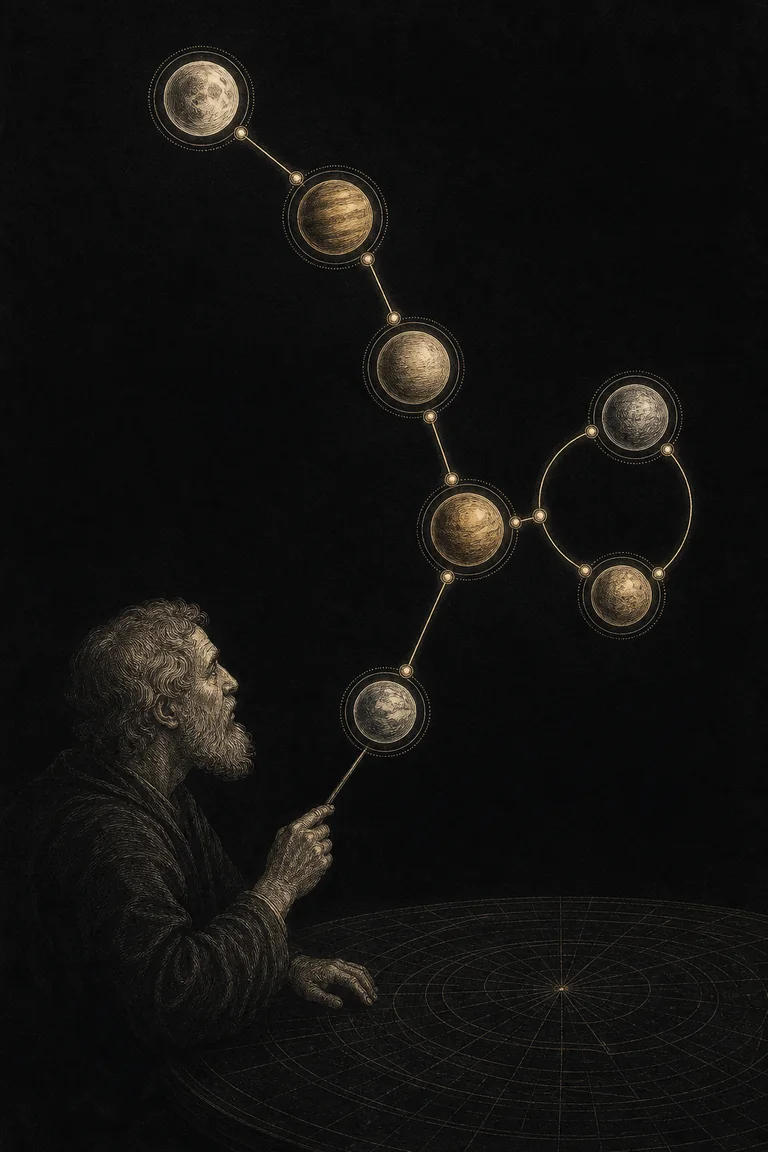
A dispositor in astrology is the ruler of the sign where a planet is placed. If Mercury is in Aries, Mars disposits Mercury because Mars rules Aries. If Mars is in Cancer, the Moon disposits Mars. Following each ruler in turn produces a dispositor chain. The chain can end with a planet in its own sign, form a mutual reception loop, or continue through a larger closed circuit.
Dispositors show a routing relationship, not a ranking of human worth or a guarantee that one planet controls the entire chart. The method depends on the rulership scheme you declare. Traditional rulership gives Mars to Scorpio, Saturn to Aquarius, and Jupiter to Pisces. Many modern astrologers use Pluto, Uranus, and Neptune as rulers or co-rulers. Different choices can produce different chains, so record the system before interpreting.
Take the next insight with you
Explore personalized Astrology guidance in Veritas, available for iOS and Android.
 Scan with your phone
Dispositors at a glance
Sign rulers used for dispositors
In the traditional scheme, the Sun rules Leo and the Moon rules Cancer. Mercury rules Gemini and Virgo; Venus rules Taurus and Libra; Mars rules Aries and Scorpio; Jupiter rules Sagittarius and Pisces; Saturn rules Capricorn and Aquarius. A modern scheme commonly assigns Pluto to Scorpio, Neptune to Pisces, and Uranus to Aquarius, sometimes while retaining the traditional ruler as a co-ruler. Either approach can be internally consistent. Problems arise when rulerships are switched mid-chain without explanation.
How to trace a dispositor chain
- List each planet and sign
Use accurate chart positions and decide whether angles or other points belong in your exercise.
- Name the sign ruler
Apply one declared traditional or modern rulership table consistently.
- Follow the ruler
Find the sign occupied by that ruler, then identify its ruler.
- Stop at an endpoint or loop
A domicile planet disposits itself; repeated planets reveal a closed circuit.
- Add chart context
Judge condition, aspects, houses ruled, houses occupied, sect, speed, and solar relationship.
A worked dispositor-chain example
Suppose Mercury is in Aries, Mars is in Cancer, the Moon is in Taurus, and Venus is in Libra. Mars disposits Mercury because Mars rules Aries. The Moon disposits Mars because the Moon rules Cancer. Venus disposits the Moon because Venus rules Taurus. Venus is in Libra, one of its own domiciles, so Venus disposits itself and becomes the final dispositor for this chain. The sequence is Mercury to Mars to Moon to Venus. Interpretation begins only after the chain is correct.
How to interpret the worked chain
Mercury's thinking and speech first route through Mars, so initiative, conflict, urgency, or assertion may shape expression. Mars then routes through the Moon, tying action to safety, habit, body, home, or changing conditions. The Moon routes through Venus, bringing values, agreements, attraction, proportion, or resources into the sequence. This does not make Venus automatically strong or beneficial. Its house, aspects, sect status, speed, and other conditions determine how well it can receive the chain.
What is a final dispositor?
A final dispositor is a planet in its own sign that stands at the end of one or more chains. If every traditional planet eventually routes to the same domicile planet, some astrologers call it the sole final dispositor. That concentration can make the planet an important coordinator, but it does not turn it into the chart ruler or erase contrary testimony. Many charts have several endpoints, mutual receptions, or longer loops and therefore no sole final dispositor. Absence of one is normal.
Mutual reception and closed loops
A mutual reception by domicile creates a two-planet loop. Mercury in Aries and Mars in Gemini route to one another, so neither reaches a separate planet in domicile. Longer loops are also possible. A loop indicates that the involved functions repeatedly answer to one another. It may support coordination, dependency, tension, or circulation depending on condition and connection. Reception adds a hosting relationship, but an applying aspect or other testimony may still matter in horary and event-oriented techniques.
Traditional versus modern dispositors
Traditional rulership produces a closed system with the seven visible planets. Modern rulership can redirect Scorpio, Aquarius, and Pisces chains to Pluto, Uranus, and Neptune. Some astrologers trace both and compare the results, treating the traditional ruler as the practical manager and the outer planet as a broader background process. If you do this, keep the two maps visible instead of combining them into an undocumented hybrid. The useful question is whether the chosen scheme improves a specific, testable interpretation.
Dispositors, houses, and aspects
A sign-based chain tells you who hosts whom. Houses tell you where the planets operate and what topics they rule. Aspects describe contact, ease, conflict, or lack of direct connection. A well-placed dispositor may have resources to support the planets that depend on it. A pressured dispositor may route several topics through the same bottleneck. Even then, avoid fatalism. Difficult condition can describe effort, delay, specialization, responsibility, or competing demands rather than inevitable failure.
Dispositor versus chart ruler and dominant planet
The chart ruler is the ruler of the Ascendant. A dispositor rules the sign occupied by a particular planet. A final dispositor receives a chain, while a so-called dominant planet is a broader synthesis produced by a chosen scoring or interpretive method. One planet can hold several of these roles, but the terms are not synonyms. Naming the exact role prevents a useful technical observation from becoming a vague claim that one planet is the most powerful.
Build the routing map before interpreting it
Use Veritas to record every planet, sign, sign ruler, chain endpoint, loop, house, aspect, and condition, then compare the map with specific recurring situations.
A practical interpretation method
- Declare the scheme
State whether you use traditional rulers, modern rulers, or two separate comparison maps.
- Audit the chain
Check every sign-to-ruler step and mark endpoints or loops before adding meaning.
- Judge each host
Assess dignity, house, sect, speed, solar condition, and aspects without reducing them to one score.
- Trace the topics
Follow both occupied houses and ruled houses to see which life areas become connected.
- Test a modest claim
Describe one likely routing pattern and compare it with behavior or events instead of declaring destiny.
Common dispositor mistakes
Do not stop after naming a final dispositor and call the chart solved. Do not assume domicile makes a planet morally good, easy, or all-powerful. Do not mix rulership schemes invisibly, confuse dispositors with aspects, or force a sole endpoint where the chart contains a loop. Dispositor analysis is a symbolic astrological technique, not scientific proof of personality, compatibility, health, money, or future events. Keep the chain auditable and claims proportional to the rest of the chart.