Astrology Journal
Echo in Astrology: Asteroid 60, Signs, Houses, and Aspects
Asteroid 60 Echo is an optional modern chart factor used to explore voice, repetition, response, quotation, and whether communication becomes a reciprocal exchange.
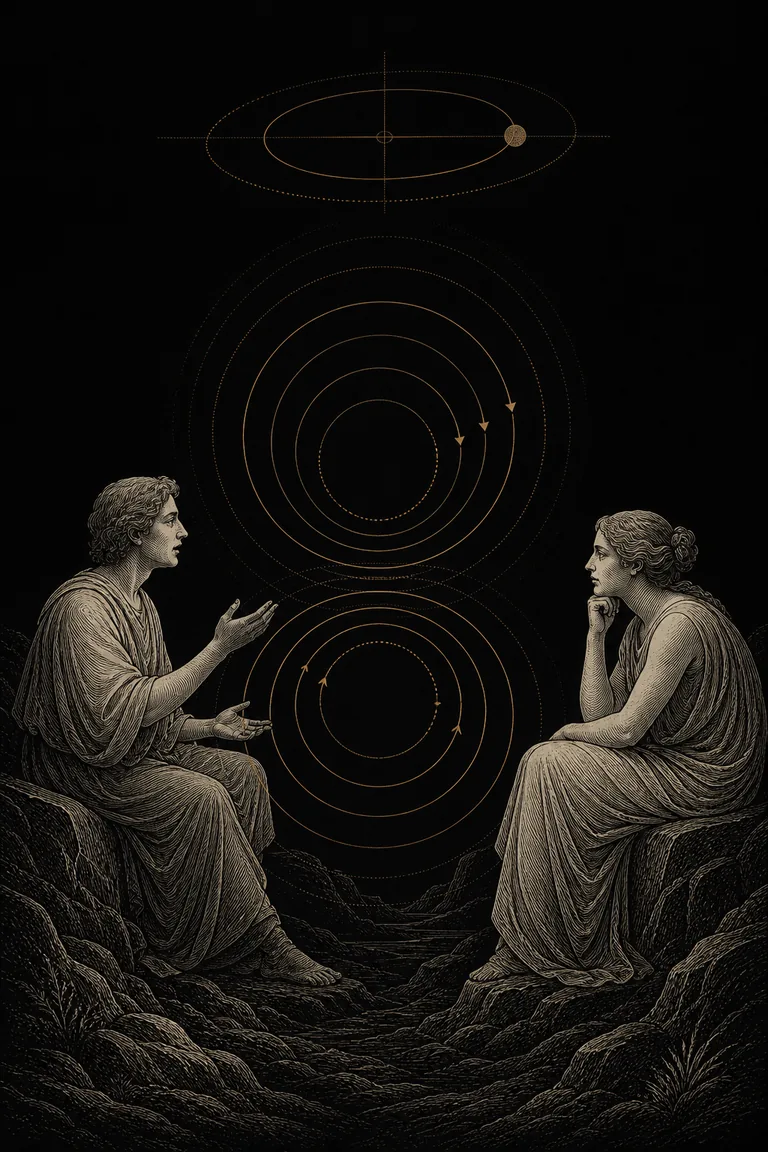
Echo in astrology usually refers to asteroid 60 Echo, a main-belt minor planet discovered by James Ferguson in Washington on September 14, 1860. Modern asteroid astrologers may use its mythic name as a narrow prompt about repeating language, reflecting another person, finding an independent voice, receiving a response, or noticing which messages continue to circulate.
Echo is not a classical planet and does not diagnose speech, hearing, memory, trauma, or relationship behavior. It cannot prove that someone is ignored, imitative, telepathic, or destined to repeat a pattern. Read the planets, angles, houses, and major aspects first. Then test whether a close Echo placement adds a useful question about communication that observable experience can answer.
Take the next insight with you
Explore personalized Astrology guidance in Veritas, available for iOS and Android.
 Scan with your phone
What Echo means in astrology
In Greek myth, Echo is a nymph whose speech becomes limited to repeating the words of others. Contemporary asteroid practice often develops that story into themes of voice, repetition, response, quotation, mirroring, and the difference between reflecting a message and authoring one. A grounded interpretation can ask what keeps returning in conversation, whose language is being carried, whether listening is reciprocal, and what original contribution is ready to be expressed.
Place the echo in the whole chart
Use Veritas to compare asteroid 60 Echo with your planets, angles, houses, and major aspects before giving one named asteroid interpretive weight.
Asteroid 60 Echo and its name
The Minor Planet Center identifies the object as (60) Echo and records its 1860 discovery by James Ferguson. It was initially called Titania before the duplication with a Uranian moon was recognized and the name Echo was adopted. The astronomical facts identify the object; they do not establish an astrological meaning. Modern interpretation comes from symbolic association with the name and myth, so the method should be labeled as optional rather than presented as ancient doctrine.
How to find asteroid Echo
Use chart software that accepts minor-planet numbers and enter 60 for Echo. Verify the object number, exact degree, zodiac, house system, aspect orb, and birth-time source. The sign and degree are usually stable without an exact birth time, while the house and contacts to the Ascendant, Midheaven, Descendant, and Imum Coeli may change. Do not confuse asteroid Echo with an asteroid family, an astronomy service, or an unlabeled point from another chart system.
Echo by sign
The sign can describe the style through which repetition and response become noticeable. Fire signs may amplify, perform, or answer through action. Earth signs may repeat what is practical, proven, or materially reinforced. Air signs may circulate phrases, questions, and competing interpretations. Water signs may carry emotional tone, memory, and implied meaning. No element determines originality or communication skill. The useful question is how the style can move from automatic reflection toward conscious response.
Echo through all 12 signs
Aries may answer quickly and need space for a second thought; Taurus, repeat what feels stable until new evidence becomes tangible; Gemini, trace how a phrase changes across tellings; Cancer, notice inherited emotional language; Leo, distinguish authentic expression from applause; Virgo, edit repetition into useful precision; Libra, hear both response and self-silencing; Scorpio, track confidential or charged subtext; Sagittarius, test the story behind a repeated belief; Capricorn, examine institutional language; Aquarius, notice ideas amplified by a network; and Pisces, give subtle impressions clear boundaries and attribution.
Echo by house
The house locates the life area where voice and response may become most visible. The first can concern self-definition; second, repeated value messages; third, everyday communication; fourth, family phrases and memory; fifth, creative response; sixth, workplace instructions and routines; seventh, mirroring in agreements; eighth, confidential narratives; ninth, teaching and belief; tenth, public reputation and quoted authority; eleventh, group amplification; and twelfth, internalized or unspoken language. These are prompts for inquiry, not promised events.
Echo aspects
A conjunction can concentrate Echo themes around a planet or angle. An opposition may make speaker and responder feel polarized. A square can add friction around attribution, timing, or being heard, while a trine or sextile may make reflection and adaptation more available without guaranteeing clear communication. With Mercury, wording and learning become central; Venus, agreement and social response; Saturn, authority and repeated rules; Neptune, imagination and projection; Kassandra, the audience response to a difficult perception. The planet remains primary.
Echo in synastry
In synastry, a close Echo contact may symbolize a relationship in which one person repeats, validates, challenges, or gives new form to the other's language. It can feel like being understood, quoted, imitated, or talked over, depending on behavior and the wider chart. The contact does not prove a soulmate bond, manipulation, plagiarism, silence, or unequal power. Compare consent, attribution, conversational turn-taking, and what each person does when the other disagrees.
Echo transits
An Echo transit can be used as a minor timing prompt when it closely contacts a natal planet or angle. A phrase may return, a previous message may receive a reply, or a communication habit may become easier to observe. Minor-asteroid contacts are frequent and do not cause events. Record the exact date, orb, repeated content, source, and later outcome. Give slower planetary transits and current circumstances greater interpretive weight.
Echo compared with Mercury and Kassandra
Mercury is a core planetary function associated with language, learning, exchange, and interpretation. Kassandra offers a narrower optional lens on consequential perception, warning, credibility, and audience response. Echo focuses more specifically on repetition, reflection, quotation, and the reply itself. None of these symbols can replace direct communication. Echo should add one precise question to the chart, not become a catch-all explanation for every experience of speaking or being heard.
Audit the response pattern
Use Veritas to identify the message, its source, what was repeated, what changed in transmission, and which original response would improve the exchange.
Birth time and aspect orbs
Without a reliable birth time, avoid confident house interpretation and angle contacts. For a minor asteroid, many practitioners begin with narrow orbs around one to three degrees and widen only when several chart factors repeat the same theme. State the orb and method before interpreting. A contact selected after an emotionally memorable conversation can easily create hindsight bias, so prospective notes are more useful than a story built afterward.
A practical response audit
- Capture the exact message
Write what was said or sent before summarizing its tone, motive, or meaning.
- Trace the source
Identify which words are yours, which were inherited or quoted, and where attribution is needed.
- Name the wanted response
Ask whether the exchange needs acknowledgment, information, disagreement, action, or space.
- Add one original sentence
Move beyond automatic repetition by stating your present view in language you can revise.
Common Echo interpretation mistakes
Do not use asteroid 60 to diagnose echolalia, hearing loss, a communication disorder, narcissism, trauma, or an inability to think independently. Do not treat repeated numbers, songs, or phrases as supernatural proof. Avoid blaming a person for not responding in the desired way or using myth to romanticize self-erasure. Echo is most useful when it improves attribution, listening, conversational choice, and the ability to answer rather than merely repeat.