Astrology Journal
Eris in Astrology: Signs, Houses, Aspects, and Meaning
Eris is a very slow modern chart factor used to examine discord, exclusion, contested legitimacy, and the rules a conflict exposes.
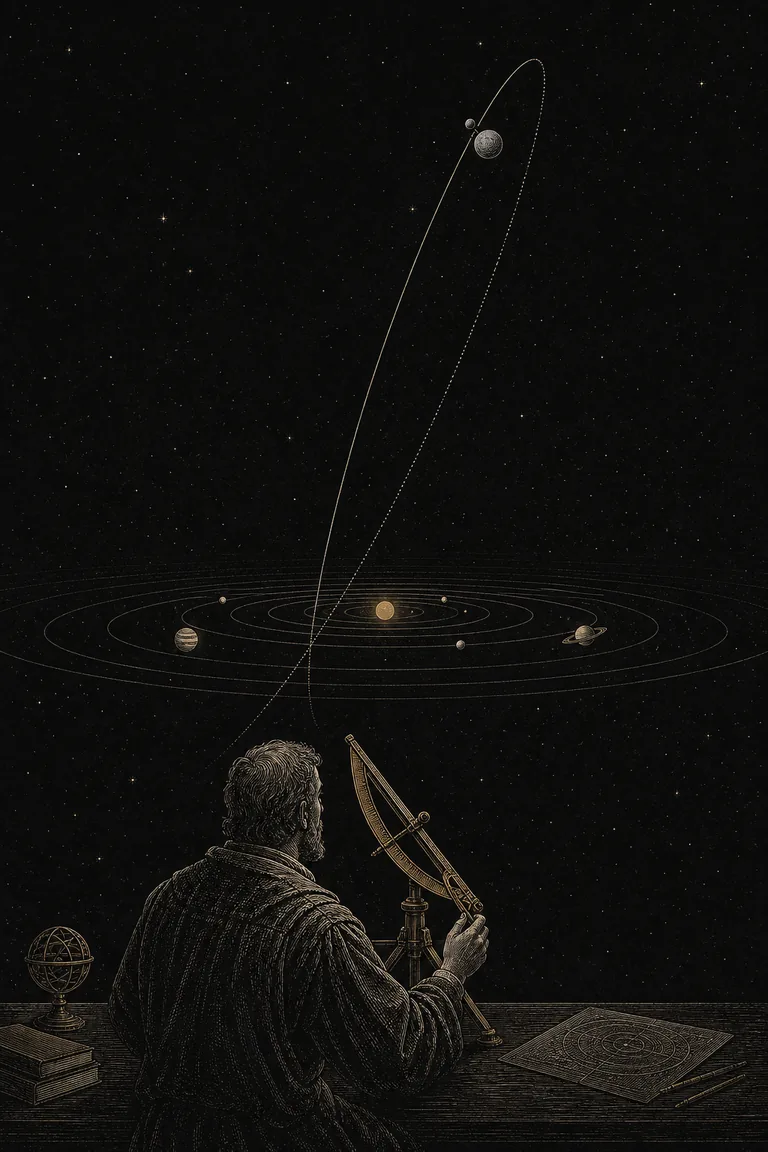
Eris in astrology refers to the distant dwarf planet named for the Greek goddess of strife and discord. Astronomers announced its discovery in 2005 after identifying it in images taken in 2003. Its discovery helped trigger the debate that produced the International Astronomical Union's 2006 planet definition. Modern astrologers often connect Eris with disruption, rivalry, exclusion, and a demand to recognize what an established order leaves outside.
Eris takes about 557 Earth years to orbit the Sun, so its zodiac sign is shared by large cohorts and cannot explain an individual personality by itself. It does not predict violence, war, rejection, protest, divorce, or social status. Read its house, close aspects, angles, chart rulership, and repeated themes alongside the planets. Its best use is to identify the rule under dispute and ask whether the response creates fairer participation or only more damage.
Take the next insight with you
Explore personalized Astrology guidance in Veritas, available for iOS and Android.
 Scan with your phone
What Eris means in astrology
Astrologically, Eris can be used as a lens on discord that exposes an unresolved allocation of voice, status, access, or legitimacy. The mythic Eris was not invited to a wedding and introduced the object that intensified an existing rivalry. A grounded reading does not glorify provocation or cast one person as a permanent outsider. It asks what prior exclusion, competition, or unspoken rule made the dispute combustible and what form of participation can withstand scrutiny.
Place Eris in the whole chart
Use Veritas to compare Eris with your planets, angles, houses, and major aspects before giving one distant body personal weight.
The dwarf planet Eris and its discovery
NASA describes Eris as a dwarf planet discovered on January 5, 2005, in data recorded on October 21, 2003, by Mike Brown, Chad Trujillo, and David Rabinowitz at Palomar Observatory. It has one known moon, Dysnomia, and an orbit that is highly inclined to the main planetary plane. Its 557-year revolution and role in the planet-definition debate are astronomical facts. The astrological meanings attached to its name and discovery story are modern symbolic interpretations, not scientific findings.
How to find Eris in a birth chart
Use chart software that includes Eris as dwarf planet 136199 or allows its name to be selected. Record its exact degree, zodiac, house system, aspects, and birth-time source. Because Eris moves slowly, people born many years apart can share its sign. The house and contacts to the Ascendant, Midheaven, Descendant, or Imum Coeli can change with birth time, so do not make confident angle or house claims when the time is uncertain.
Eris through all 12 signs
An Eris sign describes a long collective style of contest rather than a personal trait. Aries may expose rules around initiative and force; Taurus, ownership and material access; Gemini, information and voice; Cancer, belonging and protection; Leo, recognition and creative authority; Virgo, labor and standards; Libra, fairness and representation; Scorpio, secrecy and shared power; Sagittarius, doctrine and cultural reach; Capricorn, institutions and rank; Aquarius, networks and membership; and Pisces, compassion, sacrifice, or blurred boundaries. Personalize only through the rest of the chart.
Eris by house
The house can show where questions of inclusion and contested authority become more personally visible. The first concerns identity and the right to act; second, resources and value; third, speech and local knowledge; fourth, family and belonging; fifth, creative recognition; sixth, labor and service; seventh, agreements and opponents; eighth, shared assets and consent; ninth, doctrine and access to knowledge; tenth, public authority; eleventh, group membership; and twelfth, hidden exclusion or unacknowledged conflict.
Eris aspects in the birth chart
A conjunction concentrates Eris themes around a planet or angle. An opposition may stage the contested rule through another person or institution. A square can make competing claims difficult to ignore, while a trine or sextile may make dissent or coalition-building easier without guaranteeing fairness. Because Eris is so slow, aspects to other slow bodies can describe a cohort. Close contacts to personal planets and angles are usually more individual, but the planet remains the primary symbol.
Eris with the Sun, Moon, Mercury, Venus, and Mars
With the Sun, recognition and authority may become the disputed field. The Moon can bring belonging, care, and inherited loyalties into focus. Mercury may emphasize who is heard, quoted, or allowed to define terms. Venus can raise questions about value, alliance, and social access. Mars can sharpen action, competition, and boundary enforcement. None of these aspects proves a combative personality. Examine orb, aspect type, house, other chart factors, and actual behavior.
Eris in synastry
In synastry, a close Eris contact may describe a relationship that makes an unequal rule, excluded need, or competition for recognition harder to avoid. This can support honest renegotiation or fuel repeated provocation. The aspect does not prove abuse, betrayal, jealousy, incompatibility, or a fated bond. Compare consent, power, material dependence, repair attempts, and whether each person can disagree without punishment.
Eris transits
Eris transits unfold slowly. A close contact to a natal planet or angle may be used as a long review period for participation, dissent, or a rule that no longer feels legitimate. Faster planets can mark shorter moments within that period, but astrology cannot establish cause or guarantee an event. Track exact dates, retrograde passes, decisions, observable conditions, and outcomes. Give current facts and qualified advice more weight than symbolic timing.
Eris compared with Pluto, Uranus, and Black Moon Lilith
Pluto is often associated with deep power, compulsion, elimination, and regeneration. Uranus concerns disruption, invention, autonomy, and breaks with convention. Black Moon Lilith is a calculated lunar-apogee point often used for questions of refusal, taboo, or disowned instinct. Eris is narrower: it highlights contested membership, rivalry, and the rule revealed by discord. These symbols can overlap, but they are not substitutes and should not be merged into one story of rebellion.
Birth time, orbs, and generational limits
Without a reliable birth time, avoid firm house and angle interpretations. Astrologers use different Eris orbs, so state the method before reading; a narrow orb is easier to evaluate, especially for personal planets and angles. Sign-only interpretations are weak because Eris remains in a region of the zodiac for generations. Avoid selecting Eris only after a dramatic conflict, since hindsight can make any symbolic story appear more exact than it was.
Audit the rule beneath the conflict
Use Veritas to name the contested rule, the affected people, the evidence, the cost of escalation, and one revision that can be reviewed.
A practical Eris rule audit
- State the rule
Write the formal policy or informal expectation that is being contested.
- Map participation
Identify who made the rule, who benefits, who carries its cost, and who lacks a voice.
- Separate claim from tactic
Evaluate the underlying need independently from the method used to demand attention.
- Design accountable revision
Choose a change, safeguard, decision owner, and review date that can be tested.
Common Eris interpretation mistakes
Do not predict war, violence, divorce, public disgrace, rejection, activism, or a personality disorder from Eris. Do not romanticize chaos, excuse cruelty as truth-telling, or assume the excluded party is automatically correct. Avoid making a generation-wide sign placement sound personally unique. Eris is most useful when discord becomes evidence about a rule and the interpretation remains answerable to consent, consequences, and the full chart.