Astrology Journal
Haumea in Astrology: Signs, Houses, Aspects, and Meaning
Haumea is an optional modern chart factor for examining formation under pressure, rapid reorganization, regeneration, lineage, and the structures that make renewal sustainable.
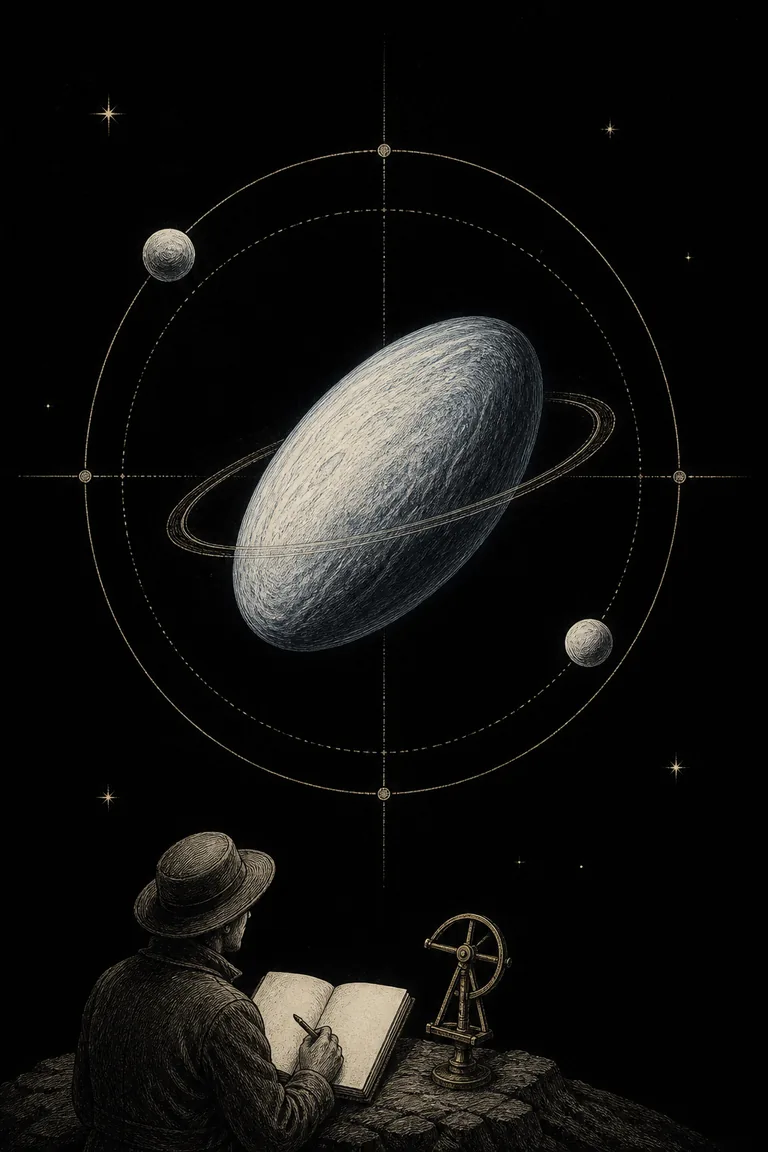
Haumea in astrology refers to dwarf planet 136108 in the Kuiper Belt. It rotates in about four hours, has an elongated shape, a ring, and two known moons. Haumea was named for a Hawaiian deity associated with birth and fertility. Some modern astrologers use the object as a secondary symbol for formation, regeneration, creative pressure, lineage, and the capacity to make a viable new structure after disruption.
This symbolism is recent, variable, and not scientifically validated. An astronomical name does not grant access to Hawaiian religion, ancestry, or spiritual authority. Haumea moves slowly, so its sign is generational. Personal relevance needs a close aspect, reliable birth data for houses and angles, repeated themes elsewhere in the chart, and evidence from lived experience.
Take the next insight with you
Explore personalized Astrology guidance in Veritas, available for iOS and Android.
 Scan with your phone
What Haumea means in astrology
A careful Haumea interpretation focuses on the relationship between pressure and form. It can help explore processes that regenerate, reorganize, or produce something viable from changed conditions. Constructively, the symbol supports adaptive creation and respect for lineage. Its shadow can romanticize crisis, demand endless productivity, or call a cosmetic rebrand a rebirth. Treat the placement as a hypothesis that must earn relevance within the whole chart.
Keep the dwarf planet in proportion
Use Veritas to compare Haumea with major planets, angles, houses, and exact aspects before giving it personal weight.
Haumea astronomy and interpretive limits
NASA describes Haumea as an elongated, rapidly rotating dwarf planet beyond Neptune. It completes an orbit in roughly 285 Earth years and a rotation in about four hours. Its two known moons are Hi'iaka and Namaka, and observations have revealed a ring. These facts explain why formation, spin, family, and structure attract symbolic attention. They do not prove any astrological meaning or personal trait.
Why Haumea is associated with regeneration
Modern interpretations often connect Haumea with birth, regeneration, and the production of new form. The astronomical body's rapid spin, unusual shape, moons, ring, and related family of icy objects offer additional metaphors for formation under pressure. Metaphor is not causation. Renewal should not be used to make loss seem necessary, erase grief, or promise that every disruption produces a benefit.
Haumea sign meaning
Haumea by sign can describe a broad cohort's style of reorganizing inherited structures, imagining renewal, and defining what deserves continuity. Because many years share the same sign, it should not become an individualized identity label. Verify the position with an ephemeris that includes object 136108, then look for a close contact to a major planet or angle before making the sign personally significant.
Haumea house meaning
The house may locate the life area where regeneration, lineage, and new structure become concrete. Accurate birth time matters because the house and angles can change while Haumea barely moves. Without reliable time, omit the house. The placement does not guarantee fertility, pregnancy, recovery, or creative success. It offers questions about what is changing form and what support the next form actually needs.
Haumea through the twelve houses
In the first house, Haumea can raise questions about reshaping identity; in the second, rebuilding resources and value; in the third, renewing language or learning; and in the fourth, family structure and lineage. The fifth may focus on creative production, the sixth on restorative systems, the seventh on remaking agreements, and the eighth on regeneration after shared change. The ninth can concern inherited knowledge, the tenth public form, the eleventh collective renewal, and the twelfth hidden recovery.
Haumea aspects and orbs
Use narrow orbs, usually about one degree and no more than two for a conjunction or opposition to a major planet or angle. A conjunction concentrates the formation theme; an opposition can place it in negotiation; a square may expose pressure that demands reorganization; and a trine or sextile can show an available regenerative pattern. Exactness and support elsewhere in the chart matter more than collecting many loose contacts.
Haumea with planets and angles
With the Sun, Haumea may connect identity with adaptive creation. The Moon can emphasize lineage and emotional recovery; Mercury, new language or models; Venus, values and fertile collaboration; Mars, force and rapid reorganization; Jupiter, expanded renewal narratives; Saturn, the structure required for continuity; Uranus, sudden re-forming; Neptune, porous or idealized regeneration; and Pluto, deep power around destruction and renewal.
Haumea in synastry
In synastry, an exact Haumea contact can provide language for how two people support change, carry family narratives, or build a new relational form. It cannot prove fertility, destiny, healing, or compatibility. A Haumea-Venus contact might highlight collaborative creation, while Haumea-Saturn can emphasize durable support and limits. Consent, communication, safety, and observable behavior remain more important than any distant-object contact.
Haumea transits
Haumea transits unfold slowly and work best as background periods. An exact pass may coincide with a long process of reorganizing a role, rebuilding after change, or developing a form that can sustain new work. Track exact contacts alongside faster transits and real decisions. Do not use Haumea to predict pregnancy, diagnosis, disaster, financial recovery, court outcomes, or relationship events.
Haumea, Makemake, Quaoar, and Pluto
Haumea can focus on regeneration, formation, lineage, and viable structure. Makemake is more useful for visibility, classification, resources, and stewardship. Quaoar can address creative ordering and workable rhythm. Pluto remains the established planetary symbol for power, compulsion, crisis, and profound renewal. Keeping these functions distinct prevents every distant object from becoming a vague synonym for transformation.
Cultural respect when interpreting Haumea
Haumea is a living figure within Hawaiian cultural and religious contexts, not a generic fertility archetype available for personal branding. Avoid inventing myths, collapsing distinct traditions, or claiming a placement confers Hawaiian identity or spiritual authority. A respectful article can state the naming context, limit its claims, and keep modern astrological speculation separate from culture-specific knowledge.
Test renewal against real support
Use Veritas to record Haumea's exact degree, one close contact, the established chart theme, and the structure that would make renewal sustainable.
A responsible Haumea worksheet
- Verify the position
Use a minor-planet ephemeris and record object 136108, zodiac degree, date, and source.
- Limit the claim
Prioritize one exact major contact and omit houses when birth time is uncertain.
- Find chart support
Check planets, rulers, angles, and repeated themes before interpreting the dwarf planet.
- Name the sustaining form
Ask what boundary, resource, relationship, or routine would let a genuine renewal continue.
Common Haumea interpretation mistakes
Do not claim that Haumea predicts fertility, grants regenerative powers, or guarantees recovery after crisis. Do not use its name to appropriate Hawaiian identity or sacred authority. Avoid broad orbs, precise personal claims from a generational sign, and event prediction. Haumea is most useful as a modest secondary lens on formation, regeneration, lineage, and the structure that continuity requires.