Astrology Journal
Hylonome in Astrology: Signs, Houses, Aspects, and Meaning
Hylonome is a little-used modern astrology factor associated by some practitioners with attachment, grief, remembrance, and agency after loss. Its meaning is experimental and not scientifically validated.
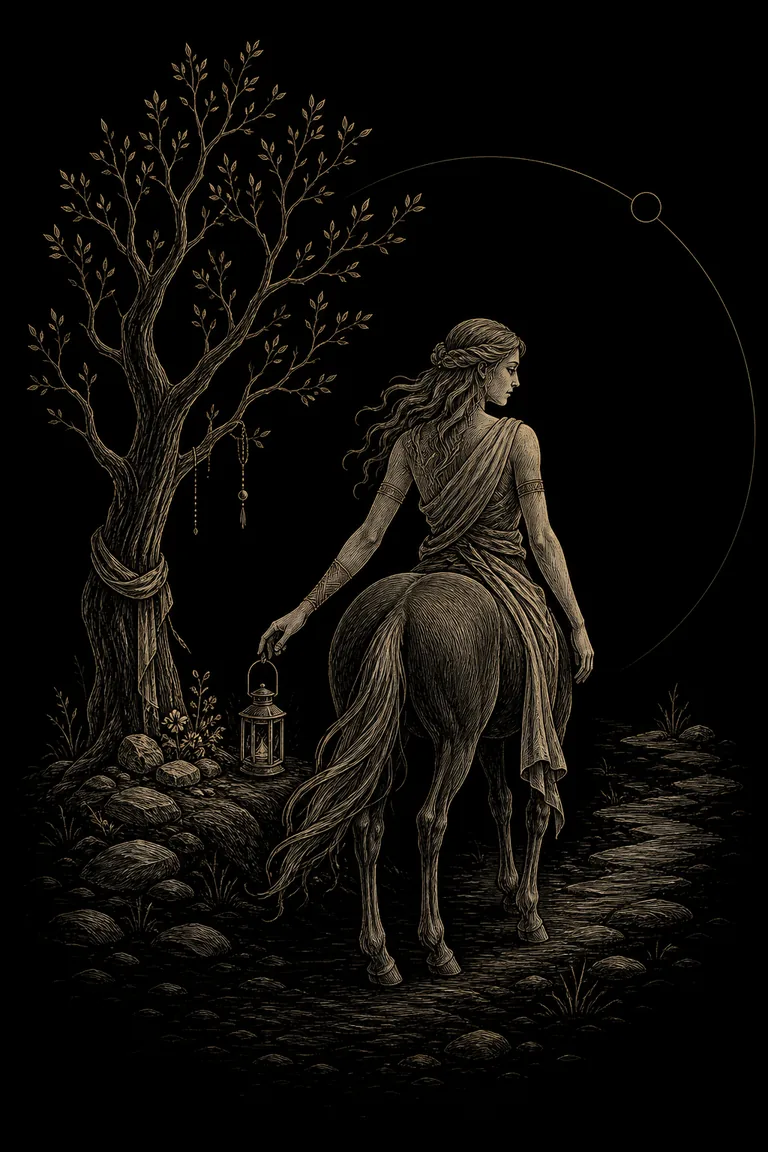
Hylonome in astrology is an optional Centaur placement. Modern astrologers may use it to explore profound attachment, the stories people build around a bond, grief when a shared identity changes, and the difficult work of carrying memory without abandoning present agency. It should never be read as a prediction of bereavement, self-harm, sacrifice, or relationship fate.
Astronomically, 10370 Hylonome is a Centaur discovered in 1995 and first designated 1995 DW2. NASA JPL classifies it as a Centaur with an orbit among the giant-planet region. Astronomy does not establish an astrological effect. The name comes from a tragic figure in classical myth, so responsible interpretation must separate symbolic reflection from literal event claims and keep the major planets, angles, houses, and lived evidence in control.
Take the next insight with you
Explore personalized Astrology guidance in Veritas, available for iOS and Android.
 Scan with your phone
What Hylonome means in astrology
A careful Hylonome interpretation explores attachment, relational identity, grief, loyalty, memory, and the boundary between devotion and self-erasure. Its constructive expression can support honest mourning, witness, commemoration, and renewed agency. Its shadow may involve idealizing a bond, refusing change, or making suffering the only proof of love. These are reflective prompts, not traits, diagnoses, or forecasts.
Read minor bodies in full chart context
Use Veritas to compare Hylonome with the major planets, exact aspects, houses, and angles before giving the placement personal weight.
Hylonome astronomy and discovery
The numbered object 10370 Hylonome has the provisional designation 1995 DW2. The Minor Planet Center records its discovery at Mauna Kea on February 27, 1995 by David Jewitt and Jane Luu. NASA JPL classifies it as a Centaur and lists a semimajor axis near 24.9 astronomical units, with an orbital period of roughly 125 years. These figures describe a small physical body, not an influence on human experience.
Hylonome mythology and an ethical boundary
In the naming citation, Hylonome is remembered as a female centaur whose beloved Cyllarus dies during conflict at a wedding and whose own story ends in self-inflicted death. That plot makes literal prediction especially irresponsible. An astrology reading must not romanticize self-harm, portray death as proof of love, or tell a vulnerable person that tragedy is destined. The usable symbolic question is how grief and attachment can be held while life, support, and choice continue.
Hylonome sign meaning
Hylonome by sign may describe a broad generational style of bonding, remembering, and responding to separation. Fire signs can emphasize identity and passionate loyalty, earth signs continuity and tangible memorials, air signs shared narratives and communication, and water signs emotional fusion and remembrance. Because many people share the sign, it cannot establish a personal loss story or relationship pattern without exact contacts and stronger chart evidence.
Hylonome house meaning
By house, Hylonome can locate the life area where attachment and continued agency become meaningful. In the fourth house this may involve family memory; in the fifth, creative bonds; in the seventh, partnership identity; in the eighth, shared resources and endings; in the tenth, public legacy; and in the eleventh, community belonging. Houses depend on accurate birth time. Omit confident house and angle claims when the time is unknown.
Hylonome aspects and orbs
Use narrow orbs for Hylonome, commonly about one degree and preferably closer. Start with conjunctions and oppositions to the Sun, Moon, personal planets, Ascendant, or Midheaven. Then test whether the contact repeats an established pattern. A wide minor-body aspect should not outweigh the chart ruler, major configurations, observed relationship conduct, mental-health assessment, grief support, or a person's stated needs.
Hylonome with planets and angles
With the Sun, Hylonome may frame identity shaped around a bond or legacy. The Moon can emphasize memory and emotional attachment; Mercury, the story told about loss; Venus, devotion and values; Mars, action around separation; Jupiter, amplification; Saturn, duty and endurance; Uranus, abrupt change; Neptune, idealization or blurred boundaries; and Pluto, intense transformation. No contact proves tragedy, self-harm, soulmates, or permanent grief.
Hylonome in synastry
An exact Hylonome contact in synastry may invite questions about loyalty, shared identity, memory, fear of separation, and whether both people retain agency. It cannot prove a soulmate bond, inevitable loss, sacrifice, danger, or emotional dependence. Read ordinary compatibility factors first and prioritize consent, direct communication, support networks, and observed behavior. Do not use the myth to pressure someone to stay or to glorify suffering.
Hylonome transits
Hylonome transits are slow background factors. An exact contact may be used to reflect on a changing bond, a memorial, an old grief becoming speakable, or the need to separate love from self-abandonment. Track dates and compare the transit with faster planets and actual events. Never use Hylonome to predict death, breakup, self-harm, trauma, illness, or an unavoidable sacrifice.
Hylonome, the Moon, Neptune, Pluto, and Chiron
The Moon already describes attachment, memory, and emotional needs. Neptune can frame idealization, longing, and porous boundaries. Pluto can describe endings, power, and deep transformation, while Chiron is often used for pain and integration. Hylonome should not replace these established factors. Its narrow contribution is a secondary question about how a bond is remembered and how agency continues when its form changes.
How to find Hylonome in a birth chart
Use an ephemeris or chart tool that accepts minor-planet number 10370 and verify the result says Hylonome or 1995 DW2. Record the zodiac, exact birth data, ephemeris source, degree, house system, and orb. A date-only chart can support an approximate degree but not dependable houses or angles. If tools disagree, inspect the object number, time zone, zodiac, and calculation settings before interpreting.
Keep memory and agency in the same frame
Use Veritas to name the bond, the change, the support available now, and one choice that honors connection without surrendering your life to it.
A responsible Hylonome worksheet
- Verify the placement
Confirm minor planet 10370, reliable birth data, the exact degree, and a narrow aspect.
- Describe the bond
Name the actual relationship, community, place, or role without turning the myth into a prediction.
- Separate memory from obligation
Ask what deserves to be carried and what present choice or boundary must remain free.
- Choose real support
Identify conversation, ritual, counseling, safety help, or practical care appropriate to the stakes.
Common Hylonome interpretation mistakes
Do not claim Hylonome predicts death, suicide, bereavement, abandonment, soulmates, doomed love, or noble sacrifice. Do not romanticize the naming myth or assign a crisis to someone from one minor-body contact. Avoid broad orbs and generational sign verdicts. A responsible reading treats Hylonome as an experimental secondary lens and keeps safety, present consent, observed reality, and qualified support ahead of symbolism.