Astrology Journal
Lot of Courage in Astrology: Meaning and Calculation
The Lot of Courage is a Mars-related calculated point in traditional astrology used to examine how pressure, risk, assertion, and fortitude are symbolically organized.
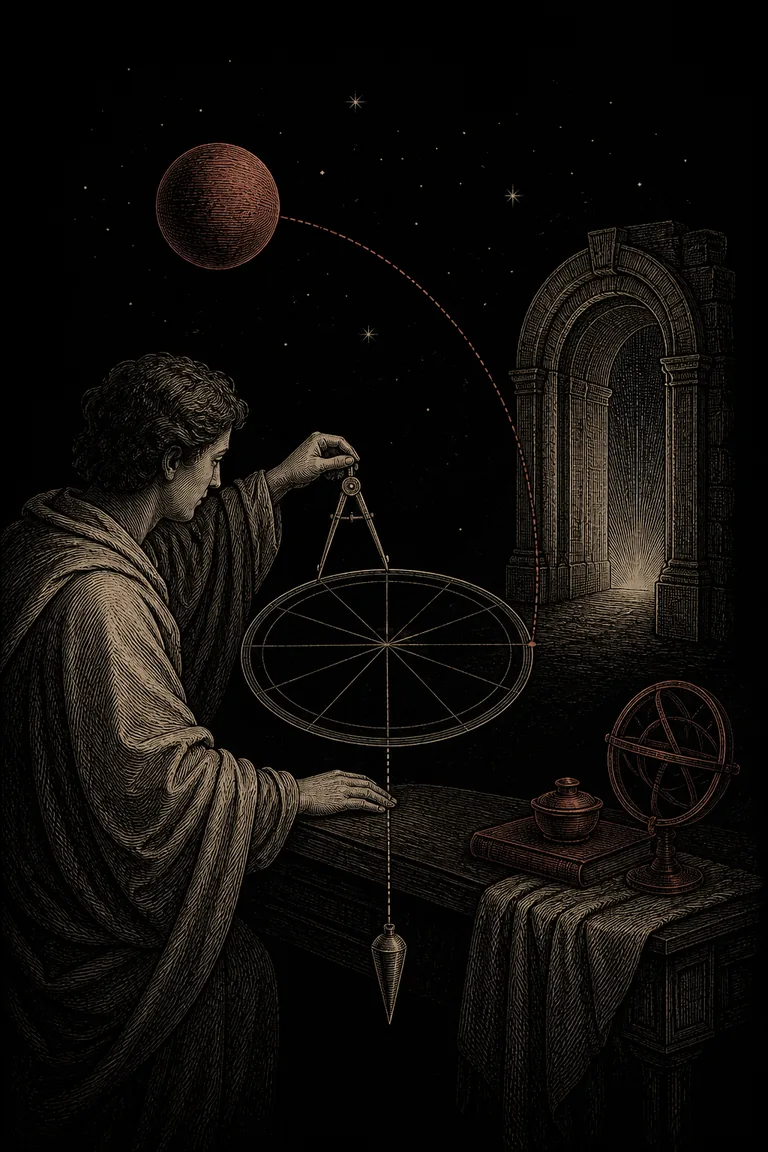
The Lot of Courage in astrology, also called the Lot of Boldness or Tolma, is a mathematical point rather than a planet or physical force. In a common reconstruction of the seven Hermetic lots associated with Paulus Alexandrinus, it is calculated from the Ascendant, the Lot of Fortune, and Mars, with the arc reversed between day and night charts.
Historical transmission and modern summaries do not always agree about formulas or whether every lot reverses by sect. This guide declares the Fortune-Mars method used here instead of treating it as universal. The point may frame action under pressure, conflict, daring, and fortitude within that method, but it cannot measure bravery, predict violence, or justify risk. Source, arithmetic, whole-chart context, and real evidence all matter.
Take the next insight with you
Explore personalized Astrology guidance in Veritas, available for iOS and Android.
 Scan with your phone
Lot of Courage at a glance
Source and formula boundaries
Lots passed through Greek, Arabic, Latin, and modern traditions, and names or arcs can shift between texts, translations, software, and teaching lineages. This article uses a Paulus-style Courage formula based on Fortune and Mars and reverses the arc for a night chart. Some modern tables report another anchor or do not reverse every Hermetic lot. When sources disagree, record both labels and equations rather than silently treating two longitudes as the same point.
How to calculate the Lot of Courage
- Calculate Fortune
Use a declared day or night convention for the Part of Fortune and preserve its exact longitude.
- Locate Mars
Record Mars at an exact 0-to-360-degree longitude in the same zodiac.
- Determine sect
Classify the chart from the Sun's position relative to the local horizon under the selected method.
- Apply the declared arc
Use Ascendant + Fortune - Mars by day and Ascendant + Mars - Fortune by night.
- Normalize the result
Add or subtract 360 until the result is at least 0 and less than 360, then convert it to sign and degree.
Worked calculation example
Suppose a day chart has an Ascendant at 80 degrees, Fortune at 205 degrees, and Mars at 145 degrees. The equation is 80 + 205 - 145 = 140 degrees, or 20 degrees Leo in a tropical zodiac. With the same sample inputs treated as a night chart, 80 + 145 - 205 = 20 degrees, or 20 degrees Aries. This only demonstrates arithmetic. An actual result depends on accurate birth data, sect, zodiac, and the chosen Fortune convention.
Fortune, Mars, and embodied circumstances
In this method, Fortune connects the lot with embodied circumstances and conditions not fully chosen, while Mars supplies themes of separation, effort, heat, conflict, defense, and decisive action. Courage is therefore not simply a personality score. It can be read as a symbolic intersection between pressure and the capacity to act, but Mars must still be judged by sect, sign, house, speed, visibility, and aspects.
How to interpret the sign and house
The sign can describe the style through which assertion or fortitude is symbolically expressed. The house can point to a life area where pressure and action become visible. A tenth-house placement, for example, might focus inquiry on public responsibility, authority, or career conflict, but it does not predict professional danger or prove leadership. Birth-time uncertainty can change the Ascendant, houses, Fortune, and the lot itself.
Read the lot ruler and Mars
Find the domicile ruler of the sign containing Courage, then assess that ruler alongside Mars. The ruler may describe how the topic is carried, supported, redirected, or complicated. A strong dignity does not guarantee wise action, and a difficult condition does not mean cowardice. Aspects and reception can add context only within a declared system; they should not be turned into moral rankings.
Courage, recklessness, and coercion
Courage requires a meaningful risk, some available choice, and a reasoned relationship to consequences. Recklessness ignores foreseeable harm, while coercion removes or narrows consent. Structural barriers can make a cautious response entirely rational. A responsible reading asks what pressure is real, who bears the cost, what protection exists, and whether action can be delayed, shared, documented, or refused.
Common mistakes
Frequent errors include copying an unlabeled software result, mixing Courage formulas, reversing the arc twice, using sign degrees instead of continuous longitude, inferring sect from clock time, rounding near a sign cusp, or calculating Fortune under one convention and Courage under another. Interpretive errors include predicting violence, glamorizing danger, shaming caution, or treating Mars symbolism as permission to override consent.
Keep boldness reproducible and accountable
Use Veritas to record the source, formula, sect, Ascendant, Fortune and Mars longitudes, result, ruler, observed pressure, available protections, and uncertainty.
A grounded interpretation worksheet
- Declare the source
Name the text, translation, teacher, or software equation before interpretation.
- Show the arithmetic
Preserve every longitude, signed operation, and normalization step.
- Describe actual pressure
Separate observed risk or conflict from what the symbol merely suggests.
- Map agency and protection
Identify consent, preparation, allies, equipment, limits, and exit options.
- Review consequences
Decide what evidence would show that action is proportionate or needs to stop.
Limits and responsible use
Astrology is not scientifically validated for measuring courage, predicting violence, assessing military or athletic performance, diagnosing impulsivity, or determining safe exposure to danger. Do not use this lot to pressure someone into confrontation, excuse aggression, or replace medical, legal, workplace, financial, or safety expertise. Treat it as a historical symbolic technique whose claims remain subordinate to evidence and consent.