Astrology Journal
Lot of Eros in Astrology: Meaning and Calculation
The Lot of Eros is a calculated point used in traditional astrology to examine desire, attraction, attachment, and what draws a person toward participation.
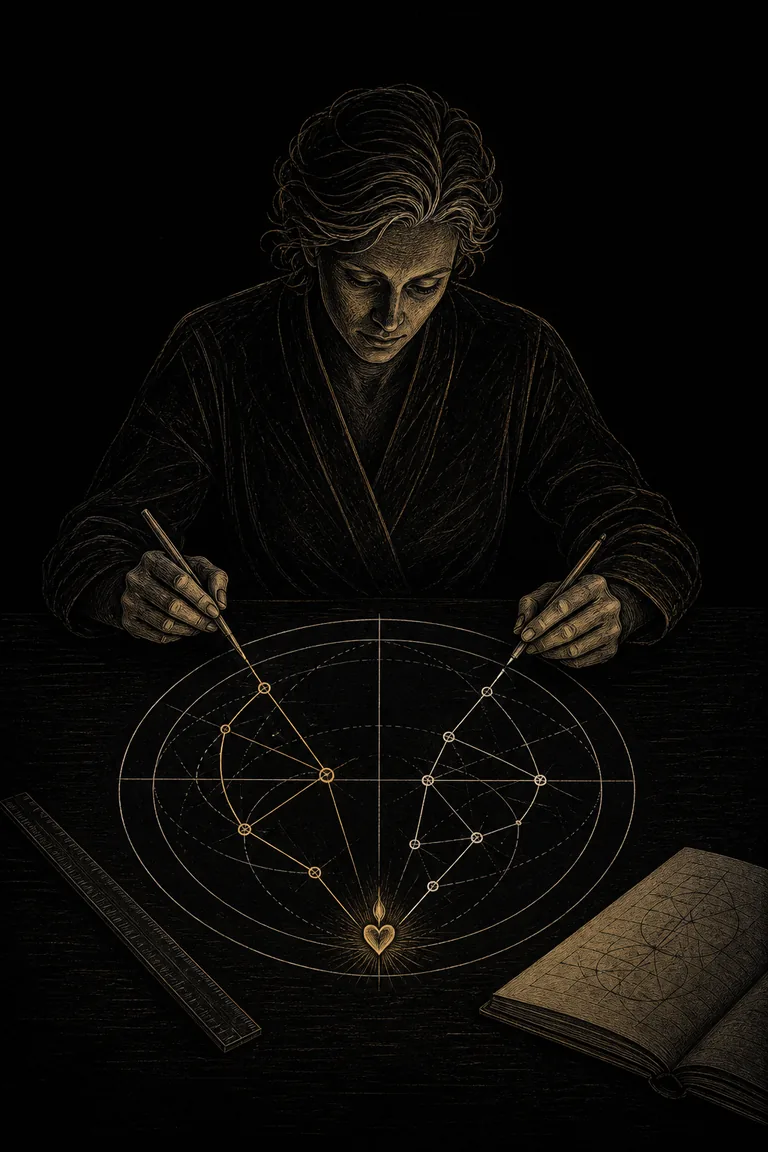
The Lot of Eros in astrology, also called the Lot of Love in some translations, is a mathematical point rather than a planet or asteroid. Ancient sources do not preserve one universal formula. Vettius Valens derives Eros from the relationship between the Lots of Fortune and Spirit, while a formula associated with Paulus Alexandrinus uses Venus and the Lot of Spirit. These methods can produce different zodiacal positions.
That formula difference is the first interpretive fact to record. A sign, house, ruler, or aspect cannot be audited unless the reader knows which Eros was calculated, how day or night sect was determined, and which zodiac and house system were used. The lot can support symbolic inquiry into desire and attachment, but it cannot prove compatibility, consent, orientation, another person's feelings, or the future of a relationship.
Take the next insight with you
Explore personalized Astrology guidance in Veritas, available for iOS and Android.
 Scan with your phone
Lot of Eros at a glance
Lot of Eros, asteroid Eros, and Venus
The Lot of Eros must not be confused with asteroid 433 Eros. The asteroid has an astronomical position from an ephemeris; the lot is calculated from other chart points. Venus is also a planet with its own sign, house, motion, visibility, and aspects. A reader may compare all three, but their identities and calculation histories should remain separate. This article addresses the traditional calculated lot; the Veritas guide to Eros in astrology covers the asteroid.
Why the formula depends on the source
Historical lot doctrines were transmitted through authors, translations, manuscripts, and later practice rather than one standardized calculator. Valens treats Eros and Necessity through the two principal luminary lots. Paulus presents a Venus-linked Eros among planetary lots. Later authors and modern software may preserve, reverse, rename, or combine these traditions differently. A surprising placement is not a reason to switch formulas after interpretation. Choose a source before calculating and label the result accordingly.
How to calculate the Valens Lot of Eros
- Calculate Fortune
Use one declared day or night convention for the Part of Fortune and keep the exact longitude.
- Calculate Spirit
Use the matching convention for the Lot of Spirit and keep the exact longitude.
- Determine sect
Classify the chart from the Sun's position relative to the local horizon under the selected source.
- Project the arc
For the Valens convention used here, calculate Ascendant + Spirit - Fortune by day and Ascendant + Fortune - Spirit by night.
- Normalize the result
Add or subtract 360 until the answer is from 0 to less than 360 degrees, then convert it to sign and degree.
A Valens-method worked example
Suppose a day chart has an Ascendant at 100 degrees, Fortune at 150 degrees, and Spirit at 210 degrees. The formula gives 100 + 210 - 150 = 160 degrees, or 10 degrees Virgo in a tropical zodiac. Under the corresponding night reversal with the same sample points, 100 + 150 - 210 = 40 degrees, or 10 degrees Taurus. The example demonstrates arithmetic only. Real Fortune and Spirit positions must first be calculated from accurate chart data under the same convention.
The Paulus formula and software differences
A commonly used Paulus-style formula calculates Eros as Ascendant + Venus - Spirit by day and reverses the arc at night. It is not interchangeable with the Valens formula because Venus replaces Fortune as one input. Software may call either result Eros or Love without identifying the source prominently. Inspect the documentation or reproduce the longitude equation. If two tools disagree, compare their formula, sect, zodiac, coordinates, and rounding before treating either output as an error.
How to interpret the sign and house
The sign can describe a symbolic style of attraction, pleasure, and participation. The house can identify a field where desire or attachment becomes especially noticeable. For example, a third-house Eros might focus inquiry on learning, conversation, siblings, or local networks, but it does not guarantee romance through communication. House placement depends heavily on birth time and the selected house system.
The ruler of the Lot of Eros
Find the domicile ruler of the sign containing the lot, then assess that planet's sign, house, sect, speed, visibility, and aspects under a coherent method. The ruler can show how the topic is carried and where its consequences appear. It does not identify a destined partner. If an almuten or another dignity ruler is used, state that as a separate layer rather than silently replacing the domicile ruler.
Relationships, attraction, and consent
Eros can frame questions about what attracts attention, how desire is pursued, and whether pleasure supports or conflicts with other commitments. It cannot establish mutual attraction because one natal chart describes only one symbolic perspective. In synastry, contacts to a calculated lot still do not substitute for explicit consent, communication, safety, and observed compatibility. Never use the placement to label someone's sexuality, trauma, fidelity, or capacity to love.
Common calculation mistakes
Frequent errors include confusing the lot with asteroid 433 Eros, mixing the Valens and Paulus inputs, reversing an arc twice, using sign degrees instead of 0-to-360 longitude, forgetting normalization, inferring sect from clock time, and copying software output without its formula. Rounding Fortune, Spirit, Venus, or the Ascendant can move the result across a sign or house cusp. Save every input and intermediate result.
Keep the method attached to the meaning
Use Veritas to record the source, formula, sect decision, zodiac, Ascendant, input longitudes, normalized result, house system, ruler, and uncertainty.
A responsible interpretation worksheet
- Name the formula
Write Valens, Paulus, or another documented source before calculating.
- Verify the inputs
Check birth data, Ascendant, sect, and every longitude used by that formula.
- Show the arithmetic
Preserve the signed equation and the normalized zodiac position.
- Read the ruler
Interpret the lot through its domicile ruler and the complete natal context.
- Compare with consent and experience
Test symbolism against stated preferences, behavior, boundaries, and lived reality.
Limits and responsible use
Astrology is not scientifically validated for proving attraction, compatibility, orientation, fidelity, fertility, or relationship outcomes. Use the Lot of Eros as a historical symbolic technique. Do not use it to override consent, diagnose another person, or make medical, legal, financial, or safety decisions. Consequential relationship choices require direct evidence, informed agreement, and appropriate professional support.