Astrology Journal
Lunar Return Chart: Calculation and Interpretation
A lunar return chart is cast for the exact moment the transiting Moon returns to its natal ecliptic longitude, creating a short symbolic cycle of about 27.3 days.
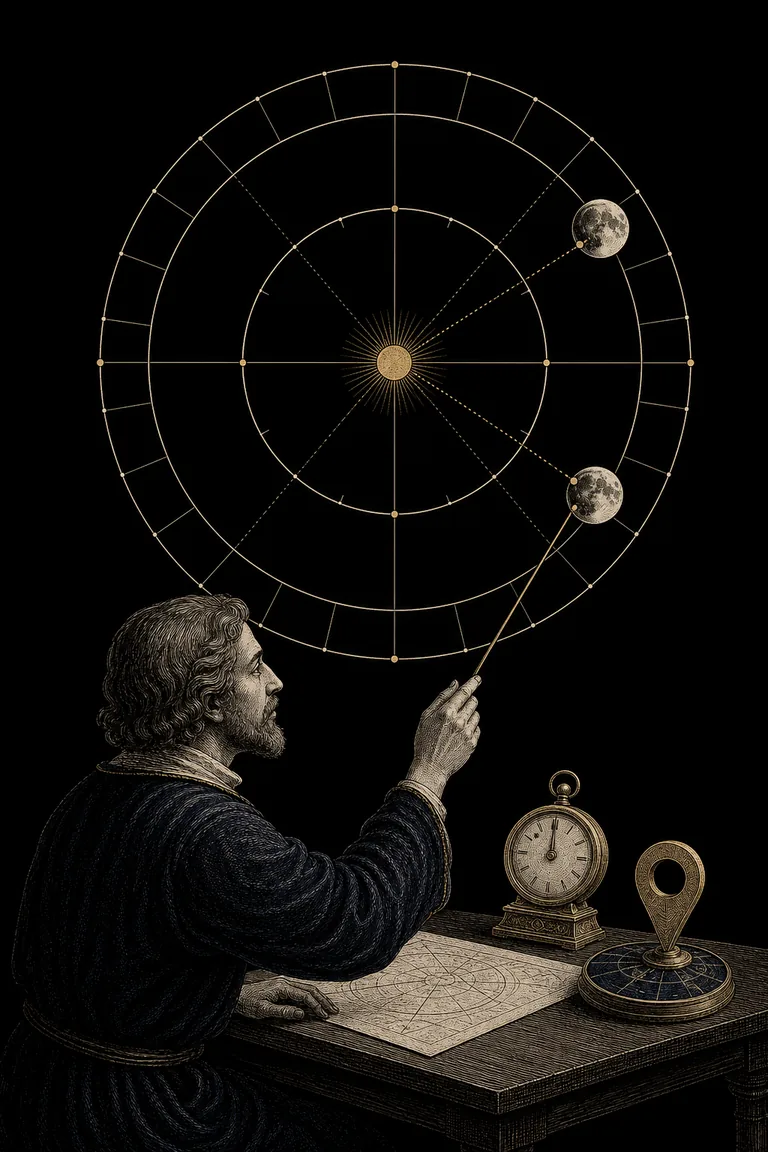
A lunar return is not the first day of a calendar month and not simply the Moon entering your natal sign. The calculation searches for the instant when the transiting Moon reaches the same tropical or sidereal ecliptic longitude used for the natal Moon. Because the Moon moves quickly, an exact timestamp and a declared zodiac are essential.
The chart can then be cast for the birthplace, residence, or actual location at the return. That choice changes the Ascendant, Midheaven, and houses, though it does not change the return instant itself. Save both UTC and local time, coordinates, location rule, house system, aspects, orbs, and comparison layers. Lunar returns are symbolic astrology, not scientifically validated monthly forecasts.
Take the next insight with you
Explore personalized Astrology guidance in Veritas, available for iOS and Android.
 Scan with your phone
Lunar return chart at a glance
What a lunar return chart is
A lunar return chart is a return chart erected when the moving Moon reaches its natal longitude. The mean sidereal month is about 27.32166 days, but the actual interval between exact longitude returns varies because lunar speed is not constant and the reference geometry includes the moving equinox in a tropical zodiac. There are usually thirteen returns in a solar year. The cycle runs from one exact return to the next, not from one calendar date to the same date next month.
Calculate the exact return condition
First calculate the natal Moon to full available precision with a trusted ephemeris. Then search forward for a sign change in the wrapped angular difference between transiting and natal longitude. Refine the bracket with interpolation or a root-finding method until the difference is below the chosen tolerance. Do not round the natal Moon to a whole degree before searching, since the Moon moves roughly half a degree per hour on average.
Refine a simple two-hour bracket around the natal longitude
Natal Moon longitude = 18.400 degrees
00:00 UTC transiting Moon = 18.100 degrees
02:00 UTC transiting Moon = 19.100 degrees
(18.400 - 18.100) / (19.100 - 18.100) = 0.300 of the bracket
0.300 x 2 hours = 0.600 hours, so first estimate = 00:36 UTC
This linear example teaches the bracket, not a final ephemeris algorithm. Recalculate the lunar longitude at 00:36 UTC and iterate because lunar motion curves and the displayed sample values are rounded. Production software should handle the 360-to-0 degree boundary, time scales, delta T where relevant, and the same tropical or sidereal settings used for the natal chart.
Why the return date drifts
A 27.3-day cycle is shorter than most calendar months, so the return usually occurs two or three days earlier by the calendar each cycle. Lunar speed also varies through the orbit, which changes the exact interval. Search from a target date rather than adding a fixed number of days indefinitely. A calendar may occasionally show two lunar returns in one named month, and neither is an error if each exact longitude match is correct.
Choose the return location explicitly
Astrologers use different location conventions. Some cast every return for the birthplace, some relocate to the current residence, and some use the actual coordinates at the exact return. The return moment depends on lunar longitude, not observer location, but houses and angles depend on coordinates and local sidereal time. Record the rule before viewing the chart and do not change location afterward to obtain a preferred Ascendant or house emphasis.
Birth-time accuracy matters
An uncertain birth time affects the natal Moon and therefore the solved return moment. It also makes natal and return angles less reliable. The Moon travels approximately 12 to 15 degrees per day, so a one-hour birth-time error can shift its natal longitude by roughly half a degree and the return time by about an hour. The effect varies. If birth time is approximate, disclose the uncertainty and avoid precise angular or house claims.
Audit a lunar return calculator
- Record the natal target
Save the Moon's full longitude, zodiac, reference frame, ephemeris, and natal timestamp.
- Bracket the return
Verify that the transiting Moon crosses the target longitude between two saved UTC times.
- Check the exact moment
Recalculate the moving Moon at the reported timestamp and compare within a declared tolerance.
- Verify place and time zone
Record coordinates, IANA time zone, daylight-saving offset, and local date.
- Save chart settings
Keep houses, zodiac, nodes, aspects, orbs, and natal overlay choices reproducible.
A clear interpretation order
Begin with the return Ascendant and its ruler only if birth time and location are reliable. Then examine the return Moon by house and aspect, planets close to angles, occupied houses, and repeated natal themes. Use a limited order chosen before reading. A chart with many symbols can support almost any retrospective story if the reader keeps adding minor aspects, asteroids, wide orbs, and house overlays after events are known.
Read the return Moon carefully
The Moon is at the same zodiacal longitude as at birth by definition, but its return house and aspects can differ. Practitioners use that house as a symbolic focus for attention, habit, care, and response during the short cycle. This is not a promise that an event will occur in that house topic. Translate a symbol into two or three testable reflection questions and preserve ordinary explanations.
Angles, houses, and angular planets
Angles change quickly, so close conjunctions to the Ascendant or Midheaven are often prioritized in return practice. Record the exact angular distance rather than saying a planet is prominent. House-system changes can move planets near cusps, especially at high latitudes. If the chosen system fails or behaves unusually, disclose the alternative used and avoid presenting a software fallback as a universal tradition.
Return-to-natal aspects
A biwheel may compare return planets with natal planets and angles. Keep return-to-return and return-to-natal contacts in separate tables. Select the aspect family and orb before examining the month, then label applying and separating only when the software method supports that distinction. A close contact can organize reflection, but it cannot establish cause, certainty, or the timing of a real-world event.
Save the exact return, not just the picture
Use Veritas to record natal longitude, search bracket, UTC and local timestamps, location rule, chart settings, selected contacts, observations, alternatives, misses, and next return.
Lunar return versus Moon transits
A lunar return is one exact Moon-to-natal-Moon conjunction used to cast a complete short-cycle chart. Ordinary Moon transits follow the moving Moon through signs, houses, and aspects every day. The return chart freezes one instant, while a transit calendar continues moving. Do not treat every aspect in the frozen chart as if it perfects at the same time during the cycle.
Lunar return versus solar return
A solar return occurs when the Sun returns to its natal longitude, roughly once per tropical year. A lunar return repeats about every 27.3 days. The solar chart is often treated as an annual frame and the lunar chart as a shorter nested frame, but the two use different return bodies and exact timestamps. Keep location conventions consistent or explain why they differ.
Lunar return versus annual profections
Annual profections advance one whole-sign house per birthday year and identify a time-lord through a traditional counting method. Lunar returns calculate an astronomical longitude recurrence. Combining them is an interpretive choice, not part of the lunar return calculation itself. If you combine techniques, define the hierarchy before the cycle and avoid promoting a symbol only after an event appears to fit it.
Review the cycle fairly
Before the return cycle begins, write no more than three specific themes, the chart factors supporting each, plausible alternatives, and evidence that would count against the reading. Review at the next return rather than continuously hunting for confirmation. Include ordinary events, misses, ambiguous cases, and choices that changed the outcome. This does not validate astrology scientifically, but it makes personal practice less vulnerable to selective memory.
Limits and responsible use
A lunar return chart cannot diagnose illness, determine fertility, reveal another person's intentions, guarantee marriage or separation, predict death, promise employment, select an investment, or replace weather, legal, medical, financial, or safety information. Exact timestamps can create false confidence when settings and interpretation remain flexible. Astrology is a symbolic tradition rather than a scientifically validated forecasting method. Use verified facts and qualified advice for consequential decisions.