Astrology Journal
Birth Time Unknown? What You Can Still Read in a Natal Chart
Without an exact birth time, a natal chart can still show many planetary signs and slower aspects, but the Ascendant, houses, angles, and Moon may remain uncertain.
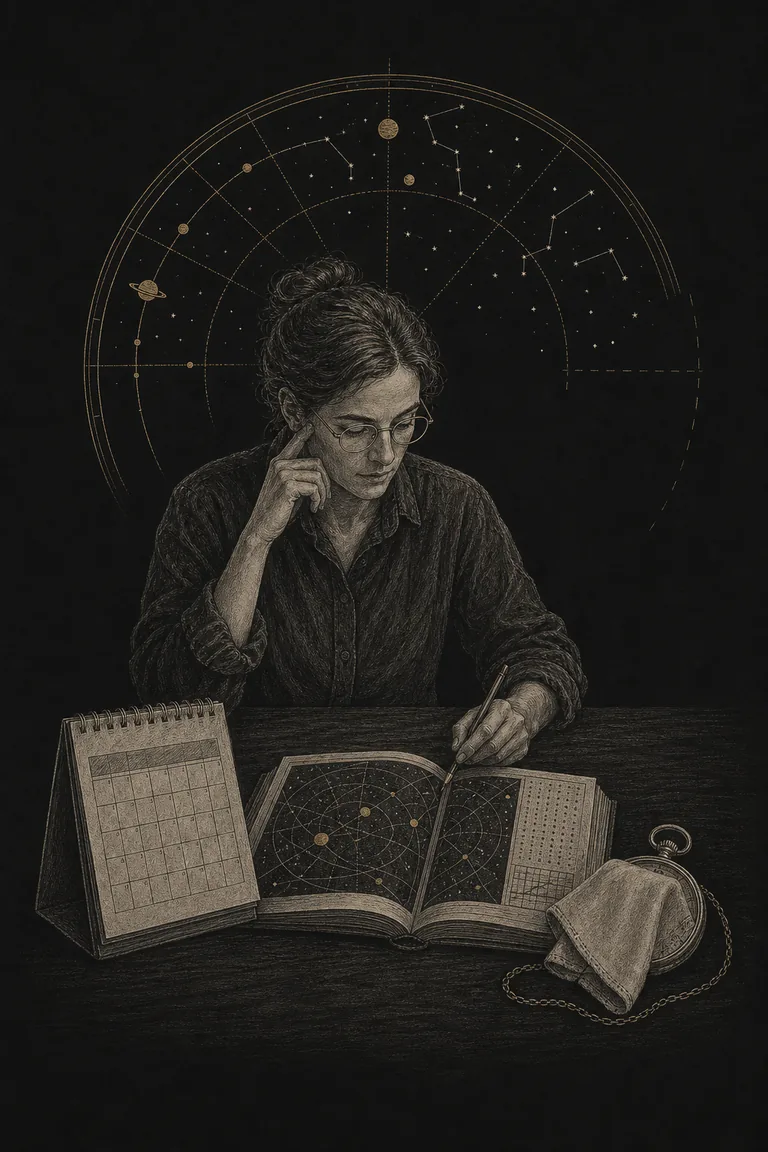
If your birth time is unknown, you do not need to abandon the entire natal chart. The birth date and place still allow an astrologer to examine planetary positions that remain stable across the day, broad aspect patterns, elements, modalities, and sign-based themes. The honest chart is a time range, not a fabricated exact wheel.
What you should not claim is equally important. The Ascendant, Midheaven, house cusps, chart ruler, house placements, and angle contacts depend on clock time. The Moon moves quickly enough that its degree, aspects, and occasionally its sign can change during one date. A default noon time is a calculation convenience, not a discovered birth time.
Take the next insight with you
Explore personalized Astrology guidance in Veritas, available for iOS and Android.
 Scan with your phone
What you can read without a birth time
You can usually read the Sun, Mercury, Venus, Mars, Jupiter, Saturn, Uranus, Neptune, and Pluto by sign after checking whether any planet changed signs that day. Many planet-to-planet aspects also remain useful, especially those between slower bodies. Every placement should be tested across the full possible time window.
Start with the chart data you can verify
Create a natal chart in Veritas with the most accurate date and place available, then distinguish stable planetary placements from time-sensitive angles, houses, and Moon details.
What an unknown birth time makes unreliable
Ascendant
The rising degree changes throughout the day and cannot be inferred from appearance or personality alone.
Houses
House cusps and planetary house placements depend on the Ascendant, location, clock time, and house system.
Midheaven and angles
The MC, IC, Descendant, and close contacts to any angle are time-sensitive.
Exact Moon details
The Moon’s degree and aspects shift quickly, and its sign may change on the recorded date.
Why a noon chart is not your natal chart
Software often uses 12:00 when a time field cannot be left blank. Noon places planets somewhere on a wheel so calculations can run, but the displayed Ascendant and houses are placeholders. They should be hidden, ignored, or clearly labeled unknown rather than interpreted.
Use a full-day range instead of one guess
Calculate the chart near the earliest and latest plausible times for the recorded place, accounting for the correct time zone and daylight-saving rules. Compare the results. A planet or aspect that stays materially stable across that range can be retained with more confidence than one that changes.
Check every planetary sign near an ingress
Most planets will remain in one sign throughout a date, but “usually” is not enough. Mercury, Venus, Mars, and even slower bodies can enter a new sign on a birthday. Verify the exact ingress against the possible time range before publishing or interpreting the sign.
Handle the Moon separately
The Moon travels roughly thirteen degrees per day, so an unknown time creates a meaningful degree range. If it crosses a sign boundary, report both possible signs and explain what evidence cannot resolve. Even within one sign, close aspects may form or separate enough to change emphasis.
Which aspects remain useful
Aspects between slower planets usually change little during one day. Sun-to-planet contacts may also remain stable when they are not near the edge of the chosen orb. Moon aspects and very tight applying or separating contacts need a range. Avoid false precision in degrees and minutes.
Elements and modalities can still be informative
After confirming stable planetary signs, you can compare fire, earth, air, and water, plus cardinal, fixed, and mutable emphasis. Do not include a guessed Ascendant or uncertain Moon as settled data. A category count is only as reliable as the placements used to build it.
What happens to the Big Three
The Sun sign is usually available after an ingress check. The Moon sign may be certain or may have two possibilities. The rising sign is unknown without a dependable time. Calling a Sun and possible Moon the Big Three would hide the missing Ascendant, so name the available placements directly.
Can you find the chart ruler?
Not reliably. The chart ruler is the planet ruling the Ascendant, and the Ascendant changes with time. Choosing a ruler from temperament, appearance, or a favored sign creates circular reasoning. You can still study each stable planet without assigning one overall ruler.
Can you read transits without houses?
Yes, with limits. You can track transiting aspects to reliably placed natal planets and use wider date windows for an uncertain Moon. You cannot confidently say which natal house a transit occupies or when it crosses an angle. Keep timing claims proportional to the data.
Solar returns and timing techniques
Techniques that depend on natal houses, Ascendant, Midheaven, or an exact degree crossing become unreliable without a birth time. Annual profections also require a known rising sign for the annual house and Time Lord. Planetary cycles such as a Saturn return can still be studied by natal degree range.
How to search for a recorded birth time
Check the long-form birth certificate, hospital or midwife records, baby books, family correspondence, religious records, and relatives who may remember the context. Confirm whether the notation used a 12-hour or 24-hour clock and whether the recorded time was rounded. Preserve the source with the time.
What birth time rectification can and cannot do
Rectification compares possible angles with dated life events to propose a time. It is interpretive and sensitive to the events, techniques, and assumptions selected. It cannot recover a clock reading with scientific certainty. Keep a rectified time labeled as estimated, not documented.
A practical unknown-time workflow
Record the date, place, time zone, and all possible time information. Calculate the day’s earliest and latest charts, mark every stable sign and aspect, give the Moon a range, remove houses and angles, and write conclusions that remain true across the range. Recheck if better records appear.
An example of honest uncertainty
Suppose Venus remains in Taurus all day, Saturn stays within the same degree, and the Moon moves from late Gemini into Cancer. You may interpret Venus in Taurus and the stable Saturn contacts. Present the Moon as two possibilities and omit all houses, rising-sign claims, and angle-based timing.
Astrology is a symbolic interpretive practice, not a scientifically validated forecasting method. An unknown-time chart cannot establish houses, angles, personality, diagnosis, events, or fate, and it cannot replace official records or medical, legal, financial, relationship, career, or safety guidance.