Astrology Journal
Triplicity Rulers in Astrology: Day and Night Guide
Triplicity rulers are traditional planetary rulers assigned to the fire, earth, air, and water sign groups. They describe shared elemental support and change according to whether a chart is diurnal or nocturnal.
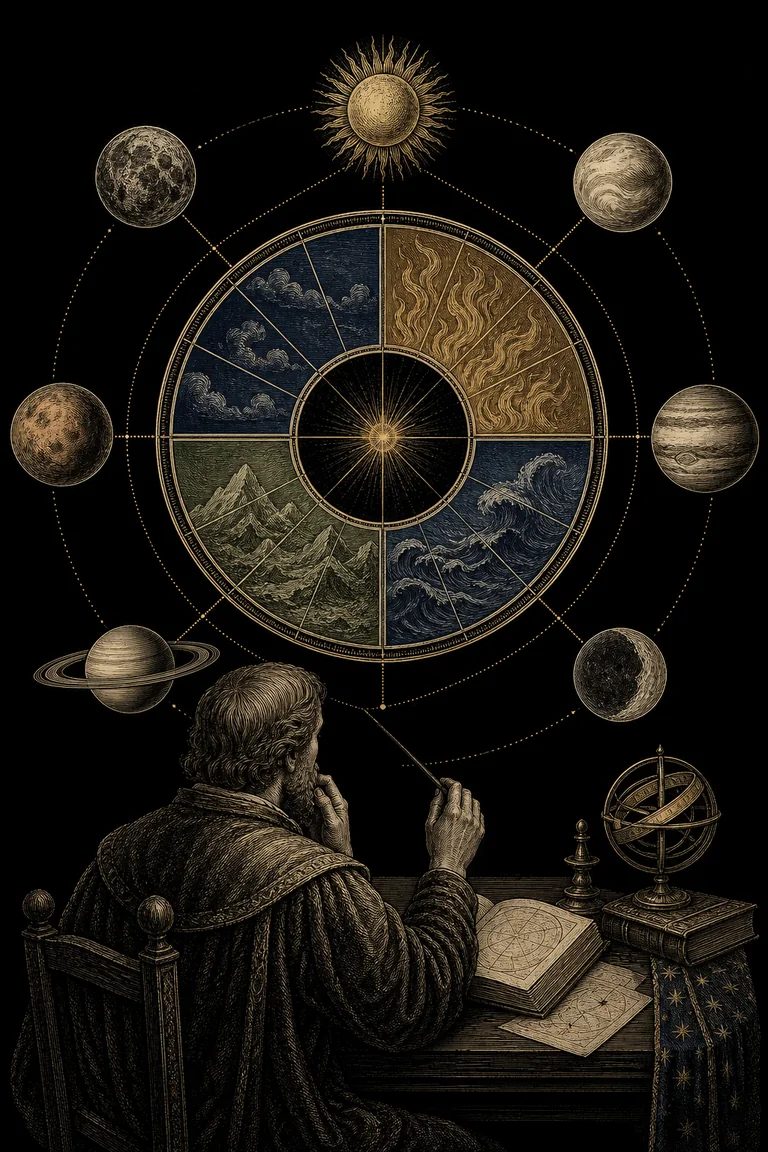
In traditional astrology, each element forms a triplicity of three signs and receives a day ruler, a night ruler, and, in the Dorothean system, a participating ruler. The chart sect chooses which ruler has first priority. Fire, for example, is led by the Sun by day and Jupiter by night, with Saturn participating.
Triplicity is one form of essential dignity. It does not replace domicile, exaltation, bounds, face, house placement, aspects, motion, or rulership of topics. Use one named table consistently, identify day or night from the Sun's position relative to the horizon, and then judge the selected ruler in the whole chart.
Take the next insight with you
Explore personalized Astrology guidance in Veritas, available for iOS and Android.
 Scan with your phone
What are triplicity rulers in astrology?
A triplicity is a group of three zodiac signs sharing one element: Aries, Leo, and Sagittarius are fire; Taurus, Virgo, and Capricorn are earth; Gemini, Libra, and Aquarius are air; Cancer, Scorpio, and Pisces are water. Traditional authors assigned planets to govern each group. A planet placed in a sign whose triplicity it rules gains a form of elemental support, even when it does not rule that individual sign by domicile.
Triplicity is not the same as element
Element describes a sign family and its symbolic qualities. Triplicity rulership is a specific dignity doctrine built on that family. Saying that Mars is fiery does not make Mars a triplicity ruler of every fire sign in the Dorothean table. Likewise, a chart with many water placements is not automatically ruled by the water triplicity rulers as a whole. Apply the doctrine to a particular planet, luminary, house, or timing technique.
The Dorothean triplicity ruler table
This article uses the table associated with Dorothean practice because it preserves three rulers for each triplicity and is common in Hellenistic and medieval technique. Other authors and schools transmit variants, especially for water. Record the table you use. Quietly switching systems when a different planet looks stronger makes the result impossible to evaluate.
How day and night choose the primary ruler
First determine sect. If the Sun is above the local Ascendant-Descendant horizon, use the day ruler first. If the Sun is below that horizon, use the night ruler first. Clock time, AM or PM, and whole-sign house number are not reliable substitutes near sunrise or sunset. A participating ruler can add support or describe another phase, but it does not erase the day-night distinction.
What does the participating ruler do?
The third ruler participates in the triplicity regardless of sect, but its weight depends on the technique and author. In a basic natal dignity assessment, treat it as secondary testimony after the sect ruler. In some length-of-life, house, or period methods, the three rulers may describe successive parts of life. Do not import that sequence into every reading without naming the source and rules.
Find the chart's day or night foundation first
Open your chart in Veritas, locate the Sun relative to the local horizon, and note the element being judged before assigning a triplicity ruler.
Fire triplicity rulers
For Aries, Leo, and Sagittarius, the Sun rules by day, Jupiter rules by night, and Saturn participates. The scheme combines solar visibility and direction, Jupiterian breadth, and Saturnian continuity. If the Sun is in Sagittarius in a day chart, it has triplicity dignity even though Jupiter owns the sign by domicile. The Sun's house, aspects, visibility, and topical rulership decide how usable that support becomes.
Earth triplicity rulers
For Taurus, Virgo, and Capricorn, Venus rules by day, the Moon rules by night, and Mars participates. This does not mean every earth placement behaves like Venus, Moon, or Mars. It means those planets can testify to the maintenance of material conditions, embodiment, resources, and productive continuity within the doctrine. Their own condition determines whether support is consistent, delayed, conflicted, or dependent on another planet.
Air triplicity rulers
For Gemini, Libra, and Aquarius, Saturn rules by day, Mercury rules by night, and Jupiter participates. A nocturnal Mercury in Libra therefore receives triplicity dignity through the night ruler, even though Venus owns Libra by domicile. Read the dignity as access to an elemental network of exchange, relation, language, rules, or abstraction, then test that idea against house topics and aspects.
Water triplicity rulers
In the Dorothean table, Venus rules Cancer, Scorpio, and Pisces by day, Mars rules them by night, and the Moon participates. This is the row most likely to differ across transmitted systems. Ptolemaic approaches are often presented with Mars as ruler of water in both day and night, sometimes without the same participating-ruler structure. Choose the system before interpretation and do not combine rows from incompatible tables.
Triplicity versus domicile and exaltation
Domicile gives a planet authority over an individual sign, while exaltation grants a distinct form of honored elevation in a specific sign. Triplicity offers broader support across an elemental group. A planet can hold several dignities at once. The Sun in Aries by day is exalted and rules the fire triplicity, but Mars still rules Aries by domicile. List each testimony separately instead of collapsing them into a single adjective such as strong.
Triplicity versus bounds and decans
Bounds divide signs into unequal degree sections ruled by the five non-luminary planets. Decans, also called faces, divide each sign into three ten-degree sections. Triplicity applies across all degrees of three signs, then changes emphasis with sect. A planet may have triplicity dignity but no dignity by bound or face at its exact degree. Degree-based methods therefore add precision rather than repeating the elemental result.
Worked example: a day chart Moon in Taurus
Suppose the Moon is at 14 degrees Taurus in a day chart. Taurus belongs to the earth triplicity, whose day ruler is Venus. The Moon is the night ruler of earth, so it does not receive the primary sect-based triplicity dignity in this daytime case. It is still exalted in Taurus, and Venus may receive or support it through sign rulership and aspect. The final judgment preserves exaltation, reception, sect, house, phase, and aspects as separate facts.
Worked example: Mercury in Aquarius at night
Imagine Mercury in Aquarius in a night chart. Aquarius is an air sign and Mercury is the nocturnal ruler of the air triplicity, so Mercury has triplicity dignity. Saturn owns Aquarius by domicile. If Saturn is angular and applies to Mercury by trine, the placement may have both elemental support and a capable dispositor. If Mercury is combust, retrograde, or placed in a difficult house, those conditions still describe real constraints.
Using triplicity rulers for a house
Some traditional methods examine the triplicity rulers of the sign on a house cusp or whole-sign house to judge the endurance and phases of that topic. For a tenth house in Leo, a day chart might begin with the Sun, then consider Jupiter and Saturn according to the chosen method. This is more specific than declaring the Sun a universal career ruler. State the house system, sect, ruler order, and life phase being assessed.
The ruler's condition matters more than the label
After identifying a triplicity ruler, inspect its sign, house, angularity, speed, direction, visibility, aspects, reception, and rulership of other houses. A ruler with resources and access can support the topic directly. A cadent, retrograde, or heavily constrained ruler may describe support that arrives indirectly, late, through obligation, or after revision. No single dignity guarantees status, wealth, marriage, health, or success.
Triplicity rulers in timing techniques
Triplicity rulers appear in several traditional timing and longevity frameworks, but the procedures are not interchangeable. Some allocate successive rulers to early, middle, and later portions of life; others use them to evaluate a luminary or house. Before using a timing claim, identify the historical method, starting significator, ruler order, and what event would count as confirmation. Avoid turning a broad phase ruler into an exact prediction date.
What if the birth time is unknown?
Near midday or midnight, the chart may remain clearly day or night across a reasonable time range. Near sunrise or sunset, a small error can change sect and therefore the primary triplicity ruler. Test the earliest and latest plausible times. If the result changes, present both rulers and rely more heavily on stable sign-based facts. Do not select the birth time that produces the preferred dignity.
A practical triplicity workflow
- Name the system
Choose a Dorothean, Ptolemaic, or other documented table before judging the placement.
- Determine sect
Use the Sun's actual position above or below the local horizon.
- Identify the element
Place the relevant sign in fire, earth, air, or water.
- Select the ruler
Use the day or night ruler first and record the participating ruler separately.
- Judge the ruler
Read its complete condition, house topics, aspects, reception, and ability to act.
- Limit the claim
State exactly what support the dignity suggests and what it cannot establish alone.
Keep the dignity judgment traceable
In Veritas, record the table, chart sect, sign element, selected ruler, its condition, and the specific topic you are testing.
Common triplicity ruler mistakes
Avoid choosing the ruler from the element alone without checking sect, treating the participating ruler as identical to the primary ruler, mixing Dorothean and Ptolemaic rows, or confusing elemental symbolism with dignity. Do not call a planet powerful because it has one minor dignity while ignoring combustion, house placement, motion, or a severely constrained dispositor. Triplicity works best as explicit, method-bound evidence inside a layered judgment.