Astrology Journal
Vertex in Astrology: Meaning, Signs, and Synastry
The Vertex is a calculated chart point used in modern astrology to study consequential encounters, but it requires accurate birth data and careful context.
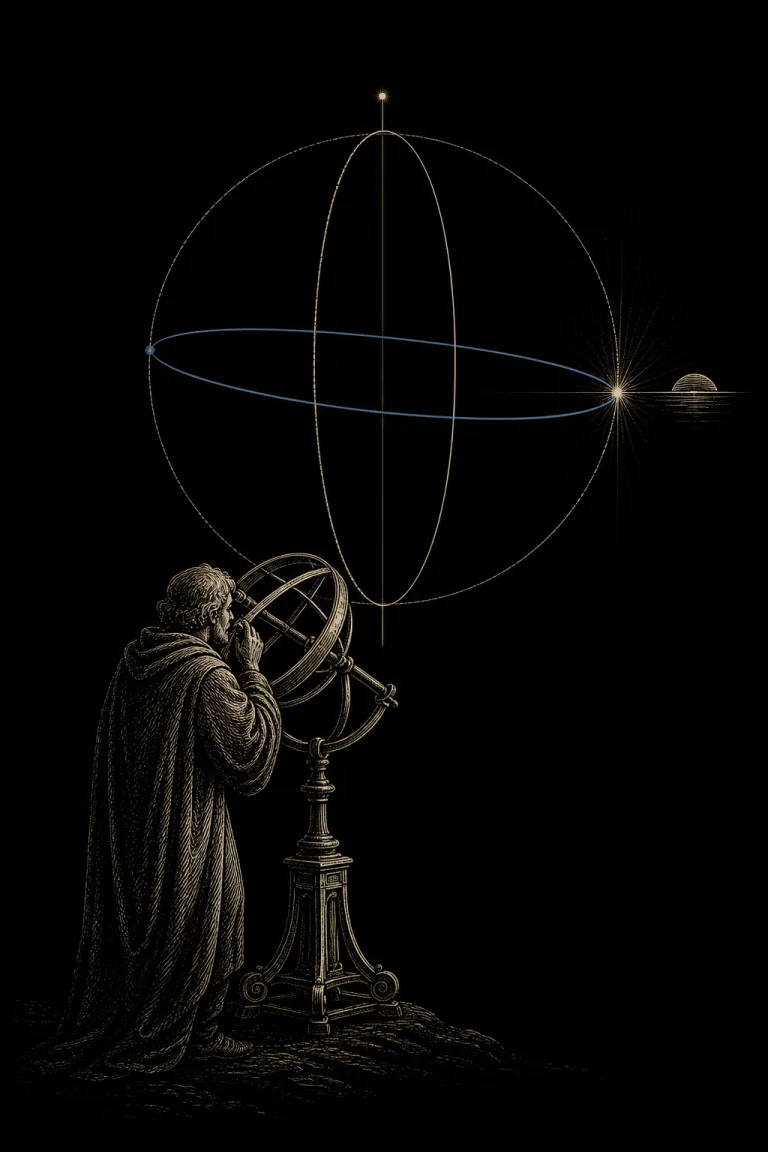
The Vertex in astrology is the western intersection of the ecliptic with the prime vertical, a great circle passing through the east point, zenith, west point, and nadir of a location. The opposite point is the Anti-Vertex. It is a mathematical point, not a planet, and its degree depends on birth time and place.
Modern astrologers often examine the Vertex in natal charts, synastry, and transits when an encounter feels unusually consequential or arrives through circumstances outside a person's usual plan. That language can be useful if it stays descriptive. A Vertex contact does not prove fate, permanence, compatibility, or a specific event.
Take the next insight with you
Explore personalized Astrology guidance in Veritas, available for iOS and Android.
 Scan with your phone
What the Vertex represents
In contemporary practice, the Vertex can focus attention on meetings, invitations, or turning points that feel as though they came from outside conscious planning. Its interpretation is relational, but not limited to romance. A teacher, collaborator, rival, client, friend, institution, or unexpected opportunity may become part of the story. The point gains meaning through contact with planets and angles rather than operating as a complete personality description.
Locate the Vertex in chart context
Open your natal chart in Veritas and compare exact angles, houses, rulers, and aspects before adding sensitive points such as the Vertex.
How the Vertex is calculated
The calculation uses the local relationship between the ecliptic and prime vertical, so the result changes with time and geographic location. Chart software usually reports a sign, exact degree, and opposite Anti-Vertex. Use the correct time zone and historical daylight-saving setting. If the recorded birth time is approximate, treat the degree and any close contacts as uncertain rather than choosing the result that feels most familiar.
Vertex versus Descendant
Both points usually appear on the western side of a chart, which is why the Vertex is sometimes compared with a second Descendant. They are geometrically different. The Descendant is the western intersection of the horizon and ecliptic, while the Vertex uses the prime vertical. The Descendant anchors the Ascendant-Descendant axis and the seventh-house framework; the Vertex is an additional sensitive point. Do not substitute one for the other.
How to interpret the Vertex
- Verify the data
Confirm date, exact local time, location, time zone, and daylight-saving rule before reading the degree.
- Read the sign
Use the sign to describe the style or qualities through which a consequential encounter may be experienced.
- Read the house
Use the house as the life area where the encounter or turning point becomes visible.
- Add close contacts
Prioritize tight conjunctions and oppositions from natal planets, another person's chart, or a transit.
- Return to evidence
Compare the symbolism with dates, choices, circumstances, and the relationship's actual development.
Vertex in fire signs
Aries Vertex encounters may emphasize initiative, candor, competition, or the need to act. Leo can highlight creative visibility, loyalty, leadership, or recognition. Sagittarius can bring learning, travel, belief, teaching, or a wider cultural horizon into focus. The sign does not identify a person's Sun sign. Read the point's exact ruler and contacts before deciding how the fire quality is expressed.
Vertex in earth signs
Taurus Vertex may focus value, resources, patience, embodiment, or continuity. Virgo can emphasize skill, service, analysis, health routines, or repair. Capricorn can bring responsibility, authority, structure, or long-term consequences into an encounter. Earth signs do not guarantee stability or material success. They describe the practical medium through which the contact is interpreted.
Vertex in air signs
Gemini Vertex may work through conversation, information, learning, siblings, or local networks. Libra can emphasize negotiation, reciprocity, aesthetics, or agreement. Aquarius can involve community, technology, reform, friendship, or an unconventional arrangement. Air placements make exchange visible, but the chart still needs evidence of commitment, emotional depth, and practical follow-through.
Vertex in water signs
Cancer Vertex may center care, home, protection, memory, or belonging. Scorpio can intensify questions of trust, privacy, shared resources, power, and change. Pisces can emphasize compassion, imagination, spirituality, art, uncertainty, or boundaries. Emotional intensity is not proof of destiny. Water symbolism needs especially clear consent, facts, and limits when projection is possible.
Compare the encounter with the whole chart
Use Veritas to examine relationship patterns through the established angles, planets, houses, and aspects, then treat the Vertex as an additional layer.
Vertex in synastry
In synastry, astrologers often watch one person's planet or angle conjunct the other person's Vertex or Anti-Vertex. The contact may describe recognition, disruption, attraction, learning, or a role that becomes significant. It does not show whether the relationship is healthy, mutual, or lasting. Compare both natal charts, two-way aspects, house overlays, communication, consent, timing, and observable behavior.
Transits to the Vertex
A planet crossing the Vertex can be used as a narrow timing marker for increased attention to encounters or developments described by that planet. Faster transits happen often and may be minor. Slower contacts can last longer or repeat through retrograde motion, but they still do not guarantee an event. Record the exact dates, orb, repeated passes, and concurrent transits before drawing a conclusion.
What if the birth time is unknown?
Without a reliable birth time, the Vertex is not a secure interpretive tool. The degree can shift enough to change sign, house, and close aspects. Do not rectify a chart by selecting a Vertex placement because one description matches a memorable relationship. You can still study date-stable planetary signs and many interplanetary aspects while acknowledging what the missing time prevents.
Common Vertex mistakes
Avoid calling every Vertex contact a soulmate marker, treating intensity as compatibility, using wide orbs until a desired aspect appears, or ignoring uncertain birth records. Do not confuse the Vertex with the Descendant, a planet, or a house cusp. Most importantly, do not let fate language remove agency. People still make choices, set boundaries, leave harmful situations, and decide what meaning an encounter earns over time.
Questions for reading your Vertex
How reliable is the recorded time? What sign, house, and ruler describe the point? Which contacts are genuinely close? What arrived through circumstances I did not plan? What choices followed the encounter? Did the connection become significant through mutual action, or only through expectation? Which part of the interpretation is documented, and which part is hindsight?