Astrology Journal
Synastry Chart Basics: How Two Birth Charts Interact
A synastry chart compares two natal charts through inter-chart aspects and house overlays. It describes patterns of contact, not a score or guarantee of relationship success.
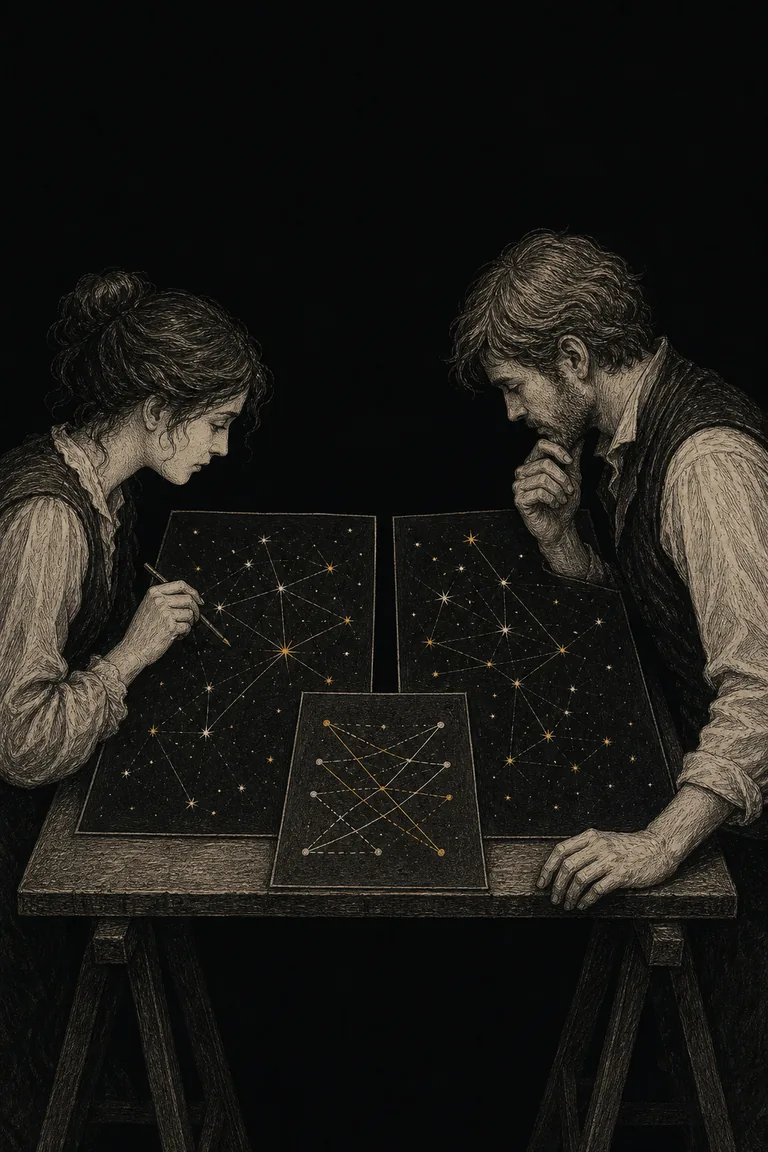
Synastry places two birth charts in conversation. The planets from one chart form aspects to the planets and angles in the other, showing where two symbolic systems reinforce, challenge, stimulate, or misunderstand each other. Both original natal charts remain intact.
This differs from a composite chart, which creates a separate chart from mathematical midpoints. Begin synastry with the two people as individuals, then study the contacts between them. Accurate birth times matter most for the Ascendant, Midheaven, houses, and the Moon when it changes significantly during the day.
Take the next insight with you
Explore personalized Astrology guidance in Veritas, available for iOS and Android.
 Scan with your phone
What a synastry chart shows
Synastry compares Person A’s planets with Person B’s planets and chart angles. A conjunction may concentrate two functions, a square may create pressure that demands adjustment, and a trine may support easier exchange. The result is a map of interactions, not a new person and not a verdict.
Compare two charts without losing the individuals
Create both natal charts in Veritas, understand each person’s core placements first, then note the closest contacts that shape communication, affection, action, and boundaries.
Start with reliable birth data
Use the recorded date, place, and exact time for each person when possible. Without a reliable time, avoid firm claims about houses and angles. The Moon may also move enough to change degree or sign on some dates, so use a time range rather than pretending to know an exact lunar contact.
Read each natal chart before the comparison
A synastry aspect activates functions already present in each chart. Venus square Saturn will not look identical for everyone because each natal Venus and Saturn has its own sign, house, aspects, and history. Knowing those foundations prevents a cookbook description from replacing the people involved.
Prioritize the personal planets and angles
Sun
Identity, vitality, purpose, and the experience of being recognized.
Moon
Emotional habits, comfort, responsiveness, and everyday regulation.
Mercury
Thinking, language, interpretation, and how misunderstanding is repaired.
Venus
Values, pleasure, attraction, reciprocity, and preferred forms of connection.
Mars
Initiative, desire, assertion, conflict, and the use of energy.
Angles
Strong points of recognition and life-area emphasis when both birth times are reliable.
How the major aspects behave
Conjunctions merge and intensify functions. Oppositions create polarity and awareness across difference. Squares generate friction, movement, and repeated negotiation. Trines support flow that may be easy to use or easy to take for granted. Sextiles offer cooperation that usually becomes stronger through participation.
Use tighter orbs for clearer contacts
Synastry can become noisy if every loose angle is treated as decisive. Start with exact and close aspects, especially those involving the Sun, Moon, personal planets, Ascendant, or Midheaven. Wider orbs may add background resonance, but they should not outrank a precise repeated pattern.
Planet-to-planet example: Mercury and Moon
A close Mercury-Moon contact links language with emotional response. A trine may make naming feelings easier, while a square can produce moments when analysis and feeling arrive at different speeds. Neither aspect guarantees communication quality. Listening, repair skills, and context determine how the pattern is lived.
Planet-to-planet example: Venus and Saturn
Venus-Saturn contacts can connect affection with commitment, time, limits, caution, or fear of rejection. A supportive aspect is not automatically warm, and a hard aspect is not automatically doomed. Ask how appreciation is expressed, which expectations are explicit, and whether responsibility is mutual.
What house overlays add
A house overlay shows where one person’s planet falls in the other person’s chart. Someone’s Sun in your fourth house may emphasize home, privacy, roots, or family themes for you. The house person experiences the life area; the planet person brings that planetary function into it. Accurate birth time is essential.
Outer planets need proportion
Uranus, Neptune, and Pluto move slowly, so contacts to the same generational planets are shared by many peers. They become more personal when tightly aspecting the Sun, Moon, Mercury, Venus, Mars, or an angle. Read intensity carefully and avoid turning Pluto or Neptune into proof of fate.
Look for repeated themes
One aspect rarely carries the whole relationship. If several contacts repeat communication tension, emotional ease, or differing approaches to responsibility, the theme deserves attention. Repetition across planet aspects and house overlays matters more than collecting isolated dramatic interpretations.
Synastry is not only romantic
The method can describe friendships, family relationships, creative partnerships, work teams, and mentorship. Choose language appropriate to the actual bond. Venus does not always mean romance, Mars does not always mean sexual attraction, and the seventh house does not erase consent or context.
How to organize a first reading
Begin with three areas: emotional regulation through the Moon, communication through Mercury, and values or initiative through Venus and Mars. Add Saturn for durability and expectations, then house overlays if times are reliable. Finish with one ease, one tension, and one behavior that could support repair.
What synastry cannot decide
No aspect proves love, loyalty, abuse, compatibility, permanence, or a soulmate bond. A flowing chart cannot compensate for unsafe behavior, and a difficult chart does not invalidate respect and skill. Use the chart to frame questions, then evaluate the relationship through direct evidence.
Astrology is a symbolic interpretive tradition, not a scientifically validated measure of relationship outcomes. Synastry cannot establish consent, diagnose a person, reveal private motives, or replace safety, medical, legal, or therapeutic support.
FREE CALCULATOR · PRIVATE BY DESIGN
Sun Moon Rising Compatibility Calculator
Calculate both Big Three profiles and inspect exact conjunctions, oppositions, trines, squares, and sextiles between them.