Astrology Journal
Vesta in Astrology: Focus, Signs, Houses, and Aspects
Vesta adds a modern astrological layer about focused attention, devotion, boundaries, and the practices that keep meaningful work alive.
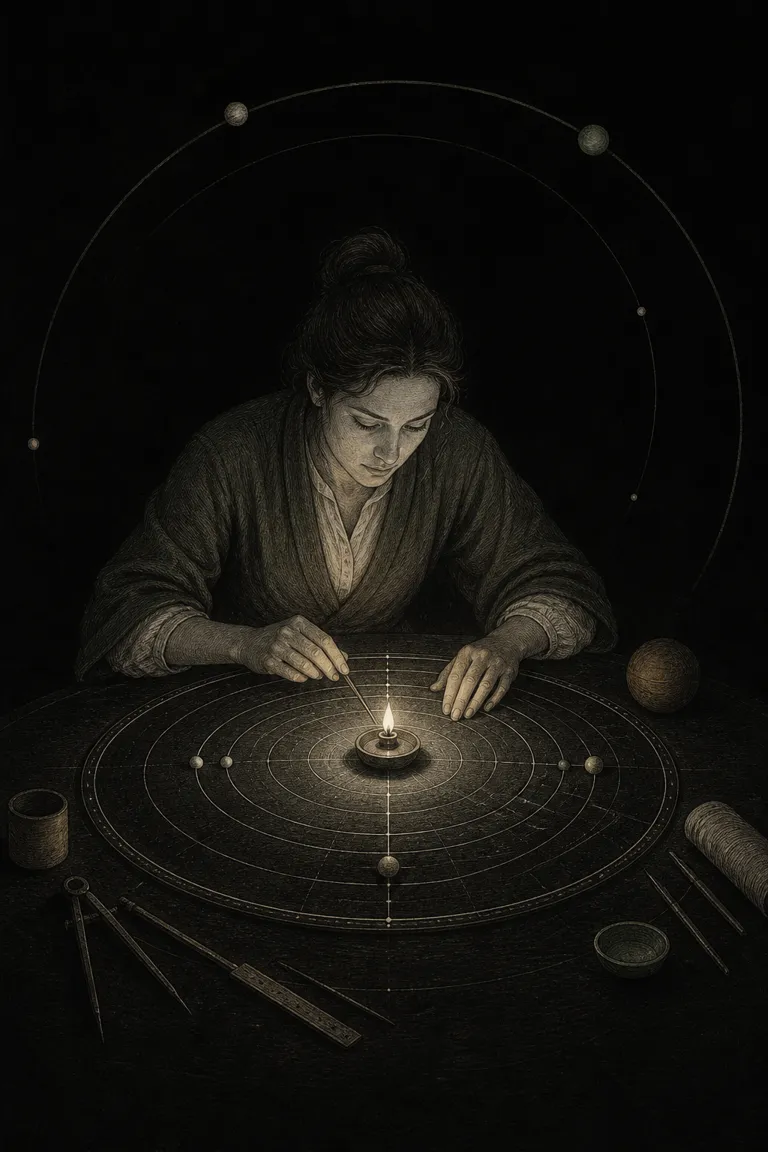
Vesta in astrology is a modern asteroid symbol associated with focus, devotion, self-possession, ritual, and the careful direction of energy. Astronomically, 4 Vesta is one of the largest bodies in the main asteroid belt. It was discovered in 1807 and named for the Roman goddess of the hearth. Astrologers use that name and mythology as a symbolic layer, not as scientific evidence that the asteroid causes personality or events.
A natal Vesta placement can be read as a prompt about what receives concentrated attention and which conditions keep that commitment sustainable. The sign suggests a style of devotion, the house locates a life area, and close aspects connect the theme with other chart functions. Vesta does not require celibacy, sacrifice, spiritual work, or constant productivity. Healthy focus includes rest, consent, and a boundary around what matters.
Take the next insight with you
Explore personalized Astrology guidance in Veritas, available for iOS and Android.
 Scan with your phone
What Vesta represents in a birth chart
Vesta is commonly used for concentration, vocation, ritual continuity, privacy, autonomy, and the management of time or life force. Its hearth symbolism is less about domestic stereotypes than about a center that must be tended. Constructively, Vesta can support craft, integrity, and deep work. Under strain, the same theme can become fixation, depletion, rigid purity rules, or isolation defended as commitment.
Place Vesta inside the whole chart
Use Veritas to compare Vesta with Saturn, the sixth house, the chart ruler, and close aspects before deciding how devotion operates in your life.
How to find your Vesta placement
Use a chart calculator that explicitly includes asteroid 4 Vesta. Enter an accurate birth date, time, and location, then record its sign, exact degree, house, zodiac, and house system. The date establishes most of the zodiac position, while time and place are necessary for a reliable house and can matter near a sign boundary. If the birth time is unknown, interpret the sign and aspects cautiously and omit a confident house claim.
Vesta in the fire signs
Aries Vesta may focus through decisive action and independent initiation. Leo Vesta can sustain a creative practice through wholehearted presence and pride in craft. Sagittarius Vesta may devote energy to study, belief, teaching, travel, or a larger horizon. Fire needs a living purpose, but intensity can burn through recovery. The practical question is how enthusiasm becomes a repeatable practice instead of an emergency pace.
Vesta in the earth signs
Taurus Vesta may concentrate through steady sensory routines, material care, and patient cultivation. Virgo Vesta can emphasize precision, service, repair, and improvement. Capricorn Vesta may organize devotion through responsibility, standards, and long-range structure. Earth placements can build durable skill, yet usefulness must not become the sole measure of worth. Maintenance includes the body and the worker, not only the output.
Vesta in the air signs
Gemini Vesta may dedicate attention to language, research, teaching, or the disciplined exchange of ideas. Libra Vesta can focus through form, fairness, mediation, or an intentional relational practice. Aquarius Vesta may serve a system, community, experiment, or reform. Air focus benefits from a clear question and stopping rule, since endless comparison or conceptual distance can protect the work from real participation and feedback.
Vesta in the water signs
Cancer Vesta may tend memory, home, protection, and emotionally meaningful continuity. Scorpio Vesta can concentrate on confidential, intimate, investigative, or transformative work. Pisces Vesta may devote energy to art, contemplation, compassion, or spiritual practice. Water placements need containers that distinguish sensitivity from unlimited access, empathy from rescue, and retreat that restores attention from withdrawal that erodes support.
Vesta through the houses
The house shows where concentrated commitment becomes most visible. The first may link it with identity and autonomy; the second with values and resources; the third with learning and language; the fourth with home and private roots; the fifth with creative practice; the sixth with daily work and maintenance; the seventh with agreements; the eighth with shared stakes; the ninth with study and belief; the tenth with vocation; the eleventh with collective work; and the twelfth with retreat or unseen service.
Vesta aspects
Aspects show where Vesta meets another chart function. Sun contacts can join devotion with identity, Moon contacts with emotional rhythm, Mercury with concentrated thought, Venus with values and selective connection, and Mars with directed effort. Saturn can strengthen endurance or austerity, Uranus can alternate focus and disruption, Neptune can inspire or blur boundaries, and Pluto can intensify commitment and control. Use modest orbs and prioritize exact contacts rather than collecting every possible link.
Vesta versus Saturn and the sixth house
Saturn describes limits, responsibility, consequence, time, and the work of developing authority. The sixth house covers routines, labor, maintenance, health practices, and service as a life area. Vesta adds a narrower modern prompt about concentrated devotion and what must remain protected at the center of a practice. A strong Vesta does not replace Saturn or the sixth house, and none of these symbols makes overwork virtuous.
Design a sustainable focus practice
Use Veritas to identify the chart context around Vesta, then choose one boundary, rhythm, or recovery condition that helps attention remain available.
Vesta in relationships and synastry
In relationships, Vesta can describe the need for protected time, meaningful ritual, selective intimacy, or dedication to a shared practice. In synastry, a close contact to another person's planet or angle may make focus, autonomy, service, or sacrifice more noticeable. It does not prove spiritual union or justify unavailable behavior. Compare actual consent, workload, emotional safety, and each person's freedom to revise the arrangement.
Vesta transits and returns
A Vesta transit can be used to review attention, boundaries, and commitment when it closely contacts a natal placement. A Vesta return occurs when transiting Vesta reaches its natal degree and may renew questions about the practice at your center. Asteroid timing should remain secondary to major planetary transits and real conditions. It is more useful for auditing a commitment than predicting a destined calling or crisis.
A practical way to read Vesta
- Verify the placement
Record the sign, exact degree, house confidence, zodiac, house system, and only the closest aspects.
- Name the focus
Translate the sign and house into a concrete practice, responsibility, question, or protected life area.
- Check the fuel
Identify what sustains attention, including time, privacy, tools, community, bodily care, and permission to stop.
- Test the boundary
Ask whether devotion strengthens life or relies on depletion, secrecy, shame, or an agreement no one can revise.
Common Vesta interpretation mistakes
Avoid turning Vesta into a purity test, a command to serve, or a guarantee of vocation. Mythic associations with virginity should not be used to prescribe sexuality or relationship status. Do not equate a sixth-house placement with illness, a twelfth-house placement with isolation, or a Saturn aspect with inevitable deprivation. Astrology is a symbolic practice. Birth-time uncertainty, calculator settings, and lived context should remain explicit.
Questions for your Vesta placement
What deserves my sustained attention? Which conditions help me return to it? What boundary protects the practice without cutting off support or feedback? Where has devotion become identity, control, or avoidance? Which part of the work can be shared? What kind of rest preserves integrity? If the commitment changed, what central value would I still want to keep alive?