Numerology Journal
Essence Cycles in Numerology: Calculate Your Number
Essence Cycles combine the active letter transit from each part of a birth name into a changing birthday-to-birthday theme with an irregular rhythm.

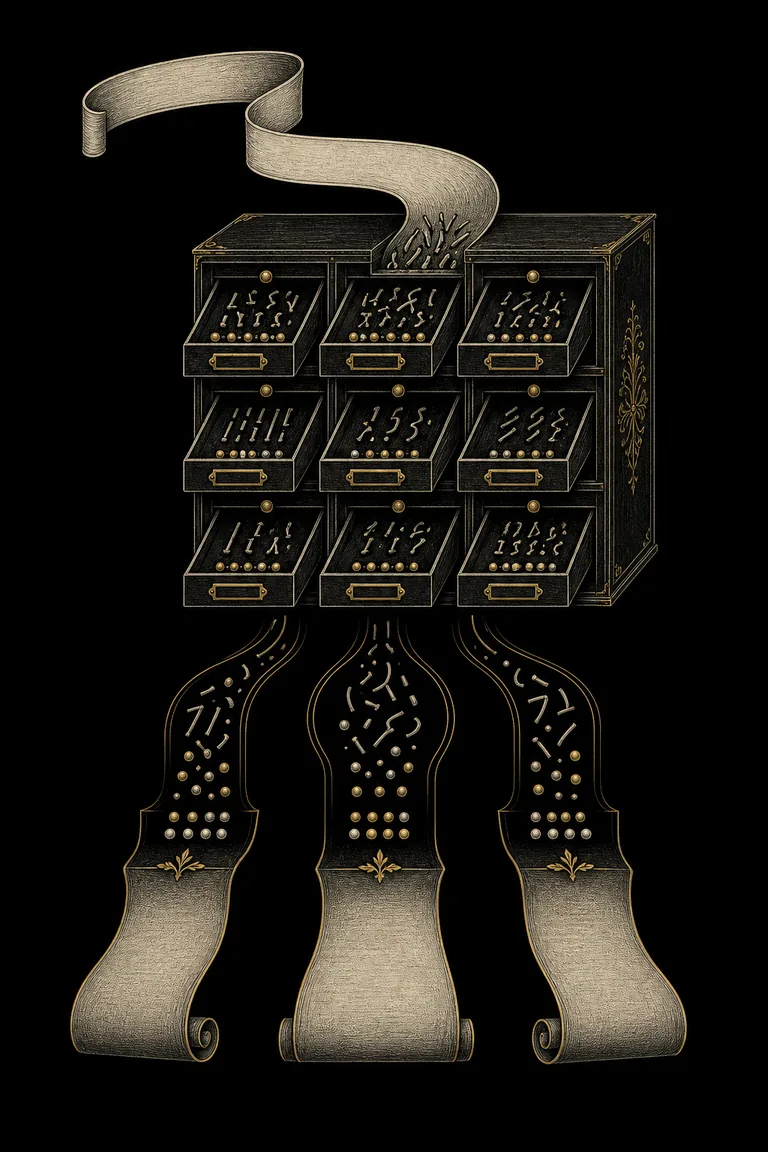
Essence Cycles are a name-based timing method in Pythagorean numerology. Each letter in every part of the full birth name becomes active for a number of years equal to its numerical value. The active letters from the first, middle, and last names are added together to produce an Essence Number for a particular age.
The method is more complex than a Personal Year because each name part advances on its own schedule. It also has competing timing conventions, especially around whether the first transit begins at birth or at the first birthday. A responsible calculation states its convention, maps every letter interval, and treats the result as a reflection prompt rather than a forecast of events.
Take the next insight with you
Explore personalized Numerology guidance in Veritas, available for iOS and Android.
 Scan with your phone
Essence Cycles at a glance
An Essence Number comes from the Transit letters active in each segment of the full birth name. It changes on an irregular rhythm because letters last from one to nine years and each name segment loops independently. The cycle is commonly read from birthday to birthday. It does not measure a person's essence, predict a required event, or replace decisions based on evidence.
Compare name and birth-date patterns
Explore your core numerology in Veritas, then use Essence Cycles as a separate timing layer instead of mixing every method into one prediction.
The Pythagorean letter chart
Assign letters in repeating groups: A, J, and S equal 1; B, K, and T equal 2; C, L, and U equal 3; D, M, and V equal 4; E, N, and W equal 5; F, O, and X equal 6; G, P, and Y equal 7; H and Q equal 8; I and R equal 9. Use the full name recorded at birth and keep each name segment separate.
How long each letter stays active
A letter remains active for the number of years represented by its value. A value 1 letter lasts one year, a value 5 letter lasts five years, and a value 9 letter lasts nine years. When the last letter in one name segment expires, that segment returns to its first letter while the other segments continue on their own schedules.
How to calculate an Essence Number
First, write each name segment on its own row and convert every letter to a number. Second, turn each number into a duration and mark the age interval it occupies. Third, choose the age or birthday-to-birthday year you want to examine. Fourth, take the one active letter from every row, add their values, and reduce the total. Keep 11 or 22 only if the school you follow preserves Master Numbers in Essence calculations.
Worked example at age 10
Use the fictional birth name Mia Rose Kent and the convention that age 0 begins at birth. In Mia, M equals 4 and covers ages 0 through 3, while I equals 9 and covers ages 4 through 12. In Rose, R equals 9 and covers ages 0 through 8, while O equals 6 and covers ages 9 through 14. In Kent, K equals 2, E equals 5, and N equals 5, so N covers ages 7 through 11. At age 10 the active values are 9, 6, and 5. Their total is 20, which reduces to Essence 2.
The birthday-boundary convention
Many practitioners run Essence periods from one birthday to the next, but published systems differ about the first interval. Some begin the first letter at birth; others describe its influence as beginning with the first birthday. This creates a one-year shift near every boundary. Do not hide the discrepancy. State the convention beside the chart and use it consistently when comparing years.
No middle name or several middle names
If the recorded birth name has no middle name, calculate with the available first and last name rows. If it has several middle names, keep each segment as its own independent row and add all active letters. Do not invent a placeholder segment. Hyphens, spaces, suffixes, accents, and transliteration choices should be documented because different conventions can change the timing map.
Essence 1, 2, and 3
Essence 1 emphasizes initiative, authorship, independence, and a clear beginning. Essence 2 emphasizes cooperation, patience, sensitivity, and reciprocal agreement. Essence 3 emphasizes expression, learning through feedback, sociability, and creative completion. None requires a matching event; use the number to notice which capacity needs deliberate practice.
Essence 4, 5, and 6
Essence 4 emphasizes structure, maintenance, skill, and workable limits. Essence 5 emphasizes movement, experimentation, freedom, and informed adaptation. Essence 6 emphasizes care, responsibility, home, teaching, and shared standards. The shadow appears when structure becomes rigidity, freedom ignores consequences, or care becomes control.
Essence 7, 8, and 9
Essence 7 emphasizes inquiry, privacy, evidence, and depth. Essence 8 emphasizes authority, resources, exchange, and proportionate power. Essence 9 emphasizes completion, compassion, creativity, and release. A useful reading converts the theme into an observable question while preserving relationships, material conditions, and professional advice.
Master Number Essence 11 and 22
Some schools preserve a total of 11 or 22 before reduction and read it together with 2 or 4. An 11/2 Essence can frame heightened perception that needs cooperation and grounding. A 22/4 Essence can frame larger-scale building that needs structure and accountability. These numbers are not ranks, guarantees, or proof of unusual ability. Other schools reduce every result to one digit, so record the rule used.
Essence Cycles versus Personal Years
Essence Cycles come from birth-name letter transits and follow an irregular birthday-based rhythm. Personal Years come from birth month, birth day, and a calendar year, then move through a repeating one-to-nine sequence. They are separate symbolic systems. Calculate both independently before comparing them, and do not force agreement when their themes differ.
Essence Cycles versus Period Cycles
Period Cycles reduce the birth month, day, and year into three broad life phases. Essence Cycles track active letters across each name segment and can change many times. Pinnacles and Challenges use still other formulas. The shared word cycle does not make the methods interchangeable, so label every result with its source formula.
Common calculation mistakes
The most common errors are merging all names into one row, advancing every row when only one letter expires, counting age boundaries inconsistently, losing the unreduced total, or using a current nickname without noting the change. Build the timeline before interpreting it. A spreadsheet can help, but verify several transitions by hand so a formula error does not repeat across the full chart.
A grounded way to use the cycle
For the current Essence, write one capacity to practice, one excess to watch, and one decision that needs real evidence. Review the previous birthday-to-birthday period for actual patterns without selecting only convenient examples. Numerology is not scientifically validated forecasting, so do not use an Essence Number to time medical care, legal action, financial commitments, or relationship safety decisions.