Tarot Journal
Eight of Cups Tarot Meaning: Leaving and Discernment
The Eight of Cups marks a deliberate departure from something that still has value but no longer supports honest participation, growth, or emotional alignment.

The Eight of Cups Tarot meaning centers on leaving, searching, and recognizing when continued investment cannot repair a deeper mismatch. The card often appears when a role, relationship, goal, or familiar identity is no longer enough, even if it once mattered and is not an obvious failure.
This is not automatic advice to disappear. A mature reading asks what has actually been tried, what duties remain, whether safety changes the timeline, and what the traveler is moving toward. Tarot can organize reflection, but it cannot replace direct communication, professional advice, or a practical exit plan.
Take the next insight with you
Explore personalized Tarot guidance in Veritas, available for iOS and Android.
 Scan with your phone
Eight of Cups meaning at a glance
Upright, the Eight of Cups can indicate emotional completion, withdrawal from a hollow success, a search for meaning, or the courage to stop repeating an unproductive cycle. Reversed, it can describe fear of leaving, repeated returns, avoidance disguised as freedom, or a premature exit from a situation that still deserves a clear conversation. In either orientation, the question is whether distance serves truth or merely postpones discomfort.
Read the departure in context
Open a Tarot reading in Veritas and compare the Eight of Cups with the question, surrounding cards, practical evidence, and the responsibilities that remain.
Eight of Cups symbols
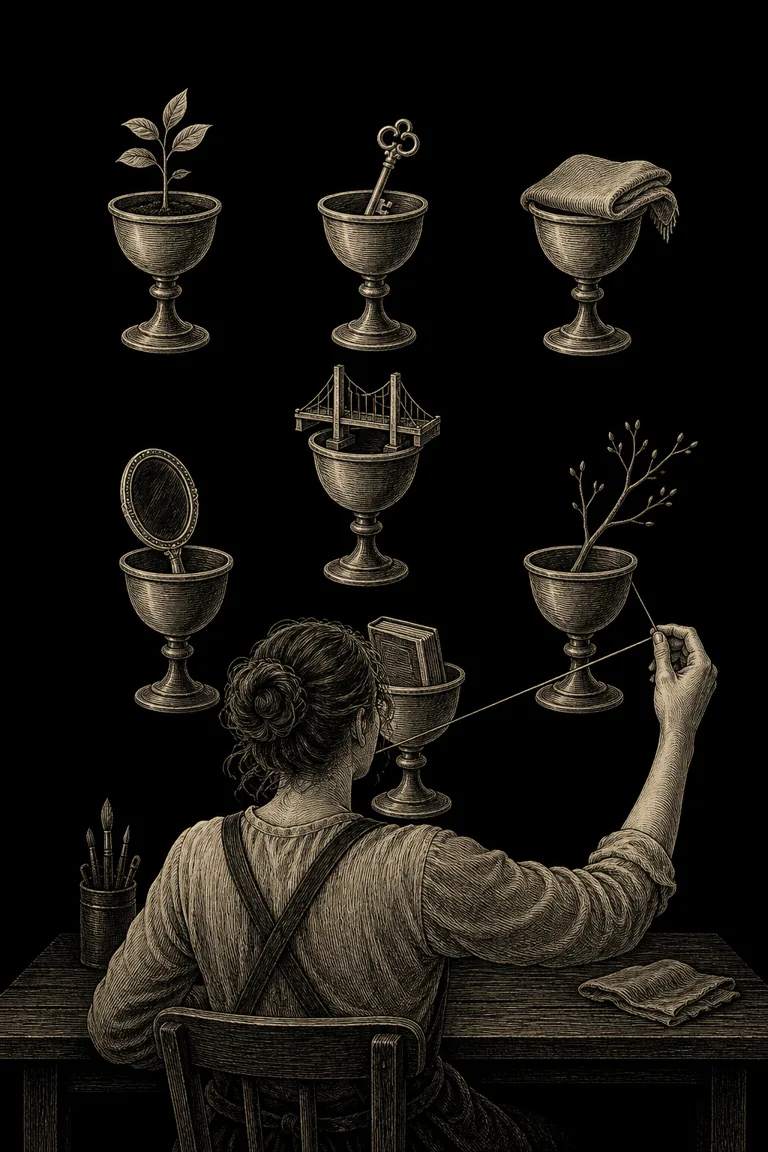
In the Rider-Waite-Smith image, eight cups remain standing while a traveler walks into uneven country beneath a moon. The intact cups show that departure is not always caused by destruction. The gap in their arrangement suggests something essential is missing. Mountains imply effort and a less certain route, while the moon adds incomplete information and mixed feeling. These symbols support interpretation; they do not predict a literal journey or secret betrayal.
Upright Eight of Cups meaning
Upright, the card favors an honest inventory. A person may have reached the limit of what recognition, habit, or emotional labor can provide. Leaving can mean resigning, ending a pattern, reducing contact, abandoning an outdated target, or taking space to learn what is actually wanted. The healthiest version includes a destination, a boundary, and appropriate closure rather than relying on absence to communicate.
Reversed Eight of Cups meaning
Reversed, the Eight of Cups may show cycling between departure and return, staying because uncertainty feels worse than dissatisfaction, or leaving whenever intimacy and accountability deepen. It can also indicate a thoughtful return after new information changes the decision. Ask what has materially changed. A reversed card does not command reconciliation or prove that someone will come back.
Eight of Cups in love and relationships
In love, the card can describe emotional distance, a need for space, the end of an old relational pattern, or a decision that affection alone cannot solve. For an established relationship, discuss the unmet need in observable terms before assuming the bond must end. For a breakup, the card supports grief and forward movement without promising reunion. For a new connection, it may ask whether someone is genuinely available or still walking away from an earlier chapter.
Eight of Cups as feelings
As feelings, the Eight of Cups can suggest disappointment, emotional fatigue, detachment, or a desire for a more meaningful connection. It may also reflect a person protecting attention while they reassess. Feelings are not commitments and Tarot cannot reveal another person's private mind. Look for direct statements, consistent behavior, and consent instead of treating the card as surveillance.
Eight of Cups for career and money
At work, the card may point to leaving a role whose cost now exceeds its learning, income, or purpose. Before resigning, distinguish a temporary difficult phase from a structural mismatch, review contracts and benefits, preserve records, and plan the handoff. With money, it can mean ending sunk-cost spending or abandoning an investment thesis that no longer holds. Financial consequences require current figures and qualified advice, not a card alone.
Eight of Cups advice
The advice is to stop using past effort as the only reason to continue. Define the condition that would justify staying and the evidence that condition is realistically available. If leaving is necessary, choose the safest proportionate form: a conversation, a reduced commitment, a trial separation, a handover, or a complete exit. If there is abuse or immediate danger, prioritize specialist support and safety planning over symbolic interpretation.
Eight of Cups yes or no and timing
For yes or no, the Eight of Cups leans no when the question asks whether the current arrangement can continue unchanged. It can lean yes when the question asks whether to acknowledge completion, seek a better fit, or release a sunk cost. For timing, it describes a threshold reached after evidence accumulates rather than a guaranteed date. Set a review point based on facts, obligations, and safety.
Eight of Cups combinations
With the Seven of Cups, test imagined alternatives before choosing one. With the Five of Cups, grief may need acknowledgment before departure becomes clean. With The Hermit, purposeful solitude supports study and discernment. With the Devil, examine attachment, coercion, or dependency and seek practical support. With Judgement, the departure follows a full review and may involve answering a long-delayed call. Read the pair as one sentence rather than stacking keywords.
Define a responsible threshold
Use Veritas to name what is no longer workable, what evidence could change your mind, which obligations remain, and the smallest safe next step.
A four-question departure test
- What is missing?
Describe the unmet need or broken condition without turning discomfort into a vague verdict.
- What has been tried?
Record the conversations, repairs, boundaries, or experiments and their observable results.
- What must be completed?
Identify safety, legal, financial, caregiving, or handover responsibilities that affect the exit.
- What are you moving toward?
Choose a destination, support, learning goal, or review date so departure is more than escape.
Common Eight of Cups mistakes
Do not assume the card always means a breakup, ghosting, travel, or permanent abandonment. Do not romanticize leaving when repair is possible, or shame someone for staying while they build safety and resources. Avoid predicting that another person will return. The Eight of Cups is most useful when it turns emotional dissatisfaction into a specific, responsible decision process.