
Tarot Journal
Five of Wands Tarot Meaning: Conflict and Creative Friction
The Five of Wands brings competing views into the open and asks whether the friction can improve the work without turning people into opponents.
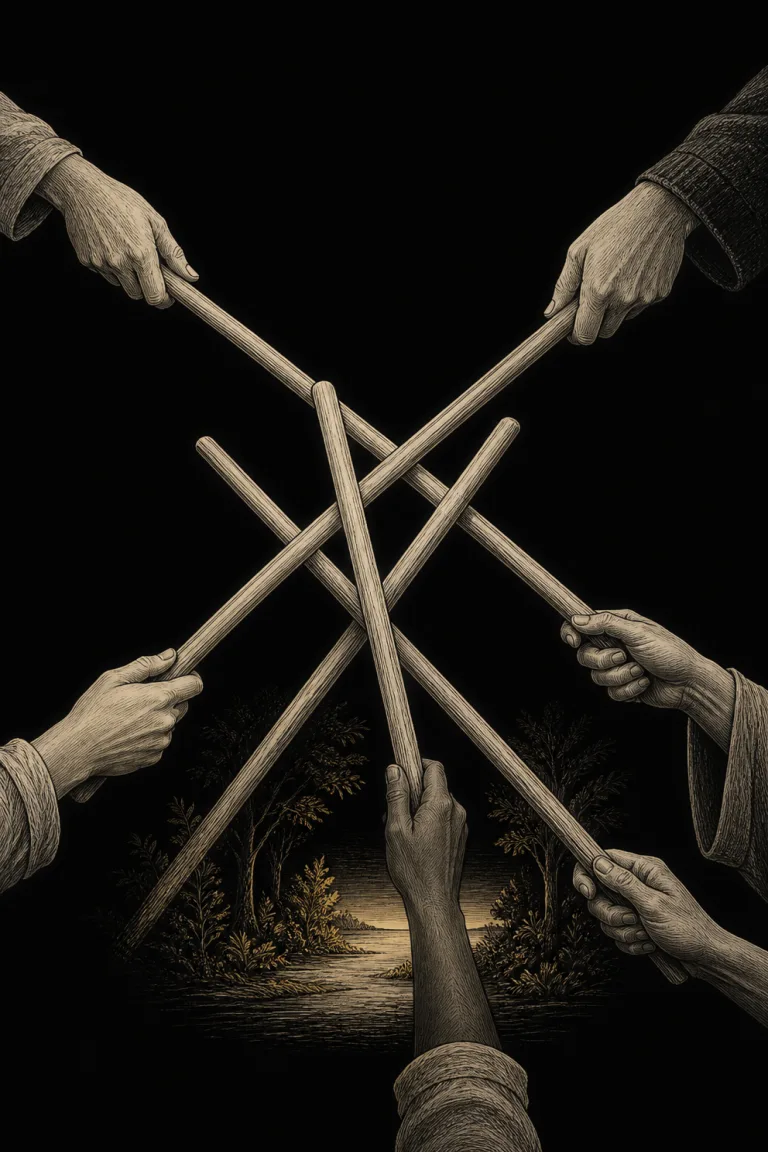
The Five of Wands is a Tarot card of competition, disagreement, rehearsal, and creative friction. Five figures raise wands in different directions, but the scene does not clearly show a winner or an injury. In a reading, it often names a situation where several needs, opinions, or methods are competing for space.
This card does not prove that someone is an enemy or that conflict must escalate. It asks what the struggle is actually about, which rules are missing, and whether the energy can be organized into a useful exchange. The spread position, surrounding cards, and real behavior decide whether the conflict is playful, necessary, draining, or unsafe.
Take the next insight with you
Explore personalized Tarot guidance in Veritas, available for iOS and Android.
 Scan with your phone
Five of Wands meaning at a glance
Upright, the Five of Wands can point to rivalry, debate, mixed signals, competition, testing, busy collaboration, or a clash of priorities. Reversed, it may describe conflict avoidance, a dispute moving underground, exhaustion from repeated arguments, or a workable truce. Neither position is automatically good or bad. Some disagreement exposes a better solution; some simply consumes attention.
See what the tension is asking for
Open a Tarot reading in Veritas and compare the Five of Wands with its position and neighboring cards before deciding whether to engage, negotiate, or step back.
Symbols in the Five of Wands
In the Rider-Waite-Smith image, five young figures hold their wands at cross-purposes. Their clothing is varied, which can suggest distinct perspectives rather than a single coordinated goal. The open ground gives the scene a practice-like quality: energy is real, yet the outcome has not been fixed. In another deck, look for whether the wands form a game, a barrier, a contest, or a dangerous confrontation.
Upright Five of Wands
Upright, this card often appears when several valid ideas are trying to occupy the same space. A team may be debating scope, friends may want different plans, or an inner decision may pull toward five competing tasks. The useful move is not to force instant harmony. Name the shared aim, separate preferences from nonnegotiable needs, and give each proposal a fair test where possible.
Reversed Five of Wands
Reversed, the Five of Wands can show a conflict being suppressed rather than resolved. Politeness may hide resentment, or a person may withdraw because the effort of arguing feels too high. It can also mark de-escalation after a chaotic period. Ask whether quieter conditions came from a real agreement, a clearer role, or simply from someone no longer being heard.
Five of Wands in love and relationships
In relationships, the card can describe recurring disagreements, mismatched schedules, competing needs, jealousy, or the awkward energy of learning how to share a life. It does not confirm betrayal or incompatibility. A constructive reading looks for a specific topic, a listening rule, and a repair plan. If there is intimidation, coercion, or fear, prioritize real-world support and safety over symbolic interpretation.
Five of Wands as feelings
As feelings, the card may suggest agitation, attraction mixed with defensiveness, a wish to prove oneself, or uncertainty about where one stands. Tarot cannot verify another person’s private feelings. Use direct communication and consistent behavior as the evidence, especially when a relationship already contains mixed messages or unequal power.
Five of Wands for career and money
At work, the Five of Wands can show a competitive interview, a noisy brainstorm, overlapping responsibilities, or a project with too many owners. It favors a clear brief, decision criteria, and a visible handoff. For money, it may point to competing expenses, bids, or advice. Do not treat the card as investment guidance. Compare current numbers, risks, and deadlines before committing.
Five of Wands as advice
Choose the contest you are actually willing to enter. State the point of disagreement in one sentence, ask what success would look like for everyone involved, and decide how the group will make a final call. If the issue has no shared purpose, reduce access to it. Not every argument deserves more preparation or emotional labor.
Turn competing signals into a next step
Use Veritas to ask what each side is protecting, which rule would make the exchange fairer, and what action would reduce needless conflict.
Five of Wands in a yes or no reading
The Five of Wands is usually a qualified maybe. It can lean yes when the question is about auditioning, practicing, testing an idea, or entering a fair competition. It can lean no when the situation requires immediate peace, reliable consensus, or a simple path. Ask what conditions would make participation worthwhile.
Useful card combinations
With the Three of Wands, differing views may be part of expanding a project beyond its first plan. With the Two of Swords, a stalled choice can keep everyone circling the same disagreement. With Justice, clear criteria and accountability matter more than persuasion. With Temperance, a careful blend of approaches may resolve the tension. With the Tower, the clash may reveal a structure that was already unstable.
A practical way to work with the card
- Name the actual issue
Replace labels such as difficult or competitive with the concrete decision, resource, or boundary under pressure.
- Separate interests
Ask what each person or option is trying to protect before choosing a side.
- Set fair terms
Agree on time, evidence, roles, and the decision rule so volume does not become authority.
- Review the cost
If the exchange keeps producing harm without new information, pause or change the structure.
Common Five of Wands mistakes
Do not use this card to justify hostility, diagnose a rival, or stay in a damaging environment for the thrill of challenge. Avoid assuming every disagreement is productive or every quiet room is peaceful. The Five of Wands is strongest when it helps you distinguish a useful test from a contest that has lost its purpose.