Tarot Journal
Two of Swords Tarot Meaning: Choice, Pause, and Boundaries
The Two of Swords marks a guarded pause when the available choices carry real tradeoffs and the information needed for a responsible decision is still incomplete.
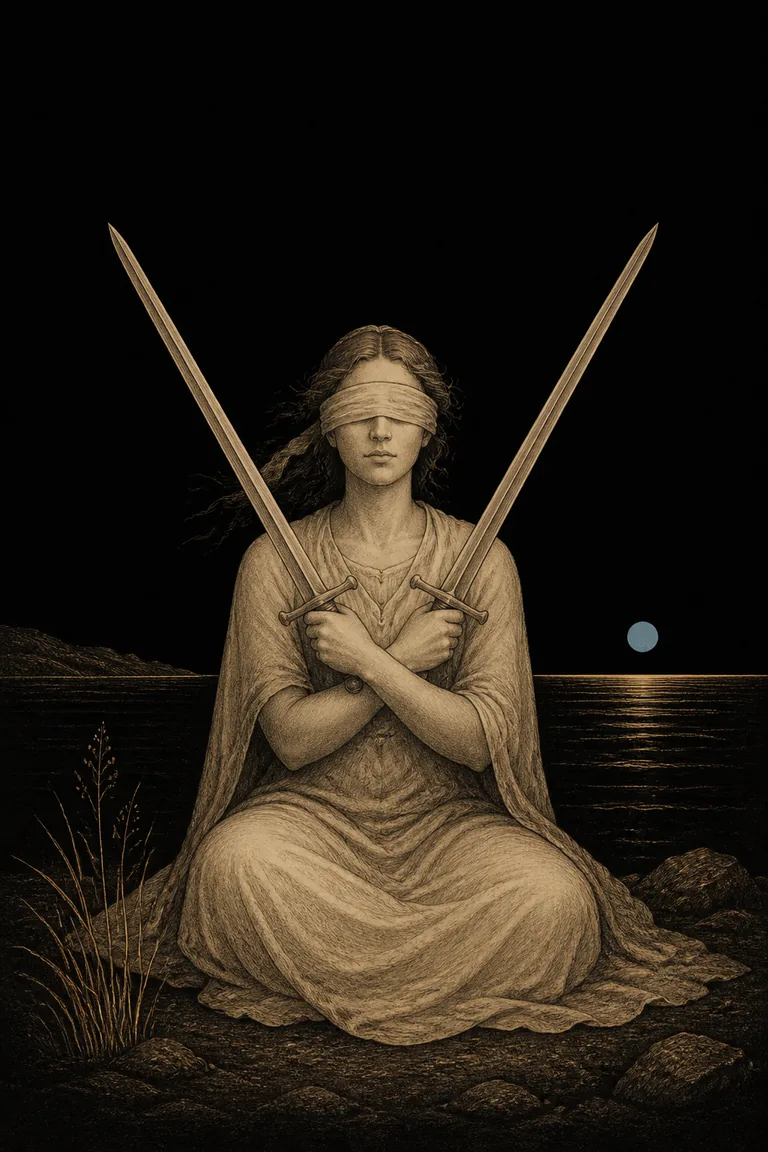
The Two of Swords is a card of suspended judgment, boundaries, and difficult choice. In the Rider-Waite-Smith image, a blindfolded figure sits before water while holding two crossed swords. The posture creates a temporary barrier: thought is active, but neither route has yet earned commitment.
This card does not mean that every delay is wise or that intuition should replace evidence. It asks what the pause is protecting, which fact could materially change the choice, and when waiting begins to create its own consequence. A useful reading distinguishes a deliberate review from fear, coercion, or avoidance.
Take the next insight with you
Explore personalized Tarot guidance in Veritas, available for iOS and Android.
 Scan with your phone
Two of Swords meaning at a glance
Upright, the Two of Swords can indicate a stalemate, guarded neutrality, competing arguments, emotional self-protection, or time needed to compare consequences. Reversed, it may show information overload, a decision made under pressure, denial becoming harder to sustain, or the first movement out of paralysis. Context decides whether the pause is skillful or costly.
Read the decision inside the spread
Open a Tarot reading in Veritas and compare the Two of Swords with its position, neighboring cards, and the real choice that brought you to the reading.
Symbols in the Two of Swords
In the familiar Rider-Waite-Smith scene, the blindfold limits sight but does not erase awareness. The crossed swords form both a balance and a defense. Water behind the figure suggests feelings and change that cannot be excluded forever, while the uneven shoreline complicates the idea of two perfectly equal options. Decks vary, so begin with the details actually shown in your card rather than forcing one inherited symbol list.
Upright Two of Swords
The upright card often appears when a decision needs a fair process more than a fast answer. Two positions may each contain a valid concern, or neither may yet be supported by enough evidence. Protecting time to think can be responsible. The task is to define what the pause is for, gather the few facts that could change the choice, and avoid pretending that indefinite neutrality has no impact.
Reversed Two of Swords
Reversed, the card may describe pressure breaking a stalemate, conflicting information becoming unmanageable, or a choice that has already been made privately but not acknowledged. It can also show that a protective boundary has hardened into disconnection. Reduce the question to its decision criteria, check whether the deadline is real, and seek support when fear or power imbalance prevents free choice.
Two of Swords in love and relationships
In relationships, the Two of Swords can mark an unresolved conversation, a boundary that has not been explained, or hesitation between continuing, changing terms, and leaving. Silence may create space, but it cannot substitute for consent or a shared agreement. Name what is undecided, what each person needs to know, and when the issue will be revisited. Tarot cannot decide compatibility or safety for either person.
Two of Swords as feelings
As feelings, this card can suggest guarded interest, ambivalence, emotional restraint, or a wish to avoid choosing between competing loyalties. It may also reflect the reader's uncertainty rather than another person's inner state. Do not use the card to claim access to private thoughts. Ask directly, observe consistent behavior, and allow a clear answer to carry more weight than symbolic inference.
Two of Swords for career
For work, the card may appear during a job comparison, role conflict, stalled approval, negotiation, or a choice between stability and change. Compare authority, compensation, workload, learning, support, and exit conditions. If two offers look equal, test the daily reality rather than only the title. If a manager is withholding essential information, the problem is not your inability to decide.
Two of Swords for money
Financially, the Two of Swords favors a temporary hold while costs, terms, or risks are checked. It does not promise that waiting will improve the market or remove the loss. Separate necessary expenses from reversible choices, verify fees and obligations, and consult a qualified professional for consequential decisions. Reversed, avoidance may be allowing interest, penalties, or an unsuitable agreement to grow.
Two of Swords as advice
Create a decision boundary. State the exact question, the values that must be protected, the evidence still missing, and the latest responsible date for action. If no new fact can change the choice, the remaining discomfort may be the cost of committing rather than proof that more analysis is needed. A smaller reversible step can reveal more than another round of abstract comparison.
Two of Swords in a yes or no reading
The Two of Swords is usually a not-yet answer rather than a clean yes or no. Upright, pause long enough to clarify terms and consequences. Reversed, the waiting period may be ending, but pressure alone does not make an option suitable. Binary Tarot is especially limited when health, law, money, safety, or another person's consent is involved.
Important Two of Swords combinations
With Justice, the choice needs evidence and a fair procedure. With The High Priestess, quiet observation may be useful, but secrecy still has consequences. With The Lovers, values and consent must become explicit. With the Ace of Swords, one clear fact or statement can break the stalemate. With the Two of Wands, the issue shifts from whether to decide toward which route deserves commitment. With The Tower, delay may no longer preserve the existing position.
A practical decision-pause exercise
- Name the decision
Write one sentence that describes the choice in concrete terms and remove imagined future identities.
- Protect the essentials
List the safety, consent, financial, ethical, or capacity limits that neither option may violate.
- Find the pivotal fact
Identify the one or two unknowns that could genuinely change the decision and how they can be verified.
- Set the review point
Choose when you will decide, ask for new terms, or consciously extend the pause with a stated reason.
Turn the pause into a clearer question
Use Veritas to explore a focused spread, then translate the cards into facts to verify, boundaries to state, and one next conversation.
Questions to ask when this card appears
What is this pause protecting? Which information is truly missing? Who bears the cost while I wait? Are the options genuinely equal, or does one violate a firm boundary? What would a fair process look like? When will I review the decision? These questions respect uncertainty without turning it into a permanent shelter.