Tarot Journal
How to Store Tarot Cards: Protection and Care
Store Tarot cards in a clean, dry, shaded place inside a container that protects the edges without making the deck difficult to use. The original box is often enough; cloth, wood, and ritual are optional.
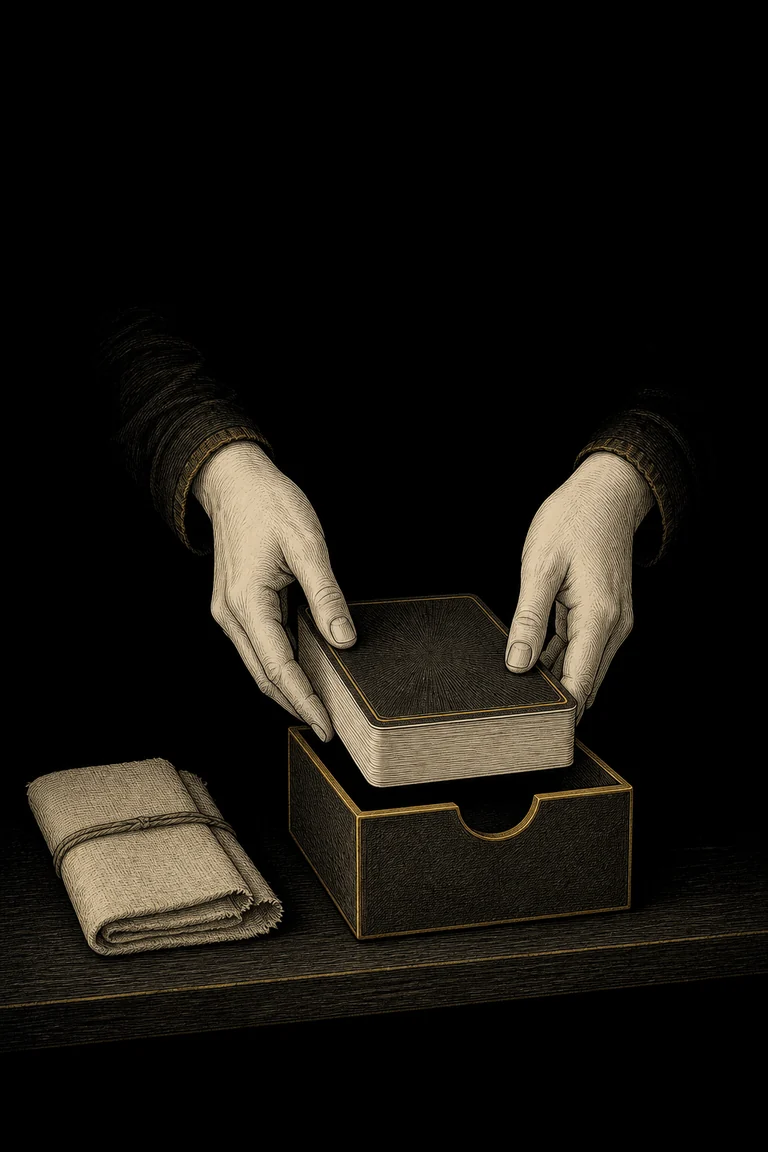
The best way to store Tarot cards is to keep the complete deck together, protect it from moisture, direct sun, dust, bending, and repeated friction, and choose a container that matches how often you read. A fitted tuck box, rigid deck box, soft pouch inside a drawer, or clean cloth wrap can all work. The practical test is whether the cards stay flat, easy to count, and easy to reach.
Tarot storage does not require silk, crystals, a wooden chest, or a private ritual. Those choices may carry personal meaning, but they do not determine whether a deck is valid. Start with the deck materials, local climate, travel needs, household risks, and your own access needs. Then use the simplest system you can maintain.
Take the next insight with you
Explore personalized Tarot guidance in Veritas, available for iOS and Android.
 Scan with your phone
What is the safest way to store Tarot cards?
Put the squared deck in a clean container with little unused space, then place it on a stable shelf or in a drawer away from direct sunlight, radiators, damp exterior walls, kitchens, bathrooms, and open drinks. Store cards flat or upright with even support across the full deck. Avoid a leaning stack that puts constant pressure on one edge. If the container closes securely without compressing the cards, it is doing its job.
Give each working deck one clear home
In Veritas, record the deck, container, shelf or drawer, handling rule, and next condition check so the cards remain ready for a deliberate reading.
Use the original box when it still fits
A sound original box is usually the most efficient option because it was sized for the deck and preserves the title and guidebook. Repair a lifting flap with an archival-quality method that does not leave adhesive against the cards, or place a weak tuck box inside a larger rigid case. Do not force swollen or sleeved cards back into a tight package. Friction at every opening can damage edges faster than ordinary handling.
Tarot pouch, cloth wrap, or rigid case?
A pouch is light, quiet, and convenient, but it does not prevent bending when carried loose in a bag. A cloth wrap can adapt to unusual deck sizes and double as a reading surface, although loose folds may admit dust. A rigid box offers better crush protection and stackability. Choose a smooth, colorfast, low-shedding interior and enough room to remove the cards without pulling individual edges. Soft protection and structural protection solve different problems and can be combined.
Does a Tarot deck need to breathe?
Paper cards respond to moisture and temperature. In a normal dry room, a regular cardboard box, fabric pouch, or wooden case is usually adequate. In humid conditions, avoid sealing visibly damp cards in airtight plastic, because trapped moisture can encourage warping, odor, or mold. Let the deck return to a stable indoor condition first. A small appropriate desiccant packet can help inside a larger storage area, but it should not touch card surfaces and must be replaced according to its instructions.
Control sunlight, heat, and humidity
Direct ultraviolet light can fade printing, while repeated heat and humidity changes can curl laminated and uncoated stock. Choose an interior location with a stable room temperature. Do not leave a deck on a car dashboard, beside a heating vent, on a bright windowsill, or in a damp basement box. If the room itself has persistent moisture, fix the environmental problem rather than expecting an ornate container to overcome it.
Flat or upright storage
Either orientation can work. Flat storage distributes the deck weight across the cards but can create pressure when heavy objects are stacked above it. Upright storage saves shelf space if the case supports the full height and prevents leaning. Keep deck boxes snug enough that they do not collapse into each other, and use a divider or bookend for a larger collection. Never use rubber bands around bare cards; concentrated pressure and aging rubber can mark edges and surfaces.
How to store sleeved Tarot cards
Sleeves increase thickness and make the original box less likely to fit. Use an acid-free card box sized for the sleeved deck, with a divider if the interior is longer than the stack. Check that sleeve seams do not catch as the deck is removed. Replace a torn or sticky sleeve promptly. Sleeving can reduce abrasion and protect a rare deck during frequent use, but it also changes grip, shuffle comfort, glare, and storage volume.
Storage for daily-use decks
A daily deck should be easy to retrieve without exposing it to household traffic. A closed drawer near the reading surface, a lidded box on a stable shelf, or a rigid case in a dedicated basket works well. Keep the guidebook and journal nearby without placing heavy books on top of the cards. Convenience matters because a storage system that takes several minutes to assemble is likely to be left open or abandoned.
Storage for collectible or rarely used decks
For a limited, signed, or delicate edition, document the condition before long storage. Keep all cards, packaging, inserts, and guide materials together unless contact with a degrading material would cause harm. Use archival-quality enclosures where preservation matters, isolate anything with active odor, residue, or mold, and inspect the deck on a schedule. Long storage is not maintenance-free; early detection makes a small environmental problem easier to correct.
Traveling with Tarot cards
Use a rigid, securely closing case and place it where luggage cannot crush or soak it. Count the cards before leaving and after the session. Keep the deck away from leaking cosmetics, drinks, food, loose keys, and grit. For flights or large temperature changes, leave the closed case time to reach indoor conditions before opening if condensation is possible. A smaller working deck may be safer and easier to manage than carrying a valuable collection.
Pets, children, and shared homes
Choose a closing drawer or higher shelf if cards could be chewed, scattered, colored on, or mixed with games. Privacy can also matter when journal notes or client readings are stored nearby. Explain handling boundaries without framing the deck as dangerous or forbidden. If another person may use it, agree on whether they should keep the existing order, return all cards, and report spills or damage.
How to organize several Tarot decks
Label the outer containers with the deck name, edition, card count, and any unusual contents rather than relying on memory. Group active decks separately from archive decks, and leave enough room to remove one box without dragging its neighbors. A simple inventory can include purchase date, condition, missing cards, sleeve size, storage location, and last inspection. Organization should reduce handling, not turn ownership into a pressure to acquire more.
Should you store Tarot cards with crystals or herbs?
You may keep a meaningful object near a deck, but separate it from the card surfaces. Rough stones can scratch coatings, mineral dust can transfer, and dried herbs can shed oils, moisture, color, or insects. Never put candles, incense ash, liquids, fresh plants, or salt inside a card container. Symbolic practice and material care can coexist when the ritual object has its own pouch or compartment.
Storage is not the same as cleansing
Storage protects physical condition and keeps the deck available. Cleansing is an optional symbolic reset that some readers use between sessions, after a difficult reading, or when a deck changes hands. A cloth wrap does not automatically cleanse cards, and a cleansing ritual does not remove dirt, moisture, or structural damage. Use ordinary care for material problems and personal ritual only when it supports your practice.
What to do with warped or damp cards
Stop using damp cards and separate the affected deck from other paper items. Let it dry slowly in clean moving air without a hair dryer, heater, iron, or direct sun. Do not press cards while moisture remains. If there is visible mold, strong persistent odor, or contamination, isolate the deck and seek conservation advice for anything valuable. For a replaceable working deck, health and preventing spread may matter more than saving every card.
A practical Tarot storage setup
- Count and inspect
Confirm the complete card count and note bent corners, residue, fading, or loose packaging.
- Choose the container
Match the fitted box, pouch, wrap, or rigid case to protection and access needs.
- Choose the location
Use a dry, shaded, stable shelf or drawer away from heat, liquids, pests, and pressure.
- Separate risky objects
Keep stones, herbs, candles, drinks, adhesives, and metal items away from card surfaces.
- Make access simple
Store the deck where it can be removed and returned without dragging, squeezing, or restacking.
- Set an inspection date
Review active decks seasonally and archived decks on a reasonable schedule for the climate.
Keep a small condition record
Use Veritas to note the card count, container, location, climate concern, current damage, care action, and next review date for each deck you value.
Common Tarot storage mistakes
Avoid direct sun, hot cars, damp rooms, rubber bands, overfilled boxes, heavy stacks, loose transport, liquids, and abrasive ritual objects. Do not apply household cleaners, oils, perfume, smoke, or heat to the cards. Most importantly, do not let an elaborate rule make the deck inaccessible or create fear that another person has ruined it by touching it. Good storage is calm, repeatable care that keeps a complete deck usable.