Tarot Journal
Rider-Waite-Smith vs Thoth Tarot: Key Differences
Rider-Waite-Smith and Thoth share a 78-card Golden Dawn inheritance, but they present evidence differently. RWS foregrounds readable scenes; Thoth foregrounds abstract art and explicit esoteric correspondences.
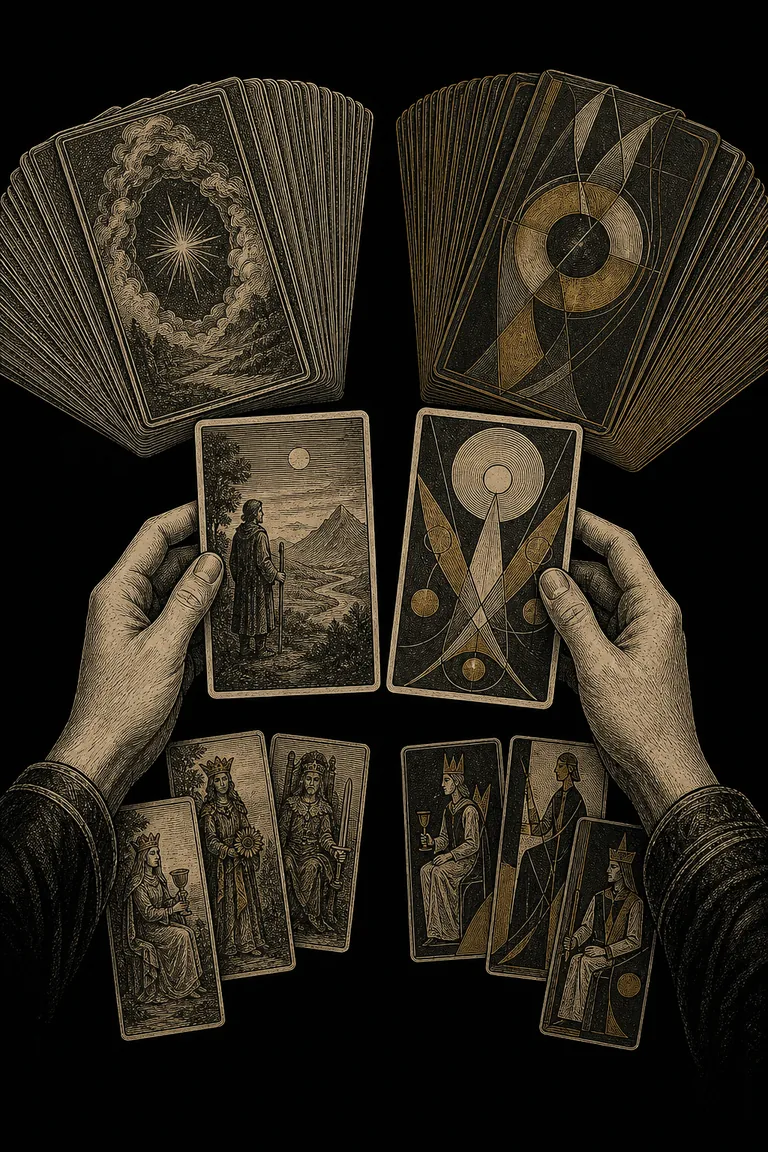
The practical difference between Rider-Waite-Smith and Thoth Tarot is their visual and editorial grammar. Rider-Waite-Smith usually leads with Pamela Colman Smith’s narrative scenes, especially in the Minor Arcana. Thoth combines Lady Frieda Harris’s abstract geometry with Aleister Crowley’s named decan cards and explicit astrological, alchemical, Qabalistic, and Thelemic framework.
Both systems normally contain 78 cards and descend in different ways from teachings associated with the Hermetic Order of the Golden Dawn. They are not interchangeable keyword decks, and neither is inherently more accurate, intuitive, spiritual, or advanced. Choose the system whose visible evidence and stated conventions you can apply consistently.
Take the next insight with you
Explore personalized Tarot guidance in Veritas, available for iOS and Android.
 Scan with your phone
Rider-Waite-Smith vs Thoth at a glance
A shared framework with different authors
Rider-Waite-Smith was conceived by Arthur Edward Waite, illustrated by Pamela Colman Smith, and first published in 1909. Crowley and Harris developed the Thoth paintings mainly between 1938 and 1943, and the deck was published later. Waite and Crowley both had Golden Dawn backgrounds, but their decks select, reveal, rename, and reinterpret that inheritance differently. Harris and Smith are not decorative footnotes. Their visual decisions shape how readers encounter each system.
Narrative scenes versus abstract fields
An RWS numbered card often offers a moment with people, weather, landscape, and an implied before and after. A Thoth pip card is usually less like a single event and more like a field of forces arranged through color, number, suit, geometry, and correspondence. Thoth pips still contain images and named themes, but they rarely ask the reader to follow one human scene in the RWS manner.
Card titles and Major Arcana changes
Thoth renames several Major Arcana. Temperance becomes Art, Judgement becomes The Aeon, Justice becomes Adjustment, Strength becomes Lust, and The World becomes The Universe. The Fool remains unnumbered or zero, while the order and attributions reflect Crowley’s system. These titles shift emphasis, so importing only the familiar RWS name can erase information that the Thoth card deliberately adds.
Suits and court ranks
RWS commonly uses Wands, Cups, Swords, and Pentacles with Page, Knight, Queen, and King. Thoth uses Wands, Cups, Swords, and Disks with Princess, Prince, Queen, and Knight. The Thoth Knight is the senior fiery court rank rather than a direct substitute for the mounted RWS Knight. Translate by elemental role and system structure, not by rank name alone.
Named Minor Arcana
Thoth prints short titles on the Two through Ten, such as Dominion, Peace, or Swiftness. These are compact parts of a larger correspondence system, not complete fortunes. RWS editions often leave pips untitled, inviting the scene to organize initial meaning. In either deck, a title or image is evidence to test against the question, spread position, neighbors, and full card context.
A Four of Cups comparison
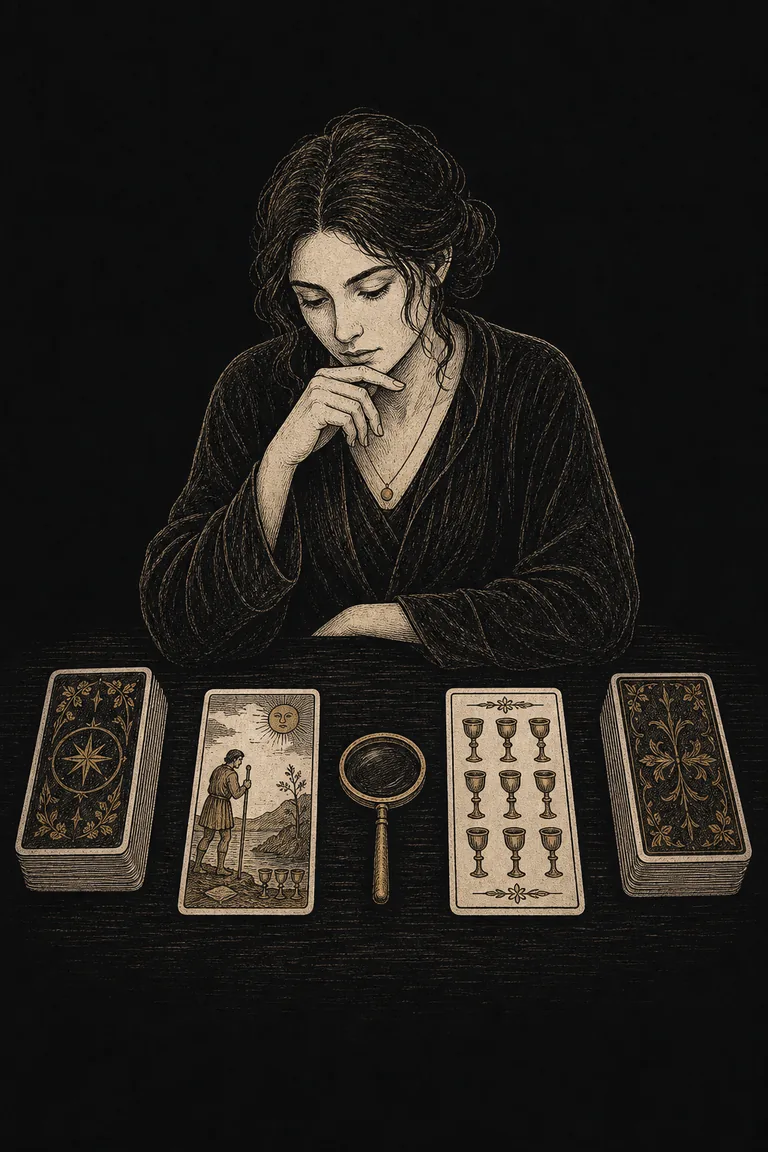
The familiar RWS Four of Cups shows a seated figure disengaged from three cups while another is offered. Attention, refusal, saturation, and reappraisal are visible possibilities. The Thoth Four of Cups is titled Luxury and presents an ordered but heavy overflow of water. It can emphasize pleasure reaching a stable limit or becoming excessive. Both involve emotional sufficiency, but their evidence and emphasis are not identical.
Astrology and Qabalah in both decks
Both decks can be studied through Golden Dawn-derived astrology, elements, Hebrew letters, and the Tree of Life. Thoth displays much of this architecture more openly and Crowley’s Book of Thoth makes it central. RWS readers may use similar correspondences, but many editions and beginner methods foreground Smith’s scenes instead. Do not assume that visible complexity makes one deck deeper or that visual accessibility makes the other simple.
Do Thoth readers use reversals?
Many Thoth readers keep cards upright and express difficulty through dignity, position, imbalance, blocked force, or surrounding cards. Other readers use reversals. RWS practice is also divided. Decide before shuffling what inversion changes, and record the rule. Adding a reversal meaning only when an upright card feels inconvenient makes the method impossible to evaluate.
Which deck is easier for beginners?
RWS often feels faster because scenic cards support description and the English-language learning ecosystem is large. Thoth can suit a beginner who enjoys systems, abstract art, astrology, color, and comparative study. Neither requires perfect mastery before a first reading. Begin with a bounded spread, describe what is visible, consult the deck-specific source, and keep confidence proportional to evidence.
Can RWS meanings transfer to Thoth?
Some suit, number, elemental, and Major Arcana themes transfer because the decks share structure and historical roots. Exact keywords may not. Thoth titles, court architecture, planetary and zodiacal attributions, and Crowley’s philosophical emphasis can redirect the card. Start with common structure, then note what the Thoth card changes rather than forcing it to illustrate an RWS scene that is absent.
Can you read with both decks?
Yes, if each deck has a declared role. You might use an RWS card for a concrete situation position and a Thoth card for the underlying pattern, or compare the same named position after two separate readings. Keep decks separate during the draw unless you deliberately designed a 156-card system. Write the translation rule before seeing the cards.
Compare evidence card by card
Use Veritas to record deck, edition, visible detail, correspondence used, spread position, interpretation, confidence, and later outcome. A consistent journal reveals whether your translation rules actually hold.
How to choose between RWS and Thoth
- Inspect the numbered cards
Compare several pips from every suit, not only the famous Major Arcana.
- Check the court system
Decide whether the rank names and elemental roles are clear enough to study.
- Read the intended framework
Review the edition’s guide and a reliable deck-specific source before buying extra keyword books.
- Test one small spread
Use the same bounded question and describe visible evidence before interpretation.
- Choose for sustained practice
Select the deck you will use and review consistently, not the one marketed as more advanced.
Does one deck give more accurate readings?
No deck guarantees prediction or accuracy. Rich symbolism can support disciplined synthesis or invite confident projection. Scenic clarity can make reasoning visible or encourage a reader to mistake a picture for a fixed event. Better practice uses a defined question, transparent spread, limited draws, specific language, and later review. Tarot should not replace medical, legal, financial, or mental health expertise.
The practical choice
RWS offers memorable scenes and broad teaching support. Thoth offers a tightly integrated symbolic system and abstract visual relationships. The useful distinction is not intuitive versus intellectual or beginner versus expert. It is which grammar you can observe, learn from its own sources, and apply without changing rules to rescue a desired answer.