Tarot Journal
Rider-Waite-Smith vs Marseille Tarot: Key Differences
Rider-Waite-Smith and Tarot de Marseille share the same 78-card framework, but they distribute visual evidence differently. Scenic Minor Arcana guide many RWS readings, while Marseille asks number, suit, pattern, and card interaction to do more work.
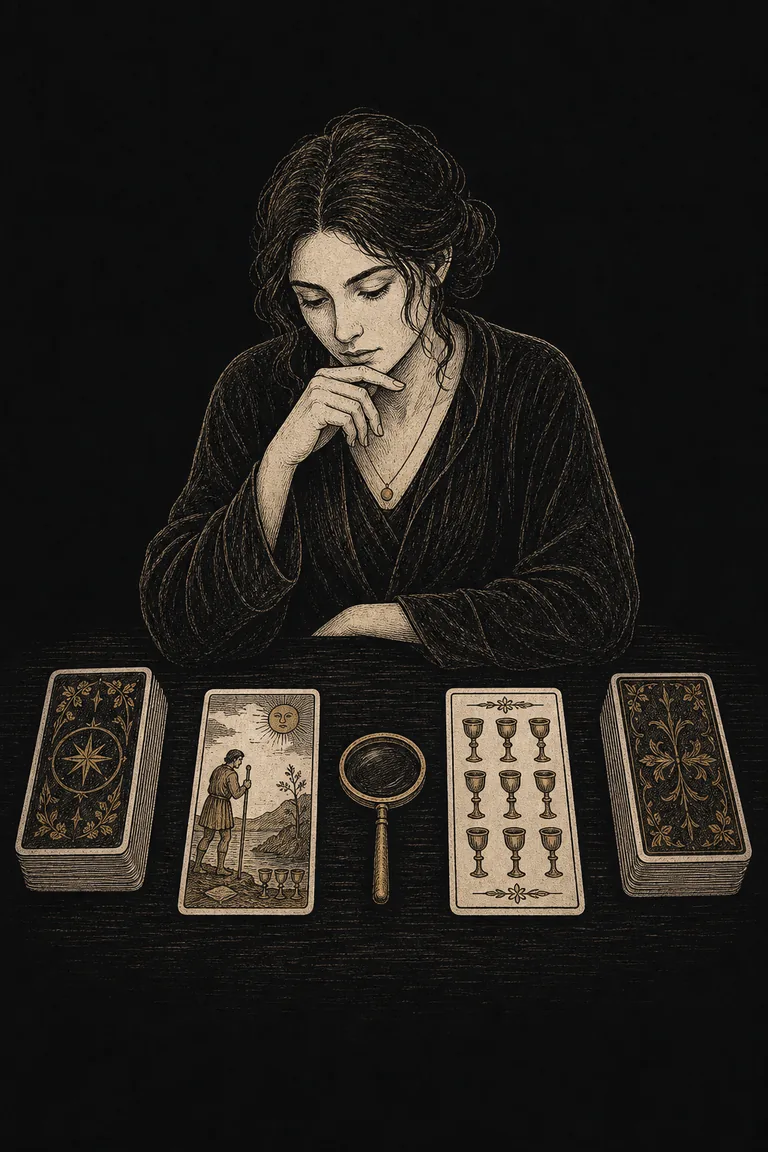
The practical difference between Rider-Waite-Smith and Tarot de Marseille is most visible in the Minor Arcana. Rider-Waite-Smith decks usually illustrate every numbered card with a scene. A Marseille deck generally shows arranged suit objects on the Ace through Ten, so the reader builds meaning from number, suit, symmetry, direction, color, and neighboring cards rather than from a single narrative picture.
Both systems normally contain 22 Major Arcana, 40 numbered Minor Arcana, and 16 court cards. Neither deck family is inherently more accurate, intuitive, advanced, or spiritual. Choose the one whose evidence you can observe, explain, and test without silently importing rules from another system.
Take the next insight with you
Explore personalized Tarot guidance in Veritas, available for iOS and Android.
 Scan with your phone
Rider-Waite-Smith vs Marseille at a glance
The shared 78-card architecture
These are not unrelated divination systems. Both belong to the Tarot family and preserve a recognizable sequence of trumps, four suits, numbered cards, and four court ranks. Names, spellings, images, and ordering vary by edition. That shared architecture lets many broad concepts transfer, but it does not make every keyword portable without adjustment. The card in front of you remains the primary evidence.
Illustrated scenes versus pip cards
An RWS Three of Swords shows a heart pierced by three blades beneath rain. The scene strongly foregrounds pain, difficult knowledge, and emotional consequence. A Marseille Three of Swords usually presents three swords in an ordered design. Its reading may begin with the number three as development, the suit as thought or conflict, and the pattern as expansion, division, or structure. The Marseille card is not blank. It simply offers a different kind of information.
How visual evidence changes the reading
RWS readers can ask who acts, what the figure sees, where movement points, and what detail interrupts the scene. Marseille readers can ask whether the pips expand or contract, whether the center is open or blocked, how repeated colors behave, and whether neighboring cards continue or disturb the pattern. A careful reader separates what is visible from what a book or teacher supplied.
Strength and Justice numbering
Many RWS decks number Strength VIII and Justice XI. Many Marseille decks place Justice at VIII and Strength, often titled Force, at XI. This difference matters when using numbered sequences, astrological correspondences, or a spread that refers to a trump by number. Say which deck order you use instead of treating one order as an error. The remaining trump sequence also contains naming and design variations between editions.
Suits and court cards
RWS commonly uses Wands, Cups, Swords, and Pentacles with Page, Knight, Queen, and King. Marseille editions may use Batons, Cups, Swords, and Coins, and English court translations vary. The structure is close, but visual emphasis differs. Marseille courts often reward attention to gaze, posture, held objects, ground, and the direction one court faces toward another.
A Three of Cups example
In a familiar RWS Three of Cups, three figures raise vessels together above a harvest. Friendship, celebration, reunion, and collaboration are immediately available, then the position and question narrow the meaning. In Marseille, three cups create a patterned relationship. The reader may combine the receptive suit of Cups with three as growth or development, then examine spacing and neighboring cards. Both can describe connection, but they reach it through different evidence.
Spreads and combinations
Both deck families work in one-card, line, and positional spreads. RWS teaching often gives each position a specific question and interprets the card scene inside it. Marseille practice often gives strong weight to how adjacent cards face, repeat, balance, or interrupt one another. These are tendencies rather than laws. Declare the spread and combination rule before drawing so the method cannot change to rescue a preferred answer.
Do Marseille readers use reversals?
Some do and some do not. The same is true among RWS readers. A Marseille deck can produce reversed cards, but many methods already use visual direction, dignity, position, and neighboring cards to show tension. If you use reversals, define what inversion changes before the reading. Do not add them only when an upright interpretation feels inconvenient.
Which system is easier for beginners?
RWS can feel faster at first because the numbered cards show memorable scenes and English-language resources are abundant. Marseille can teach foundational pattern reading without binding every pip to one inherited scene. Ease depends on the learner. A person comfortable with images and stories may prefer RWS; a person who enjoys number, structure, and comparative layout may prefer Marseille.
A note on historical labels
Tarot de Marseille names a family of related historical patterns, not one perfectly uniform original deck. Rider-Waite-Smith refers to the deck first published in 1909, conceived by Arthur Edward Waite, illustrated by Pamela Colman Smith, and published by Rider. Modern decks may borrow from either family while changing titles, colors, courts, or correspondences. Check the actual edition and guidebook.
How to choose between RWS and Marseille
- Inspect ten Minor Arcana
Look at cards from every suit and several numbers, not only the Major Arcana artwork.
- Describe before interpreting
Notice whether scenes or structural patterns give you clearer observable evidence.
- Read the guidebook method
Check card order, suit names, reversals, correspondences, and how combinations are taught.
- Test the same bounded question
Use a small spread with a written stopping rule and compare how each grammar supports an answer.
- Choose for practice
Pick the deck you will study consistently rather than the one presented as more prestigious.
Can you switch from RWS to Marseille?
Yes, but expect the numbered cards to slow you down at first. Keep your knowledge of suit and number, then suspend scene-specific RWS details unless the Marseille image supports them. For each pip, write visible structure, suit function, number function, positional role, and interaction with its neighbors. Compare the result with a Marseille-focused source before deciding that a keyword transfers unchanged.
Can you use both decks together?
You can, provided each deck has a declared job. One method might use a Marseille line to show the situation structure and one RWS card for a named response position. Record which deck answers which question and stop at the planned count. Mixing all 156 cards into one pool removes useful information about system and card distribution unless that hybrid method is deliberately defined.
Compare methods, not mystique
Use Veritas to record the deck family, edition, spread, visible evidence, inherited convention, interpretation, confidence, and later outcome. Over time, your journal will show which grammar you can apply consistently.
Does one deck give more accurate readings?
No deck family guarantees accuracy. A vivid RWS scene can clarify a pattern or invite projection. A Marseille structure can encourage disciplined comparison or become vague if the reader changes number meanings mid-reading. Better practice uses a defined question, transparent rules, limited draws, specific language, and later review against evidence. Do not use either system to replace medical, legal, financial, or mental health expertise.
The practical choice
RWS gives every card a scenic prompt and supports a large modern learning ecosystem. Marseille keeps the pips more structurally open and rewards close attention to number, suit, arrangement, and card relationships. The stronger first choice is the deck whose method you can state plainly and practice without forcing certainty. You can learn the second family later without declaring the first obsolete.