Tarot Journal
Seven of Swords Tarot Meaning: Strategy and Accountability
The Seven of Swords examines strategy, privacy, and incomplete accountability. It asks whether a quiet plan protects something legitimate or avoids the consent, ownership, and consequences the situation requires.
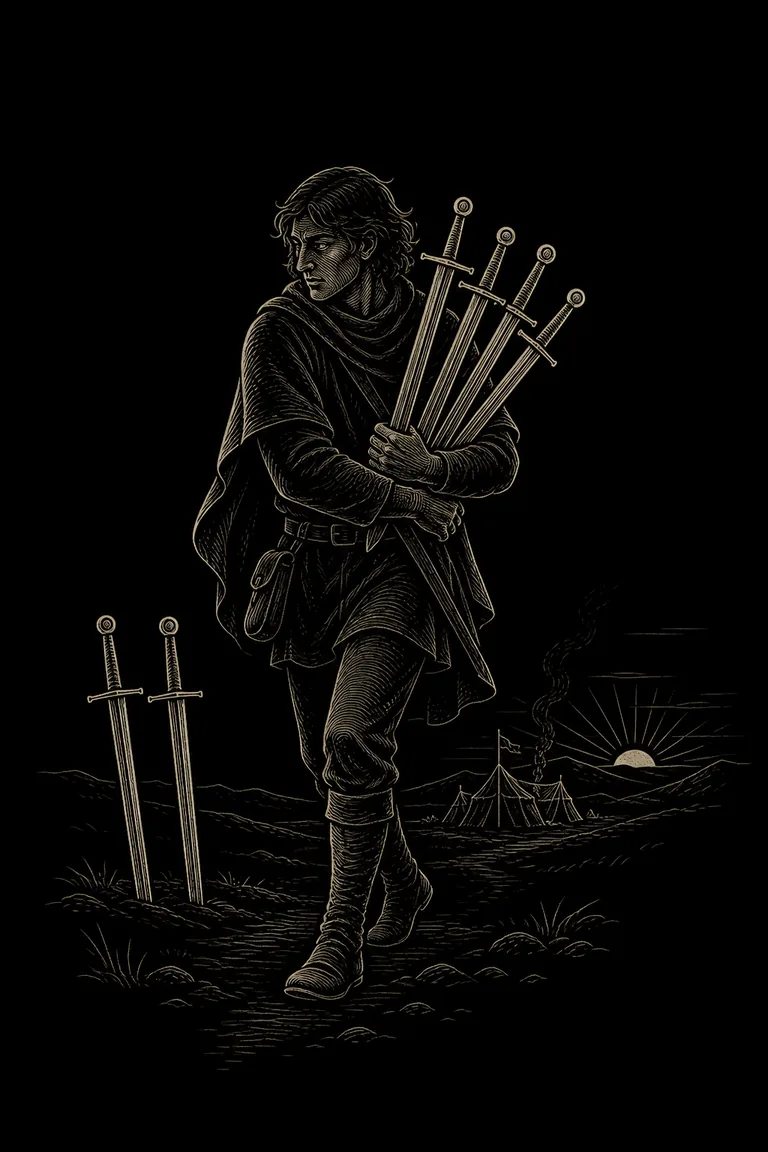
The Seven of Swords Tarot meaning centers on selective disclosure, independent strategy, and the ethics of acting outside a group. In the Rider-Waite-Smith image, a figure carries five swords away from a camp while two remain behind. The careful posture can suggest skill and timing, but the backward glance raises questions about permission, exposure, and what has not been taken into account.
Upright, the card can describe discretion, research, a private exit, tactical thinking, or deception. Reversed, it may show a plan being revealed, an uneasy conscience, self-deception, confession, or a strategy that must be revised. Neither orientation proves infidelity, theft, or betrayal. The spread position, actual evidence, and the rights of everyone involved determine which meaning is responsible.
Take the next insight with you
Explore personalized Tarot guidance in Veritas, available for iOS and Android.
 Scan with your phone
Seven of Swords meaning at a glance
Symbols in the Seven of Swords
The five carried swords make the action deliberate, while the two left behind show that the plan is partial. Swords connect the scene with thought, information, language, conflict, and judgment. The camp can represent a group, institution, shared agreement, or competing side. A backward glance may indicate awareness of witnesses, doubt, divided attention, or a necessary security check. Decks change the figure, setting, and emotional tone, so describe the visible details before assigning motive. A clever method is not automatically unethical, and a secret is not automatically safe.
Upright Seven of Swords
Upright, the Seven of Swords often favors planning away from noise. You may need to protect an early idea, document evidence, negotiate privately, leave an unsafe setting, or avoid announcing a move before the practical pieces are secure. The same card can warn of copied work, concealed terms, manipulated information, or responsibility shifted onto someone else. Distinguish discretion from deception by asking who owns the information, who bears the risk, whether consent is possible, and whether the plan could withstand fair review.
Reversed Seven of Swords
Reversed, a hidden method may become visible through contradiction, guilt, a missed detail, or direct disclosure. This can support correction: admit an omission, return property, update the record, or abandon a tactic that creates more risk than value. It can also indicate deeper self-deception, especially when a person keeps explaining away evidence that conflicts with the preferred story. Reversal does not guarantee that a liar is caught or that a confession is complete. Verify claims and make repair proportional to the actual impact.
Seven of Swords in love and relationships
In love, the card can describe private processing, a need for space, indirect communication, hidden plans, or an agreement that is not being honored. It should not be treated as proof of cheating. Ask what the relationship explicitly defines as private, shared, exclusive, or reportable. A surprise gift and a concealed financial obligation are both secret for a time, but they differ in consent and consequence. If safety is a concern, prioritize trusted support and practical planning over confrontation based on a card.
Seven of Swords as feelings
As feelings, the Seven of Swords may suggest caution, guarded interest, anxiety about exposure, or a wish to keep options open. It may also reflect your own suspicion rather than another person's private state. Tarot cannot verify thoughts, intentions, or future contact. Use direct statements, consistent behavior, and agreed boundaries as evidence. If the card describes you, ask what you are afraid would happen if you communicated more clearly and whether withholding protects a valid boundary or avoids a necessary conversation.
Career and money
At work, the card can support confidential research, careful negotiation, information security, a quiet job search, or an efficient route around unnecessary friction. It can also flag plagiarism, vague ownership, missing documentation, expense abuse, or decisions made without affected people. With money, review permissions, fees, access, records, and exit terms. Do not interpret the card as permission to hide debt, evade a lawful obligation, misuse credentials, or take financial risk with someone else's resources.
Advice, yes or no, and timing
As advice, reduce unnecessary disclosure while preserving every disclosure required for consent, safety, law, and fair ownership. For a bounded yes-or-no question, the card often means proceed carefully only if the method survives an ethics and evidence check; otherwise it leans no or not under these terms. Timing is linked to a private preparation stage or a disclosure threshold rather than seven automatic days. Define the condition that ends secrecy before the plan begins.
Seven of Swords combinations
With the Five of Swords, strategy may be shaped by conflict and the temptation to win at disproportionate cost. The Six of Swords can turn a private plan into a supported exit or transition. Justice emphasizes records, agreements, and accountability, while the Moon increases uncertainty and the need to test assumptions. A Pentacles card may identify the property, budget, labor, or practical resource at stake. Read the cards through their positions rather than assuming every pair confirms betrayal.
How it differs from nearby Swords cards
The Five of Swords asks about conflict, victory, and cost. The Six organizes movement toward more workable conditions. The Seven chooses what to reveal, what to carry, and how to act when full visibility is absent. The Eight examines restriction and the beliefs or structures that maintain it. The Seven is distinctive because intelligence and ethics must be judged together. A plan can be elegant yet unfair, or quiet yet necessary.
Audit the plan before you act
Use Veritas to record the goal, information you will protect, consent you need, ownership you must respect, evidence supporting the move, likely consequences, and the point when secrecy ends.
A practical Seven of Swords strategy audit
- Name the legitimate goal
Describe the result you need without using secrecy itself as the objective.
- Classify the information
Separate personal privacy and safety from facts another person needs for informed consent.
- Check ownership and impact
Identify whose work, money, access, reputation, or time the plan uses and who bears the downside.
- Set a disclosure threshold
Choose the event, deadline, or safety condition that requires explanation, permission, or review.
- Prepare repair
Decide how you will correct the record, return value, or accept consequences if the plan causes harm.
Common interpretation mistakes
Do not accuse a partner, colleague, or friend because this card appears. Do not romanticize manipulation as cleverness, and do not shame every private choice as dishonest. Avoid using Tarot to investigate crimes, replace cybersecurity or legal advice, or justify unsafe confrontation. The useful reading is specific: what information is protected, what obligation remains, what evidence exists, and what accountable action follows.