Tarot Journal
Tarot Stalker Card Meaning: Why a Card Repeats
A Tarot stalker card is a card that appears often enough to catch your attention. The useful question is not whether it is chasing you, but what the repeated context can teach you.
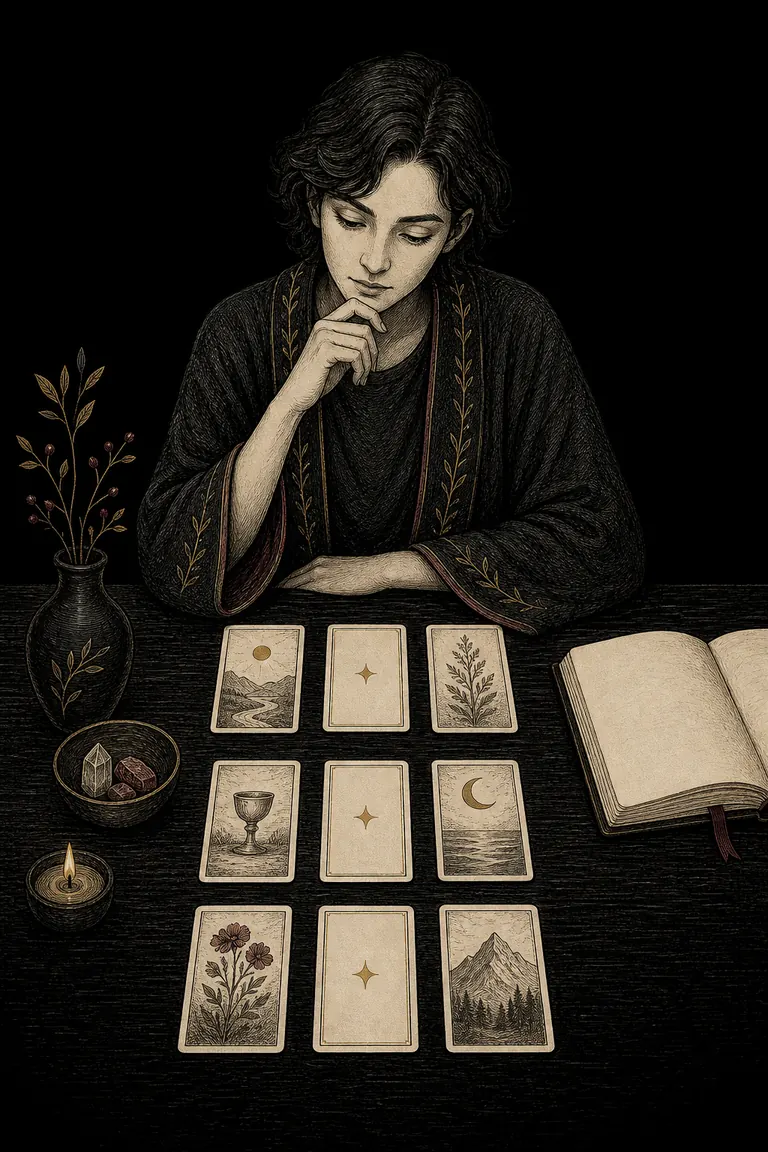
A Tarot stalker card is an informal name for a card that keeps appearing across separate readings, daily pulls, or shuffles. Readers may also call it a recurring Tarot card. The recurrence can be worth studying, but it is not automatic proof of fate, danger, a spirit message, or a fixed fact about you.
Start by recording the card, date, question, spread position, orientation, and your first interpretation. Then check ordinary causes such as repeated questions, incomplete shuffling, a bent card, or selective memory. A dated pattern gives you something specific to interpret. A vague feeling that a card is everywhere does not.
Take the next insight with you
Explore personalized Tarot guidance in Veritas, available for iOS and Android.
 Scan with your phone
What is a stalker card in Tarot?
The term describes recurrence, not a special category printed into the deck. Any Major Arcana, Minor Arcana, or court card can become a stalker card when it appears repeatedly enough to seem relevant. Because there is no universal threshold, define one before reviewing your journal. For example, you might investigate a card that appears three times in ten independent readings rather than deciding after every surprising draw.
What counts as a real recurring pattern?
Separate readings should have distinct dates or genuinely distinct questions. Pulling five cards about the same conversation in one evening does not create five independent confirmations. It creates one extended session. Count the card once for that session, note every position it occupied, and stop when the defined reading is complete. This prevents repeated drawing from manufacturing the pattern you are trying to assess.
Why does the same Tarot card keep appearing?
A card can repeat because the underlying situation has not changed, several questions share the same decision pattern, or the card names a skill you are actively practicing. Ordinary deck mechanics also matter. Cards can cling because of finish, humidity, static, edge wear, or a familiar shuffle. Attention adds another effect: once a card becomes memorable, you notice its appearances more readily than cards that feel neutral. These explanations can coexist with symbolic usefulness.
Check the deck before interpreting the message
Inspect the recurring card for bends, worn corners, residue, or a different surface texture. Confirm that all seventy-eight cards are present. Use a shuffle that changes both order and adjacency, then cut the deck without looking for a desired result. If accessibility or hand size limits your shuffle, mix small packets on the table. Fair handling makes the later interpretation more trustworthy.
Read the question and position first
The same card can perform different work in different positions. The Hermit in an obstacle position may describe isolation or insufficient feedback. In an advice position it may recommend private study, a slower pace, or consultation with a specialist. In an outcome position it describes the direction of the current pattern, not an unavoidable future. Write the position meaning before expanding the card meaning.
Capture the recurrence before drawing again
Open Veritas and record the exact card, question, position, orientation, first interpretation, and one detail that would change your conclusion.
Upright and reversed appearances
If you use reversals, track orientation without assuming that an upright and reversed appearance cancel each other. They may show different expressions of one theme. The upright Eight of Pentacles could emphasize deliberate practice, while the reversed card might point to poor standards, unhelpful perfectionism, or repetition without learning. Choose your reversal method before shuffling and keep it consistent for the observation period.
Recurring Major Arcana cards
A repeating Major Arcana card often invites a broad review of values, transitions, agency, or a durable life pattern. That does not make it more predictive. If Justice repeats, examine evidence, accountability, agreements, and proportional consequences in each question. Do not turn it into a promise of a legal victory or punishment. Look for the common decision principle across the readings.
Recurring court cards
A court card can represent a person, role, communication style, level of mastery, or behavior the situation requires. Avoid deciding that every repeat identifies one specific person. A recurring Queen of Swords might describe careful boundaries in a relationship reading, exact editing in a work reading, and evidence-based self-talk in a personal reading. Rank and suit provide a pattern without fixing age, gender, or identity.
Recurring Minor Arcana cards
A repeated pip card often points to a concrete process. Suit suggests the field, number suggests the stage, and spread position gives the task. The Two of Pentacles may connect several readings through allocation, timing, or competing demands. Instead of asking what dramatic event it predicts, compare which resource is being balanced and what practical limit remains unnamed.
Worked example: the Eight of Swords appears three times
Imagine the Eight of Swords appears in a career spread, a daily pull, and a decision reading over two weeks. The questions differ, but each entry shows an assumption treated as a rule: a job seeker assumes only one role is possible, the daily pull follows a schedule that no longer fits, and the decision spread omits a negotiable option. A useful experiment is to list the real constraints, verify each one, and ask one qualified person which restriction can change.
Worked example: the Star keeps returning
Suppose the Star repeats after a difficult project, in a relationship check-in, and during a weekly reflection. The shared theme may be realistic renewal rather than guaranteed success. In one context it can mean rebuilding confidence through small evidence. In another it can mean honest expectations after disappointment. The next step could be a two-week practice that produces visible feedback, not another reading asking whether hope is justified.
Daily cards need a larger sample
Daily one-card pulls create many opportunities for repetition, so a repeat can happen without being unusually frequent. Keep a simple tally for at least several weeks and write what actually occurred before reviewing the card. Avoid rewriting the day so it matches a favorite interpretation. A card can be useful because it prompts better observation even when its recurrence is statistically ordinary.
When reading for another person
Tell the querent that the card has appeared before only when the information helps this reading. Do not suggest that the deck is pursuing them, that a repeated card proves a secret, or that they must keep paying for readings until it stops. Consent, the present question, and the visible spread remain more important than the reader's private sense of significance.
When to pause Tarot readings
Pause if the same question is being asked to reduce anxiety, reverse an unwanted answer, or avoid direct information. Set a waiting period tied to a real change, such as receiving a reply, collecting new evidence, or completing one agreed action. Tarot is not a substitute for medical, legal, financial, or safety support. Use qualified help and verifiable information for high-stakes decisions.
A four-step stalker card journal experiment
- Define the threshold
Choose the number of appearances, time window, and kinds of readings you will count before checking the log.
- Record complete context
Note question, position, orientation, neighboring cards, first interpretation, and the action taken.
- Compare the function
Look for one repeated decision, behavior, resource, or boundary rather than one generic keyword.
- Close with an experiment
Choose one observable action and wait for new evidence before reading on the same issue again.
Turn the repeated card into an observable question
Use Veritas to compare your entries, name the shared pattern, and set a date to review what changed outside the reading.
Common stalker card mistakes
Avoid counting multiple redraws as independent evidence, ignoring deck wear, forcing every question into the same meaning, or treating recurrence as a threat. Do not keep pulling clarifiers until the card disappears. A recurring Tarot card becomes useful when the log makes the pattern more specific, the interpretation remains open to correction, and the reading ends with a proportionate action.