Tarot Journal
Tarot Journaling: A Practice That Builds Real Reading Skill
A useful Tarot journal does more than preserve card names. It separates observation from interpretation, records context, and gives you evidence to review after time has passed.
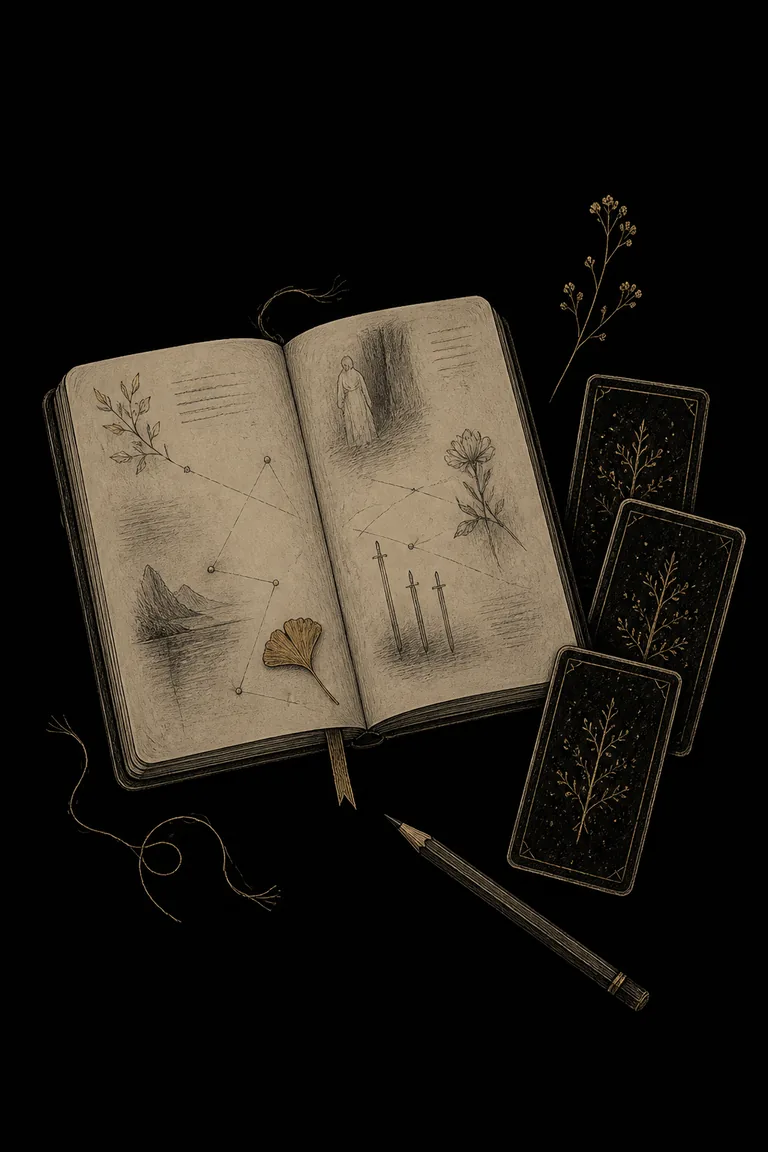
A Tarot journal becomes valuable when it helps you see how you actually read. Memory tends to preserve the striking interpretations and quietly discard the vague or mistaken ones. Written notes keep the whole process available for review.
You do not need an elaborate notebook or a perfect daily streak. A consistent entry with the question, spread, first observations, interpretation, and later outcome is enough to reveal patterns in your cards and in your own attention.
Take the next insight with you
Explore personalized Tarot guidance in Veritas, available for iOS and Android.
 Scan with your phone
What a Tarot journal is for
The journal is not a museum of polished readings. It is a working record of questions, visual evidence, choices, uncertainty, and results. Over time it shows which symbols you notice reliably, where emotion narrows your reading, and which interpretations produce useful action.
Keep the first reading intact
Create a Tarot reading in Veritas, then copy the cards and your first response into a journal before you look for a more comfortable answer.
Use one repeatable entry
Question and context
Write the exact question, relevant facts, emotional state, and time frame.
Cards and positions
Record the deck, spread positions, cards, and whether you intentionally use reversals.
Literal observations
Note posture, direction, objects, color, repetition, contrast, and anything visually dominant.
Interpretation
Combine card foundations with their positions and the evidence already known.
Action and review
Name one grounded next step and a realistic date for checking what happened.
Write the question exactly as asked
A later review is only fair if you can see the original scope. “What should I understand about preparing for Friday’s interview?” can be evaluated. “Tell me about my career” is too broad, and hindsight can make almost any event seem relevant.
Separate seeing from meaning
Give literal observation its own short paragraph before interpretation. If two figures face away from each other, write that first. Only afterward consider distance, disagreement, privacy, independence, or another meaning supported by the position. This habit keeps intuition connected to something visible.
Preserve uncertainty
When two readings seem plausible, record both and state what evidence would distinguish them. Certainty added for dramatic effect is difficult to learn from. A confidence note such as low, medium, or high can show whether your strongest convictions were actually the most dependable.
Photograph or sketch the spread
A quick photograph preserves placement and visual relationships. If you prefer an offline notebook, rectangles with card names are enough. The purpose is retrieval, not decoration. Include clarifiers only when they answered a specific ambiguity, and mark them separately from the original spread.
Review on a useful schedule
Match the review date to the question. A conversation planned for tomorrow may need a two-day review; a job search may need several weeks. At review, do not rewrite the original interpretation. Add a dated note describing what became known, what remained unknown, and which action helped.
Measure usefulness, not theatrical accuracy
A reading can be useful without predicting an event. Ask whether it clarified a choice, exposed an assumption, improved a question, or prompted evidence gathering. Also record misses and interpretations broad enough to fit anything. Honest misses teach more than retrofitted successes.
Build a personal card vocabulary
After several appearances of one card, compare the entries. Keep the traditional foundation, then note recurring context and visual details. The Eight of Pentacles may repeatedly accompany deliberate practice in your journal, but it does not mean the same event in every position. Pattern adds nuance; it does not create a fixed code.
Track combinations without memorizing pairs
Tag repeated suits, numbers, court roles, directions, or Major Arcana themes. When cards recur together, compare how position and question changed the sentence they formed. This supports the relational method described in the Tarot card combinations guide without turning pairs into universal predictions.
Notice bias in self-readings
Mark redraws, urgent questions, repeated topics, and interpretations that changed after reassurance seeking. A cooling-off note can reveal whether fear or desire dominated the first reading. The goal is not to remove subjectivity, but to make it visible enough to manage.
Keep the system light enough to continue
Start with one page per reading and a simple index by question type or card. Add tags only when you know you will use them. Decorative spreads, long correspondence tables, and daily quotas can become a substitute for reading. Consistency grows from a system that takes minutes, not from a perfect setup.
A monthly review that improves skill
Once a month, choose three entries: one useful reading, one unclear reading, and one miss. Compare question quality, observation, confidence, and follow-through. Write one small adjustment for the next month, such as limiting clarifiers or describing images before consulting a guidebook.
Tarot is a symbolic reflective practice, not a scientifically validated forecasting method. A journal cannot verify private thoughts, diagnose a condition, establish consent, or replace medical, legal, financial, or safety advice.