Tarot Journal
Tarot Storytelling: How to Connect Cards Clearly
Tarot storytelling connects cards through scene, change, and response, while keeping visible evidence separate from the narrative a reader builds around it.
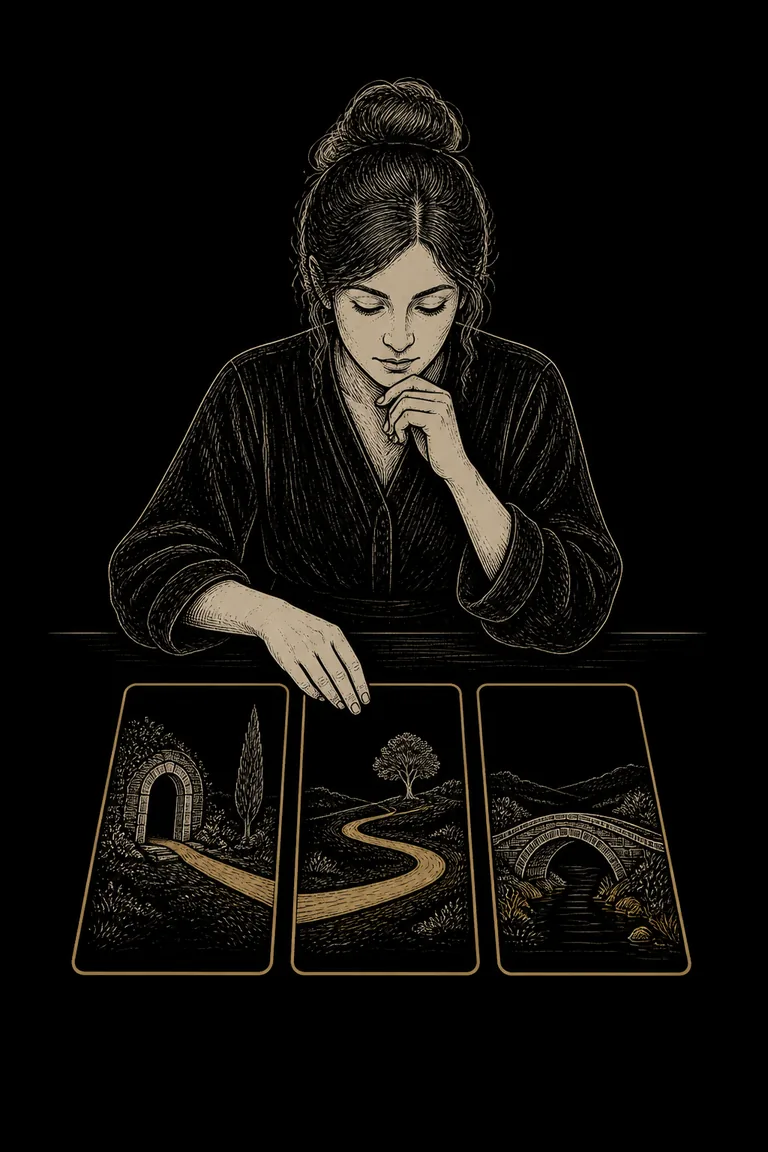
Tarot storytelling is the skill of reading several cards as one developing account instead of giving three isolated definitions. A practical story identifies what is present, what changes between cards, how the spread position shapes that change, and which uncertainty remains. It does not need dramatic prediction or a hidden character to feel coherent.
Use the three-card exercise below with a low-stakes question. Record the scene in each card before interpreting it, write one sentence per position, connect those sentences with exact transition words, and then build a credible rival story. The method improves synthesis while leaving real people, facts, and outcomes open to verification.
Take the next insight with you
Explore personalized Tarot guidance in Veritas, available for iOS and Android.
 Scan with your phone
Tarot storytelling at a glance
What Tarot storytelling means
A spread already creates relationships: one card comes before another, occupies a named position, faces or turns away from a neighbor, repeats a suit, changes pace, or introduces a contrasting element. Storytelling makes those relationships grammatical. Nouns name the subjects, verbs show what they do, and connectors explain whether the next card continues, complicates, or redirects the movement.
Storytelling versus card combinations
Tarot card combinations focus on how two or more symbols modify one another. Storytelling uses those interactions but adds sequence, position, cause, uncertainty, and response. The same Queen of Swords beside the Two of Cups may describe a candid agreement in one spread and a boundary around closeness in another. The question and assigned positions decide which relationship matters.
A three-card scene, change, response method
- Set one bounded question
Ask about a situation you can influence and name the evidence you do not yet have.
- Place scene, change, and response
Keep these three positions fixed so the story has a stable grammar.
- Describe before interpreting
Record visible subjects, objects, gaze, direction, distance, weather, and movement.
- Write three short sentences
Give each card one active verb and keep its sentence inside the assigned position.
- Connect and challenge
Add transition words, write a rival story, and finish with one checkable question.
Start with the visible scene
Before using a guidebook keyword, describe what the illustration actually shows. Count figures, note who looks toward whom, identify open and closed routes, and distinguish stillness from motion. If the deck is abstract, record color, density, line direction, repetition, and contrast. Observation does not remove intuition. It gives intuition something specific to answer.
Give every card a verb
A noun-heavy reading becomes a list: conflict, hope, authority. Verbs produce movement: people compete, recover, negotiate, wait, protect, disclose, or revise. Choose a verb supported by the image, traditional meaning, question, and position. Avoid verbs that claim inaccessible facts, such as secretly loves, will betray, or definitely returns, unless direct evidence exists outside the cards.
Use connectors to show the relationship
Words such as because, although, therefore, meanwhile, unless, and instead reveal the logic you are assigning. Two sentences joined by therefore make a causal claim; the same sentences joined by meanwhile describe parallel conditions. Write the connector rather than letting the story feel inevitable. You can then ask whether that exact relationship is supported or merely convenient.
Let positions control the plot
In the scene position, describe the active condition rather than summarizing an entire past. In change, identify what enters, ends, intensifies, weakens, or becomes visible. In response, describe an available stance or experiment, not a guaranteed outcome. A fixed positional frame prevents the final card from becoming whatever conclusion the reader already wanted.
Read visual continuity across cards
Look for a gaze that appears to continue into the next card, a road that seems to cross a boundary, repeated colors, increasing numbers, changing elevation, or movement from enclosed to open space. These are compositional prompts, not literal proof that the pictures share one world. If decks use unrelated art styles, rely more on positions, suit dynamics, numbers, and verbs than on forced visual geography.
Example: Eight of Pentacles, Five of Wands, Queen of Swords
For a question about improving a team project, the scene may be skilled work under way. The change introduces competing methods or unclear coordination. The response asks for fair standards and exact language. One connected story is: work is progressing, but competing approaches create friction, so the team needs a documented decision rule. That story suggests a meeting agenda and acceptance criteria, not a prediction that one colleague will win.
Build a rival story
The same cards could say that repetitive work has become too narrow, creative friction is exposing better options, and the Queen of Swords should evaluate them without loyalty to the old method. The rival story changes the role of conflict from obstacle to useful comparison. Keep both until project data, stakeholder feedback, or actual behavior supports one more strongly.
How to handle reversals
A reversed card can modify direction, availability, intensity, timing, or expression. Choose one reversal rule before the draw and state it plainly. For example, a reversed response card may show an action that is blocked, internal, excessive, or not yet available. Do not cycle through every reversal meaning until the sentence confirms the preferred plot.
Keep the cast of characters honest
Court cards and figures do not automatically represent named people. They may describe a role, stance, resource, interaction, or part of the reader's own approach. If a card might refer to someone else, phrase it as a hypothesis and verify it through consent, communication, records, and behavior. Tarot cannot establish another person's feelings, motives, identity, fidelity, diagnosis, or future choice.
Save the story and its alternative
Use Veritas to record visible evidence, positions, verbs, connector words, the first story, a rival story, the unanswered factual question, chosen action, and review result.
Tarot storytelling for larger spreads
Do not force ten cards into one long plot on the first pass. Group a larger spread into two-card or three-card clauses based on its printed positions. Summarize each clause in one sentence, then connect those sentences. In a Celtic Cross, for example, the central pair, conscious and underlying factors, recent and approaching conditions, and final column can be read as separate units before synthesis.
Journal the reading without rewriting it
Save the original question, positions, card order, orientation, observations, three sentences, connector words, and rival story before events unfold. At review, append what happened instead of editing the first entry. Mark clear matches, misses, ambiguous language, actions that changed conditions, and facts learned later. A reading that can explain every outcome teaches very little.
Common storytelling mistakes
The most common errors are assigning secret motives, ignoring positions, adding people who are not in the question, treating sequence as guaranteed chronology, and using a dramatic final card as destiny. Another error is coherence bias: once a smooth story appears, contradictions feel like noise. Preserve awkward cards and counterevidence. A useful reading may remain partial.
Limits and responsible use
Tarot storytelling cannot reveal hidden facts, recover reliable memories, prove abuse or infidelity, diagnose health, determine consent, identify a criminal, guarantee contact, or replace legal, medical, financial, mental health, or safety advice. A coherent story is still an interpretation. Use the method to organize reflection and questions while allowing documents, experts, direct communication, and lived evidence to disagree.