Tarot Journal
Three Card Tarot Spread: Past, Present, and Future
A three-card Tarot spread is small enough to read clearly and flexible enough to answer a real question. The useful part is not pulling three separate meanings. It is noticing the movement from the first card to the third.
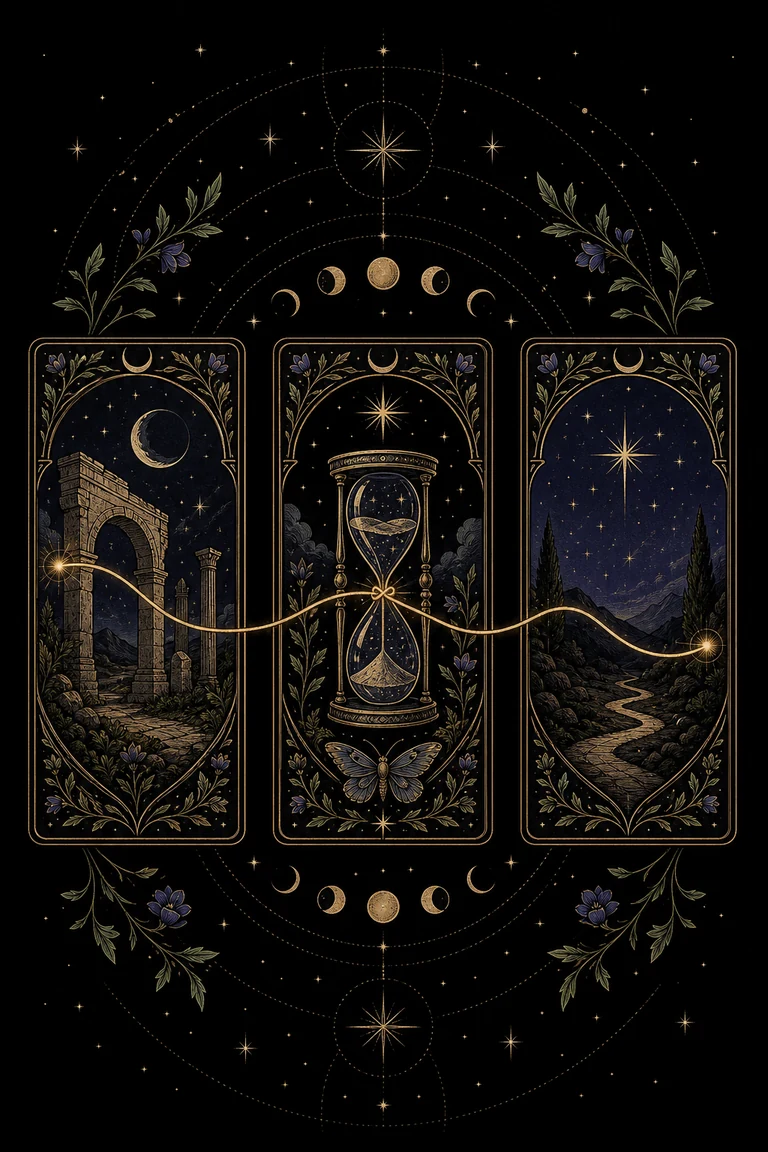
The three-card Tarot spread is often taught as past, present, and future. That classic layout works because it gives a reading a beginning, a middle, and a direction. It can reveal what shaped a situation, what is active now, and what may develop if the current pattern continues.
Three cards do not make a fixed prediction. They create a compact conversation. Each position gives the card a job, while the sequence shows how the parts relate. Once you learn to read that sequence, the same three-card structure can explore relationships, decisions, creative blocks, work, or a daily check-in without becoming vague.
Take the next insight with you
Explore personalized Tarot guidance in Veritas, available for iOS and Android.
 Scan with your phone
What is a three-card Tarot spread?
A three-card spread is a Tarot layout in which every card has a defined position. In a past-present-future reading, the first card describes relevant background, the second shows the present condition, and the third suggests the direction of travel. The positions narrow the possible meaning of each card and make the reading easier to synthesize.
The spread is useful for beginners because it offers more context than a single card without the visual noise of a large layout. Experienced readers return to it for the same reason. A small spread makes it harder to avoid the central issue by pulling more cards whenever an answer feels uncomfortable.
How to do a past, present, and future Tarot spread
- Choose one focused question
Ask about a situation you can name clearly. “What pattern should I understand in my current job search?” gives the cards more useful boundaries than “What will happen to me?”
- Shuffle with the question in mind
There is no required number of shuffles. Stop when the deck feels mixed and your attention has settled. Cut the deck if that helps mark the transition into the reading.
- Lay three cards from left to right
Place the first card for the past, the second for the present, and the third for the future direction. Keep the positions visible so their roles remain clear.
- Read each card, then read the line
Notice the image, name the card’s core action, and connect it to its position. After all three, describe the change across the row in one or two sentences.
The third card is not a sentence handed down by fate. It is the likely next chapter of the pattern currently on the table.
What each position actually means
The past card should describe the part of the past that still matters to the question. It does not need to summarize your entire history. It might show an earlier decision, an inherited assumption, a habit, or an event whose effects are still present. Ask, “What did this card set in motion?”
The present card is the hinge of the spread. It can describe your current stance, the pressure point in the situation, or the resource available now. The future card then shows what becomes more likely if nothing important changes. Read it as direction and consequence, not certainty.
Read the cards as one story
Suppose a reading shows the Eight of Cups in the past, the Two of Swords in the present, and the Ace of Wands in the future. Three isolated definitions might say departure, indecision, and inspiration. The sequence is more specific: leaving something emotionally incomplete has created a pause, and a new direction becomes available when the avoided choice is faced.
Look for visual and structural links. Are figures facing toward or away from one another? Does the suit change from Cups to Swords to Wands, moving from feeling through thought into action? Do the numbers rise, fall, or repeat? Major Arcana cards may show turning points, while Minor Arcana cards often locate the pattern in everyday behavior.
Turn three cards into one clear reading
Open a Tarot reading in Veritas, choose a focused question, and explore how the cards connect across the spread instead of reading each meaning in isolation.
Useful three-card spread variations
Past, present, and future is only one possible structure. For a practical problem, try situation, obstacle, and next step. For a decision, use option A, option B, and what matters most. A relationship reading can use you, the other person, and the dynamic between you. A reflective check-in can use mind, body, and emotion.
Name the positions before drawing. Changing their meaning after seeing a difficult card makes the reading less honest. If none of the familiar layouts fits, write three positions that describe the exact movement you want to understand, such as what I know, what I am missing, and what I can do next.
Questions that work well with three cards
Three-card readings respond best to questions about patterns, choices, and participation. Ask what you can understand, what deserves attention, or how you can approach a situation. Questions such as “What is shaping this conflict?” and “What would help me move this project forward?” leave room for insight without pretending the cards remove your agency.
Avoid repeatedly asking whether another person will act, especially when the answer is meant to replace a direct conversation. A more grounded relationship question is, “What do I need to see clearly about this dynamic?” The reading then returns attention to information and choices you can actually use.
Should you use reversed cards?
Reversals are optional. If you use them, decide before shuffling what they mean in your practice. A reversed card may show blocked expression, inward experience, delay, excess, or a quality that needs conscious attention. It does not automatically turn a positive card negative or make a difficult card worse.
Beginners can read every card upright and still produce nuanced readings. Position, imagery, elemental balance, and the relationship between cards already provide plenty of contrast. Add reversals when they sharpen your observations, not because a complete Tarot practice is supposed to include them.
When to draw a clarifying card
A clarifier is useful when you can state exactly what remains unclear. Place one card beside the position it clarifies and ask a narrow follow-up, such as “What quality of the Seven of Cups matters here?” Do not use clarifiers to replace every card you dislike. That turns a focused spread into a negotiation with the deck.
If the question contains several separate decisions, three cards may not be enough. Finish the current reading, record it, and begin a new spread for the next question. Keeping the boundaries clean usually produces more useful insight than building an accidental twelve-card layout around one uncertain answer.
Common mistakes in a three-card reading
The most common mistake is treating the cards as three dictionary entries. Another is making the future card absolute. Readers also lose clarity by asking several questions at once, changing positions after the draw, or searching for a new card until the message feels reassuring. A spread becomes trustworthy through consistent rules and honest observation.
Write down the question, positions, first impressions, and final synthesis before checking a guidebook. Then compare your interpretation with what happens or what becomes clearer over time. This practice develops judgment far more reliably than trying to memorize every possible card meaning.
Keep the reading practical
Tarot is a reflective practice, not a scientifically validated forecasting method. Do not use a reading as a substitute for medical, legal, financial, or mental health advice. Be especially careful when reading about someone who is not present. Focus on the seeker’s experience, boundaries, and available choices rather than claiming access to another person’s private thoughts.
A strong three-card reading ends with one useful sentence. Name the pattern, the choice it reveals, and the next action worth considering. The spread is complete when it makes the situation easier to meet with awareness, not when every possible future has been explained.