Tarot Journal
Tarot Card Combinations: How to Read Cards Together
Tarot card combinations become readable when you connect position, sequence, repeated elements, and visual direction instead of memorizing thousands of fixed pairs.
A Tarot card combination is the meaning created when two or more cards interact in a spread. Each card keeps its foundation, but position and relationship change the sentence. The Eight of Pentacles beside the Three of Cups can describe collaborative craft, while the same Eight beside the Hermit may emphasize solitary practice.
You do not need a dictionary for every possible pair. A repeatable reading order is more useful: establish each card, identify the link, test the emerging sentence against the question, and keep only interpretations supported by the spread.
Take the next insight with you
Explore personalized Tarot guidance in Veritas, available for iOS and Android.
 Scan with your phone
Start with each card’s job
Name the spread position before combining anything. A card in “resource” does different work from the same card in “constraint.” Give each card a short phrase that answers its position, then connect those phrases. This prevents the most dramatic image from taking over the reading.
Practice reading the space between cards
Open a Tarot reading in Veritas and connect position, sequence, suit, number, and image before reaching for a fixed combination meaning.
Use a simple combination formula
- Foundation
State the ordinary meaning of each card in one phrase.
- Relationship
Decide whether the cards support, complicate, sequence, or redirect one another.
- Sentence
Join the phrases using because, but, then, while, or through.
- Evidence
Check the sentence against the question, spread position, and known facts.
Sequence creates movement
In a left-to-right spread, the Page of Pentacles followed by the Eight of Pentacles and then the Three of Pentacles can read as curiosity becoming practice and then collaboration. Reverse the order and the emphasis changes: group work may lead to individual refinement and a new area of study.
Repeated suits show concentration
Several Cups may concentrate emotional exchange, relationship, memory, or receptivity. Several Swords may emphasize language, thought, decision, or conflict. Repetition does not make a suit good or bad. Ask whether that element is useful, excessive, blocked, or missing from the situation.
Missing suits can matter carefully
In a practical work question, a spread with many Wands and Swords but no Pentacles may suggest energy and ideas without enough attention to resources or implementation. Absence is a prompt, not proof. Small spreads omit suits by chance, so use the observation only when it improves the question.
Numbers create rhythm
Repeated numbers can connect stages across suits. Two Fives may emphasize disruption or adjustment in different domains. A sequence such as Three, Four, Five can suggest development becoming structure and then meeting change. Do not force arithmetic when imagery and position tell a clearer story.
Major and Minor Arcana together
A Major Arcana card can frame the larger principle while a Minor Arcana card shows its ordinary expression. Justice with the Two of Pentacles may connect fairness or consequence with competing practical demands. The Major is not automatically more important than the position assigned to each card.
Court cards describe roles and approaches
The Queen of Swords beside the Page of Cups might combine discernment with emotional openness, or show a clear communicator responding to a tentative message. Decide whether courts represent people, roles, styles, or stages from the question and surrounding cards rather than assigning identities immediately.
Look at visual direction
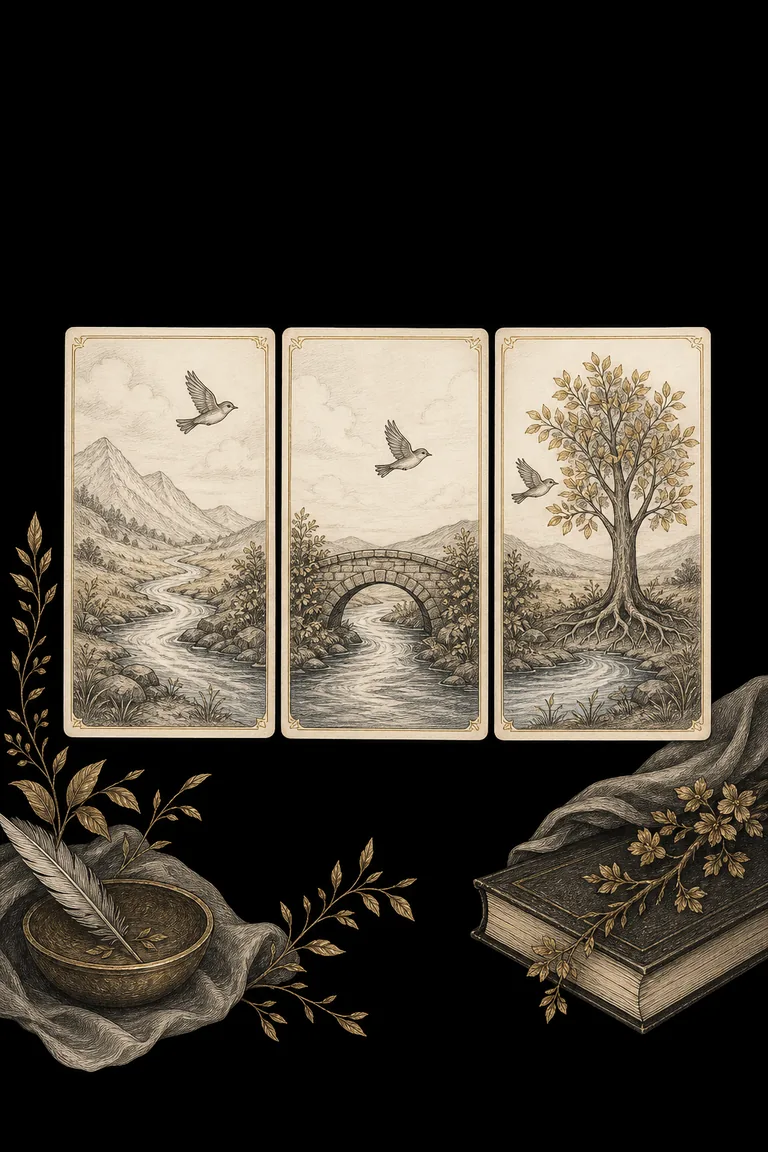
Figures may face toward or away from another card. A river, road, hand, or gaze may continue across the spread. Treat this visual flow as supporting evidence, not a rigid rule. Deck artwork differs, and one directional detail should not override the card foundations.
Read contrast as a pivot
The Four of Pentacles beside the Fool creates a tension between holding and stepping into uncertainty. Instead of deciding one card cancels the other, ask where protection is useful and where it prevents movement. Contrast often describes the actual choice inside a situation.
A three-card example
For “How can I improve this project?” imagine the Hermit as diagnosis, the Eight of Pentacles as action, and the Three of Cups as support. The combination reads: private analysis identifies what needs work, repeated practice improves it, and trusted feedback keeps the process connected.
Reversals in combinations
Keep the upright foundation, then test whether the reversed expression is blocked, internal, delayed, excessive, or redirected. A reversed Three of Pentacles beside the Eight of Pentacles may show skilled effort without usable collaboration. Avoid treating every reversal as negation.
Do not over-combine
Read adjacent cards and clear positional pairs first. Combining every card with every other card produces noise. Write one sentence for each meaningful relationship, then one paragraph for the spread. If a connection cannot be tied to the question, leave it out.
Tarot is a symbolic reflective practice, not a scientifically validated forecasting method. Card combinations cannot verify private facts, diagnose conditions, establish consent, or replace medical, legal, financial, or safety guidance.