Tarot Journal
Tarot Timing Techniques: Pace, Windows, and Conditions
Tarot timing techniques can describe sequence, pace, a broad window, or the conditions required for movement, but they cannot guarantee a calendar date.

Tarot timing techniques are systems for turning cards into a sequence, speed, season, or conditional window. Readers commonly use spread positions, suit pace, card numbers, astrological correspondences, or a question such as "What must happen before this can move forward?" These systems do not produce the same answer, so the first discipline is choosing one method before drawing.
A responsible timing answer reports the method, assumptions, and uncertainty. "The spread looks active once approval arrives, so review it within two weeks" is more useful than claiming a card proves an event will occur on a specific date. Tarot can organize attention around timing. It cannot control another person, remove practical delays, or replace a contract, medical timeline, legal deadline, or project plan.
Take the next insight with you
Explore personalized Tarot guidance in Veritas, available for iOS and Android.
 Scan with your phone
Tarot timing at a glance
Start by deciding what timing means
A "when" question often contains several different needs. The reader may want a deadline, reassurance that movement is possible, an order of operations, or a sign that waiting should stop. Clarify the job before choosing cards. Ask whether the reading should estimate pace, compare two available windows, identify a dependency, or set a review point. If the event depends entirely on someone else, reframe toward what the querent can observe and decide.
Method one: read sequence from spread positions
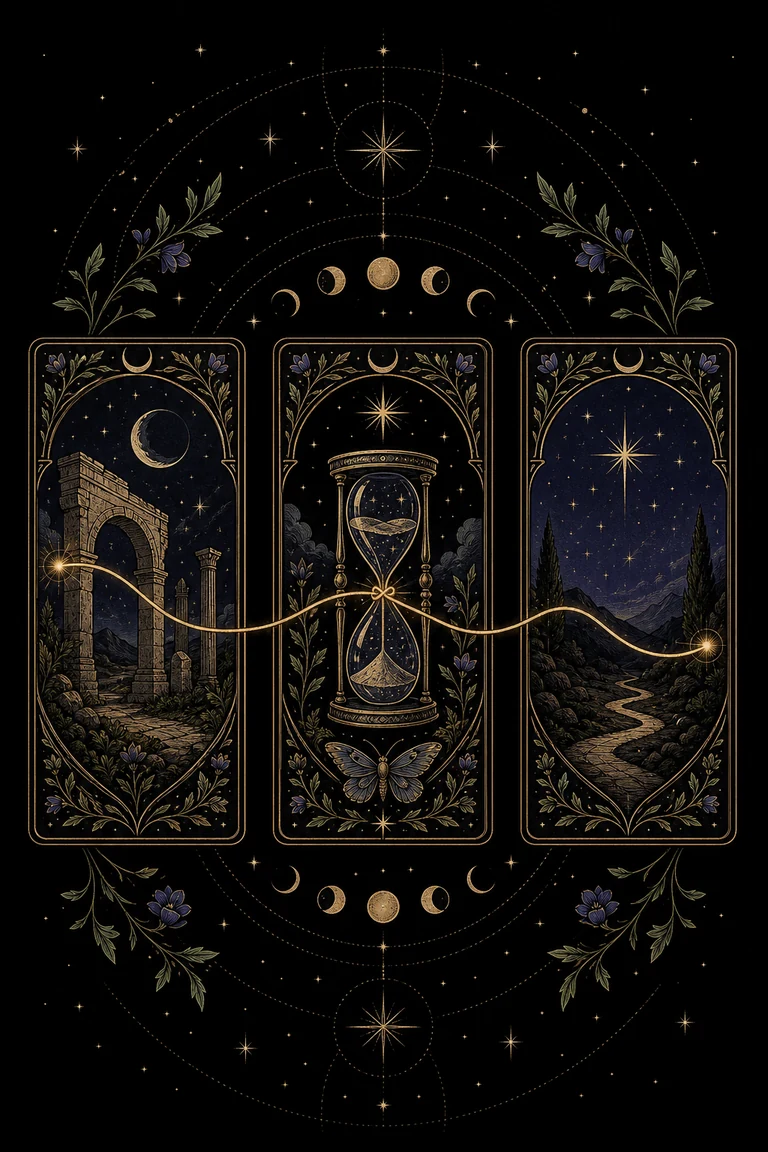
Sequence is the least complicated form of Tarot timing. A three-card line can represent current condition, transition, and next available phase. It tells a process story without pretending that equal card spacing equals equal calendar time. The middle card matters because it identifies the bridge. If the transition requires an application, conversation, payment, recovery period, or signed approval, that real condition supplies a better clock than symbolism alone.
Method two: use suits to estimate pace
Many readers use the four suits as speed cues, but published tables disagree. Wands may be called fast because Fire moves quickly, while Pentacles may be called slow because Earth builds gradually. Cups and Swords change order across systems, and some tables assign days, weeks, months, or seasons to suits in entirely different ways. Treat the table as a reading convention. Write it down before the draw and do not change the unit after seeing an inconvenient card.
Method three: combine a card number with a unit
A simple number-plus-unit system reads the pip number as quantity and the suit as a declared unit. Under one possible table, the Six of Swords might mean six days; under another, Swords might indicate weeks or autumn. That disagreement is exactly why the method must be disclosed. Court cards and Aces also need rules set in advance. A wide range is usually more honest than an exact day, especially when the underlying event has multiple dependencies.
Method four: use astrological correspondences
Golden Dawn-derived Tarot systems connect many cards with zodiac signs, planets, and decans. A numbered Minor Arcana card may point to an approximately ten-day solar period, while a zodiacal Major Arcana card may suggest a sign season. This approach is internally detailed, but it only fits decks and practices that use those correspondences. It also needs a clear rule for year selection. A seasonal window without a justified year is not a precise appointment.
Method five: read the condition, not the date
Condition-based timing asks what must become true before movement is available. The Eight of Pentacles might point to completed practice, the Justice card to a documented decision, or the Three of Cups to coordinated support. These are symbolic hypotheses, not proof. Convert each one into something observable: a credential submitted, a budget approved, three practice sessions completed, or a direct answer received. The condition can then be tracked without waiting for a mystical signal.
A worked timing example
Suppose the question is, "When should I review whether this job application is moving?" A three-card spread is assigned to current status, required condition, and review window before drawing. The cards are Page of Pentacles, Justice, and Two of Wands. The reading could describe a submitted opportunity, a formal screening step, and a short planning window. Rather than saying "two days" or promising an offer, set a two-week review, check the employer's stated process, and send one appropriate follow-up if the published contact policy allows it.
What to do when methods conflict
A fast suit, a high number, and a delayed card image can point in different directions. Do not average incompatible systems or keep adding cards until one answer feels attractive. Return to the method selected before the draw. If a secondary cue matters, describe it as a modifier, such as "the process may begin quickly but completion depends on review." When uncertainty remains high, widen the window or state that the cards do not support useful calendar precision.
How to test a timing system
- Declare the rules
Record the spread positions, suit units, number rule, and treatment of courts, reversals, and Major Arcana before drawing.
- Define the event
Describe the observable outcome precisely enough that you can tell whether it occurred.
- Set a range
Use a broad window and note practical dependencies rather than converting ambiguity into a single date.
- Record the result
Log what happened, what did not happen, and any information that was unavailable during the reading.
- Review misses
Count misses and vague hits as carefully as striking matches, then simplify or retire rules that do not help.
Common timing mistakes
Common mistakes include choosing the unit after seeing the card, mixing several correspondence tables, treating the outcome position as a guaranteed event, ignoring business days or known delays, and repeatedly redrawing when a date passes. Another error is using timing claims to pressure someone into contact, commitment, spending, treatment, or a risky decision. A missed prediction is not evidence that the querent lacked faith or performed the reading incorrectly.
Turn the forecast into a reviewable note
Use Veritas to record the question, timing job, declared rule, card evidence, estimated window, required conditions, practical deadline, and review date.
A grounded timing worksheet
- Name the decision
State what you will do differently if the event is early, late, or does not happen.
- Choose one clock
Select sequence, pace, a broad correspondence window, or condition-based timing.
- List dependencies
Include people, documents, money, health, travel, approvals, and other real constraints.
- Set the review point
Choose a reasonable date to check evidence rather than monitoring signs continuously.
- Prepare a fallback
Decide what safe action is available if the expected movement never arrives.
Limits and responsible use
Tarot timing cannot guarantee conception, recovery, contact, marriage, employment, payment, a legal outcome, market movement, or another person's behavior. Use official schedules, written agreements, clinicians, lawyers, financial professionals, and direct communication for high-stakes timelines. The most useful reading leaves room for changed conditions and gives the reader a clear point at which to stop waiting and reassess.