Tarot Journal
Tarot vs Lenormand: Differences, Methods, and Which to Use
Tarot is a 78-card symbolic system usually read through card imagery and spread positions. Petit Lenormand uses 36 fixed emblems whose order, proximity, and combinations form a more compact reading language.
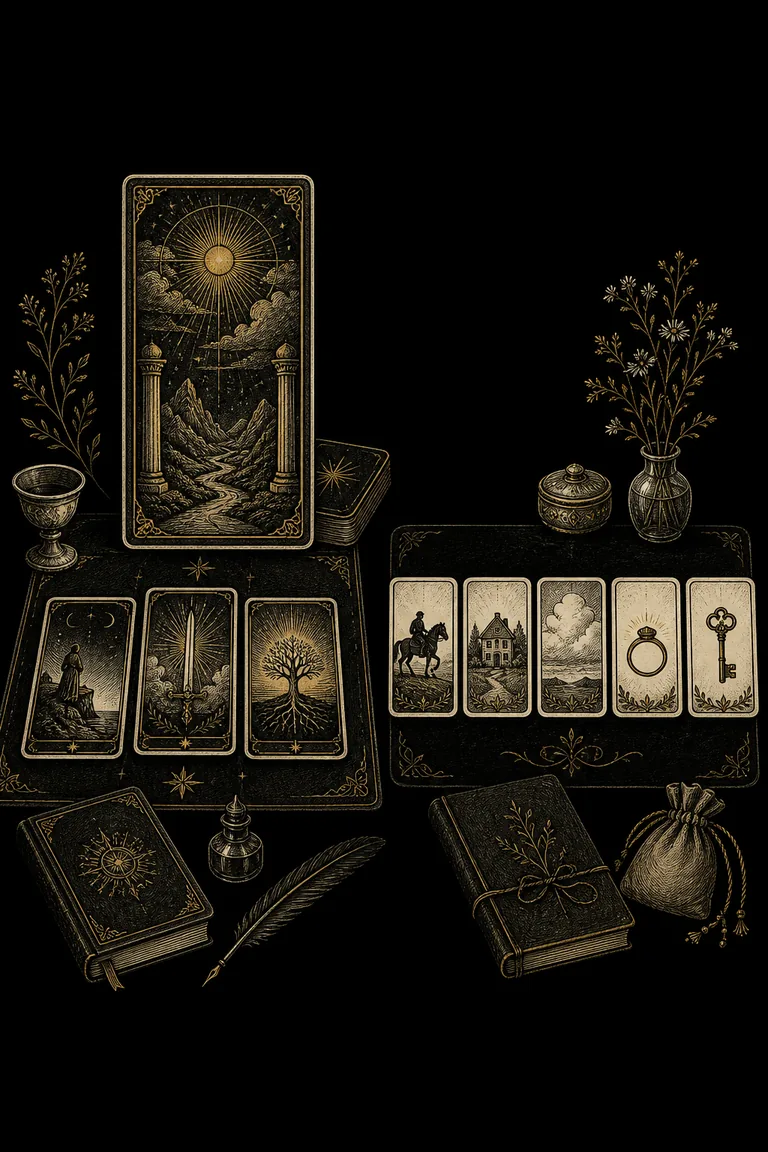
The main difference between Tarot and Lenormand is not simply deck size. A standard Tarot deck has 78 cards divided into Major and Minor Arcana. Petit Lenormand has 36 numbered cards with recurring emblems such as the Rider, House, Tree, Clouds, Ring, and Key. Tarot readers often begin with one card in one named position. Lenormand readers usually begin with two or more cards and read how the emblems modify one another.
Neither method is inherently more accurate. Tarot can be useful for examining motives, values, tensions, and possible responses. Lenormand is often used for concise descriptions of people, objects, messages, obstacles, movement, and ordinary situations. The useful choice depends on the question, the reading rules you can explain, and whether you can stop without redrawing until a preferred answer appears.
Take the next insight with you
Explore personalized Tarot guidance in Veritas, available for iOS and Android.
 Scan with your phone
Tarot vs Lenormand: the short answer
Is Lenormand a type of Tarot?
No. Both are card-reading systems, and many Petit Lenormand decks display a small playing-card inset, but Lenormand does not contain Tarot’s Arcana, four 14-card suits, or court hierarchy. Several names overlap, including Moon, Sun, Stars, Tower, and Rider-like figures, yet the meanings and reading rules are not interchangeable. The Lenormand Tower often concerns institutions, boundaries, distance, or isolation; it is not a smaller version of the disruptive Tarot Tower.
Symbols in Tarot and emblems in Lenormand
Tarot imagery invites layered observation. Color, gesture, landscape, number, suit, figure, and the card’s place within a sequence can all contribute. In Petit Lenormand, the central emblem keeps a comparatively stable practical range across decks. Artistic details may affect readability, but a decorative bird added behind the House should not quietly become a second Birds card. Learn the shared emblem vocabulary before improvising from every visual flourish.
Positions versus combinations
Tarot spreads often assign a distinct question to each position: context, obstacle, value, action, or likely consequence. Lenormand lines may have no separate positional labels. Instead, one card acts on or describes another. Rider plus Letter can suggest incoming written news, while Clouds plus Letter can describe unclear information. Different schools handle direction and syntax differently, so declare whether you read left to right, use a central focus card, or apply another consistent method.
A three-card Tarot example
Suppose the question is, “What should I clarify before signing this service contract?” The positions are current understanding, unresolved concern, and useful action. Justice in the first position can emphasize documented standards; the Moon in the second can mark ambiguity or projection; the Queen of Swords in the third can support direct questions and precise language. The synthesis is to compare the written terms with the actual promise and resolve uncertainty before signing.
A three-card Lenormand example
Use the same practical question and draw Letter, Clouds, and Key. Letter points to the document or message, Clouds modifies it with uncertainty, and Key can indicate the essential fact or workable resolution. A cautious sentence is, “The document contains an unclear point that must be identified and resolved.” The cards do not reveal a hidden clause by themselves. The next action is still to read the contract, ask a specific question, and obtain the answer in writing.
What is the Grand Tableau?
The Grand Tableau is Petit Lenormand’s signature full-deck layout. All 36 cards are arranged in a grid and read through houses, proximity, lines, direction, key cards, and other techniques chosen by the reader. It is not simply a 36-position Tarot spread. Because every card is present, the method depends on relationships across the table rather than on drawing more cards for clarification. Beginners usually learn pairs, three-card lines, and small grids before attempting the full layout.
Do Lenormand cards use reversals?
Traditional Petit Lenormand practice generally does not need upside-down meanings. Nuance comes from combinations, context, distance, direction, and method-specific positive or difficult tendencies. Tarot reversals are also optional, but they are supported by many established Tarot workflows. If you exclude reversals, orient the deck consistently. If a Lenormand deck’s artwork is directional, decide in advance how left-facing and right-facing images affect nearby cards.
Which system is easier to learn?
Lenormand has fewer cards, but fewer does not mean effortless. You need a stable vocabulary and practice combining cards without turning each emblem into an unlimited metaphor. Tarot requires a larger inventory, yet illustrated scenes can make a single-card interpretation easier to enter. The better first system is the one whose rules you can apply repeatedly, explain in plain language, and test against the question without adding meanings after the outcome is known.
How to choose for a question
- Define the task
Ask whether you need values and perspective, a concise description, a comparison, or one practical next action.
- Choose one grammar
Use named Tarot positions or a declared Lenormand combination method, not an improvised mixture.
- Set the card count
Start with the smallest spread that can answer the task and decide the stopping rule before drawing.
- Write the evidence
Separate what the card, position, or combination contributes from facts already known outside the reading.
- Translate into action
End with a proportionate step, an uncertainty, and a review point rather than a certainty claim.
Keep the deck grammar visible
Use Veritas to record the question, deck, spread or line, position rules, card order, combinations, interpretation, uncertainty, next action, and review date.
Can Tarot and Lenormand be used together?
Yes, if each system has a separate declared job. Tarot might explore competing values, followed by a short Lenormand line describing the practical condition that needs attention. Or Lenormand might identify a document, delay, or conversation, while Tarot considers how to approach it. Do not let the second deck cancel the first answer. Finish and record one reading before opening the other, and label which claim came from which method.
Lenormand, oracle cards, and playing cards
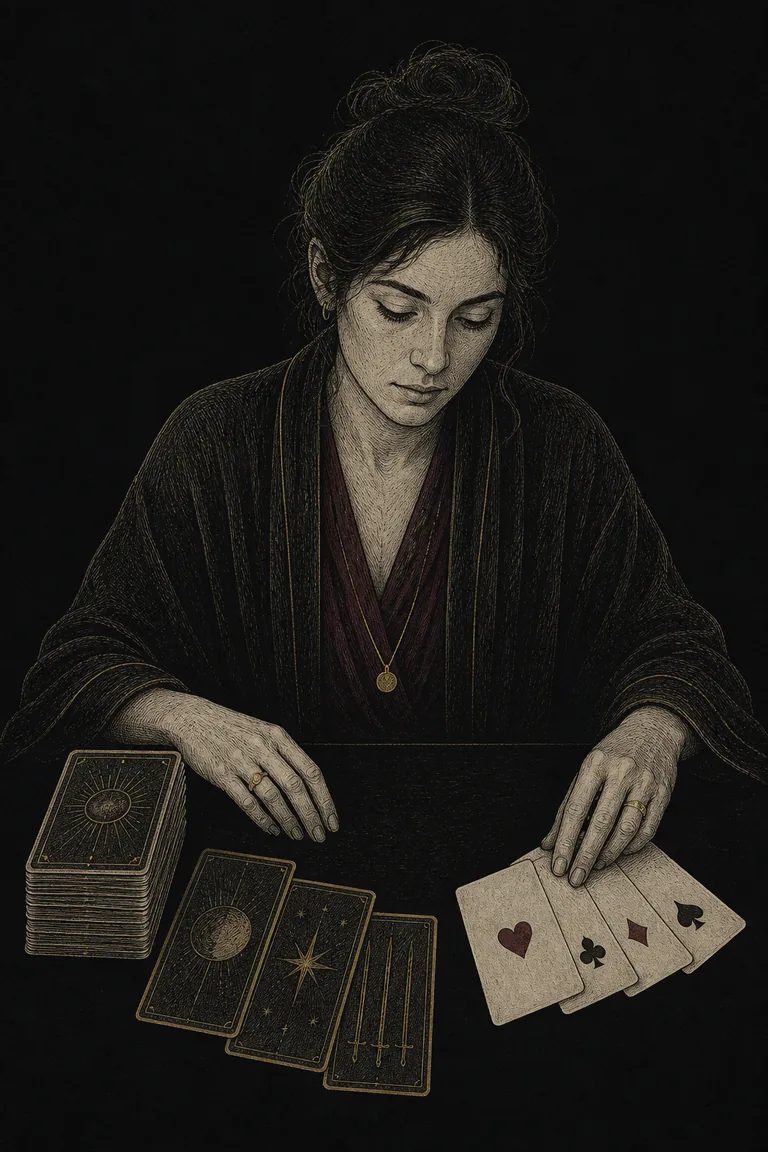
“Oracle cards” is a broad publishing category whose deck size, images, and rules depend on the creator. Petit Lenormand is a specific 36-card tradition with a recognizable sequence and combination methods. Ordinary playing cards have four suits and courts and support multiple cartomancy traditions, but they do not become Lenormand because a reader gives them keywords. Some Lenormand cards include playing-card insets; those insets are one layer inside the Lenormand system, not proof that the decks are identical.
Which is better for prediction?
Lenormand is often phrased more concretely and Tarot more reflectively, but style does not establish predictive validity. A concise statement can still be vague, wrong, or fitted after the fact. Judge specificity, timing rules, recorded misses, base rates, information already known, and whether the reading changes when the reader knows the outcome. Neither deck can guarantee a message, payment, job offer, diagnosis, pregnancy, legal result, betrayal, reconciliation, or another person’s private decision.
A clean comparison exercise
For six low-stakes questions, alternate systems instead of reading every question twice. Use a three-position Tarot spread for three questions and a three-card Lenormand line for the other three. Write each interpretation before acting. At review, mark which statements were specific, which relied on known facts, which were unsupported, and which prompted an ordinary useful action. This compares your practice without forcing the decks to compete on the same draw.
Ethical limits
Use both systems with consent, privacy, and proportion. Concrete Lenormand language is not permission to accuse someone or announce a medical, legal, or financial fact. Layered Tarot imagery is not access to another person’s mind. If a reading increases fear, encourages surveillance, pressures payment, or delays qualified help, stop. Return to documents, direct communication, observable behavior, and professional guidance appropriate to the decision.