Tarot Journal
Tarot vs Playing Cards: Differences and How to Read Both
Tarot uses 78 cards with Major and Minor Arcana, while a common playing-card deck uses 52 cards in four suits. Many reading skills transfer, but the missing trumps, knights, and dedicated Pages change the symbolic grammar.
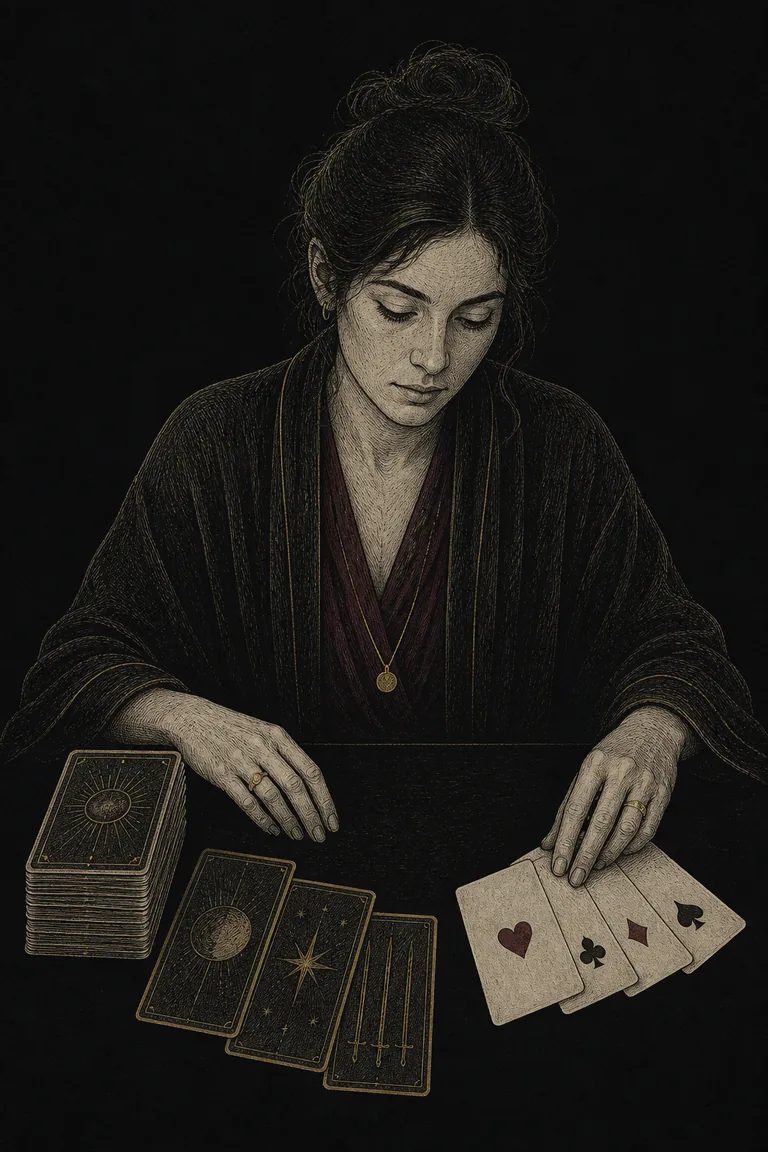
The clearest difference between Tarot and playing cards is deck structure. A standard Tarot deck contains 22 Major Arcana and 56 Minor Arcana. A common French-suited playing-card deck contains 52 cards divided among hearts, diamonds, clubs, and spades. Both have numbered suit cards and courts, but playing cards do not contain a separate Major Arcana sequence.
You can use either deck for reflection or cartomancy. Tarot offers more named positions in its shared system, while playing cards are compact, familiar, and easy to carry. Neither deck is inherently more accurate. A useful reading depends on a clear question, a declared method, careful interpretation, and honest limits.
Take the next insight with you
Explore personalized Tarot guidance in Veritas, available for iOS and Android.
 Scan with your phone
Tarot vs playing cards: the short answer
Are Tarot cards playing cards?
Historically, Tarot belongs to the wider family of playing cards. Tarot packs developed for games and are still used for trick-taking games in parts of Europe. Divinatory Tarot became prominent later. In present English usage, “playing cards” usually means the familiar 52-card French-suited pack, while “Tarot” usually means a 78-card pack used for readings. The categories overlap historically, but their modern structures and common uses differ.
How the four suits compare
A common modern mapping pairs hearts with cups, diamonds with pentacles or coins, clubs with wands, and spades with swords. This works because both systems organize much of the deck into four repeating suits. It is still a convention rather than a law. Regional playing cards use other suit symbols, and cartomancy traditions may assign meanings that do not match a modern Tarot handbook. Name the source or mapping you use before interpreting a spread.
What happens to Pages and Knights?
Each Tarot suit has four court cards, while the standard playing-card suit has three. A Jack may be treated as a young or developing court, as a messenger, or as a blend of Page and Knight qualities. Do not assign it both roles differently after seeing the answer. Choose one court model in advance. Queens and Kings can retain comparable roles, but they should describe modes of relating, deciding, or carrying responsibility rather than fixed gender, age, appearance, or status.
What is missing without the Major Arcana?
The Major Arcana provide a sequence of named figures and situations such as The Fool, Justice, Death, and The World. A playing-card deck has no one-to-one substitute for that sequence. Do not force an Ace to become The Magician or a Joker to stand for all 22 trumps. A Joker can be excluded or given one declared role, but adding one or two Jokers does not recreate the Major Arcana. Playing-card readings can be complete within their own number, suit, court, color, and combination system.
Do numbers mean the same thing?
Ace through Ten gives both decks a shared numerical scaffold, but a number never acts alone. The Five of Hearts and Five of Spades may both involve disruption while pointing to very different domains. Tarot imagery also supplies scene-level evidence that a plain playing-card pip may not. If you transfer Tarot number meanings, state that choice and let the playing-card suit and position reshape the result. Avoid memorizing one sentence that supposedly applies to every Five or every Seven.
How to read playing cards with a Tarot-style workflow
- Choose the deck rules
Decide whether Jokers are removed, how Jacks work, whether Aces are high or low symbolically, and whether reversals are ignored.
- Define one question
Ask about a situation, choice, resource, obstacle, or next action rather than demanding proof of another person’s hidden thoughts.
- Set the positions
Use one card or a small spread with distinct jobs, such as context, pressure, and useful response.
- Draw consistently
Shuffle, cut, and select with a method chosen before the faces are visible.
- Read in layers
Combine suit, number or court, color if your method uses it, spread position, and nearby cards.
- Synthesize and stop
Write one answer, one uncertainty, and one proportionate next step without drawing until the result feels comforting.
Example three-card playing-card reading
Suppose the question is, “What should I clarify before accepting this freelance project?” The positions are existing resource, unresolved pressure, and next action. The Eight of Diamonds can point to practiced material skill; the Two of Spades can highlight an unresolved decision or boundary; the Queen of Hearts can suggest a calm, receptive conversation. A grounded synthesis is to document the skill you are selling, resolve scope and approval authority, then discuss the terms without guessing what the client secretly intends.
Can you use Tarot spreads with playing cards?
Yes, if the spread does not require named Major Arcana. A three-card spread, decision spread, or relationship spread is a map of positions, not a deck type. Large spreads may become repetitive if your playing-card meanings are too narrow, so start small. Read every position before adding optional cards. If the method cannot distinguish two positions clearly, revise the spread rather than blaming the deck.
Which deck is easier to learn?
Playing cards have fewer cards and familiar suits, which reduces the initial inventory. Their minimal imagery can make interpretation less obvious, however, and different cartomancy systems disagree. Tarot asks you to learn more cards but supplies a stable architecture and, in many modern decks, illustrated scenes. Ease depends on whether you learn better from compact rules or from visual narratives. Try the same small spread with each deck and compare how clearly you can explain the result.
Keep your card system explicit
Use Veritas to save the deck, suit mapping, court rule, question, positions, draw order, card evidence, synthesis, next action, and review date.
Can Tarot and playing cards be used together?
They can, but each deck needs a separate job. You might complete a Tarot spread and draw one playing card to name a practical domain, or use a playing-card spread for daily practice and reserve Tarot for questions that benefit from Major Arcana. Do not shuffle unlike card sizes into one stack or keep drawing from both decks to erase an unwelcome answer. Record which system produced each card.
How to choose between them
Choose Tarot if you want the Major Arcana, four courts per suit, illustrated Minor Arcana, and abundant shared learning material. Choose playing cards if portability, durability, price, or an established cartomancy tradition matters more. Card size and handling also count: a bridge-size pack may be easier for small hands than an oversized Tarot deck. You do not need a rare deck, a gifted deck, or a ritual before you can begin.
Are playing-card readings as accurate as Tarot?
Deck structure cannot prove predictive accuracy. More cards create more possible distinctions, but they also create more opportunities to fit a story after the fact. Evaluate the question, method, specificity, consistency, known information, and later evidence. Neither deck can verify a medical diagnosis, legal outcome, investment return, pregnancy, betrayal, reconciliation, or another person’s private thoughts.
A clean comparison practice
For seven days, alternate decks while keeping the question format and spread positions constant. Write interpretations before the day unfolds. At review, record clear matches, mismatches, vague statements, and actions that were useful for ordinary reasons. The goal is not to declare a mystical winner. It is to discover which symbolic vocabulary helps you think clearly without hiding uncertainty.
Ethical limits
Use both systems with consent, privacy, and proportion. Do not claim that a familiar playing-card deck is harmless while using it to frighten, pressure, diagnose, accuse, or demand payment. Do not treat Tarot’s richer imagery as authority over another person. If repeated draws increase anxiety or delay a necessary conversation, professional consultation, or safety action, close the deck and return to direct evidence.