Tarot Journal
Ten of Swords Tarot Meaning: Ending and Recovery
The Ten of Swords marks an ending that can no longer be minimized and asks what becomes possible once the facts are named, support is accepted, and recovery begins.
The Ten of Swords Tarot meaning centers on completion, painful clarity, exhaustion, and the moment a difficult pattern reaches its limit. The image can feel severe, but the card does not predict death, disaster, betrayal, or permanent defeat. It asks what is genuinely over, which conclusion is supported by evidence, and what care is needed now.
In a reading, the Ten of Swords can describe a final conversation, an unsustainable plan, a belief contradicted by events, or the end of carrying more than your share. Its horizon also matters: once denial stops consuming energy, repair can become specific. Position, question, surrounding cards, and real circumstances decide whether the emphasis falls on closure, overstatement, prevention, or recovery.
Take the next insight with you
Explore personalized Tarot guidance in Veritas, available for iOS and Android.
 Scan with your phone
Ten of Swords meaning at a glance
Upright, the Ten of Swords often brings finality, mental overload, an undeniable result, or the last stage of a damaging pattern. Reversed, it may show early recovery, resistance to closure, a narrowly avoided problem, or pain that is being repeated through rumination. Neither orientation guarantees an event. The useful distinction is whether the ending has happened, is being prevented, or still needs to be acknowledged.
Read the ending in context
Use Veritas to compare the Ten of Swords with its spread position, neighboring cards, and the question you actually asked.
Symbols in the Ten of Swords
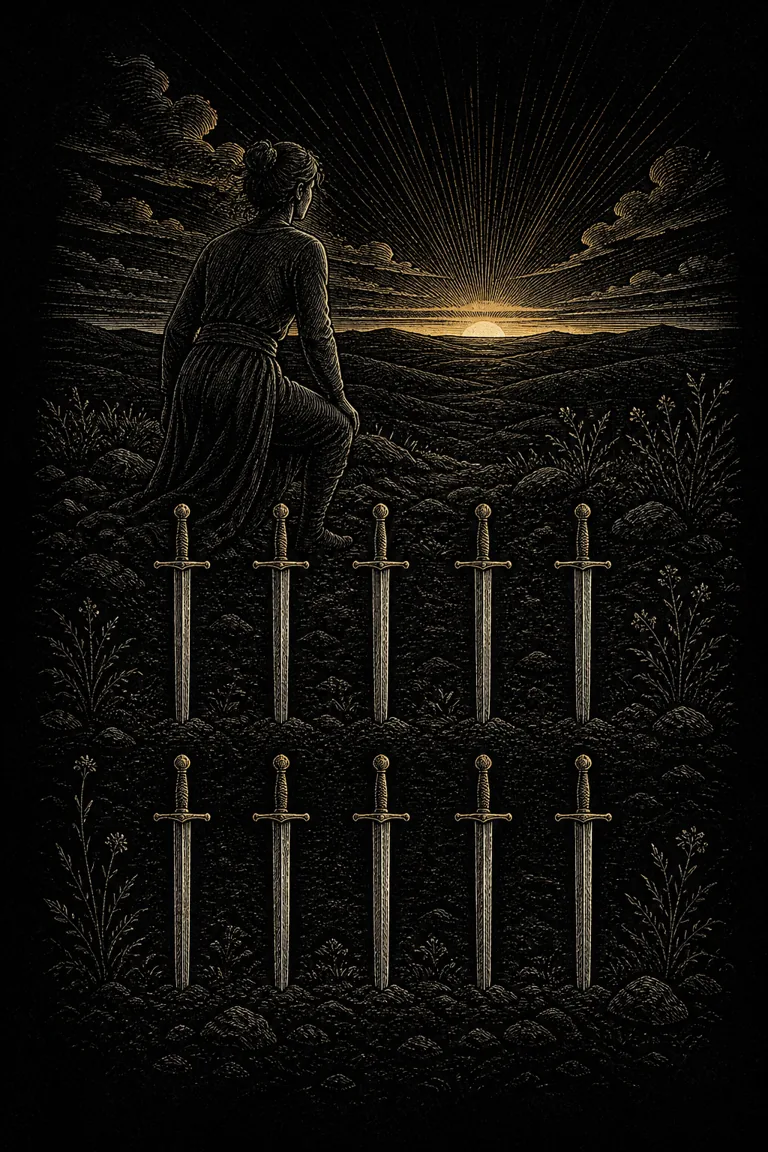
Traditional imagery shows a figure beneath ten swords while light appears at the horizon. Swords belong to thought, language, judgment, conflict, and decisions. Ten completes the numbered sequence, so the image can describe a conclusion that the mind cannot negotiate away. The still figure emphasizes limits; the distant light emphasizes that this scene is a moment, not an eternal identity. Deck artwork varies, so begin with what is visibly present before importing a familiar keyword.
Upright Ten of Swords
The upright card can appear when evidence has accumulated and a chapter is finished. A promise may no longer be credible, a strategy may have failed, or repeated strain may have reached capacity. The card favors accurate naming over dramatic language. Identify the concrete loss, decision, or boundary. Then separate irreversible facts from consequences that can still be reduced through rest, documentation, medical or legal help, honest communication, and a safer next plan.
Reversed Ten of Swords
Reversed, the Ten of Swords may suggest getting up after a difficult ending, noticing warning signs before total depletion, or refusing to let one result define the future. It can also show delayed closure, replayed arguments, or an attempt to restart what has not changed. Ask what has improved in observable terms. Relief, apology, or hope matters, but recovery becomes credible when behavior, capacity, and safeguards also change.
Ten of Swords in love and relationships
In love, the card can mark the end of an agreement, a painful truth, accumulated resentment, or exhaustion with the current pattern. It does not prove infidelity or require a breakup. For an existing relationship, ask which behavior must stop and whether both people consent to repair. For a separation, focus on safety, practical arrangements, support, and grief. For a new connection, do not make another person responsible for repairing an earlier wound.
Ten of Swords as feelings
As feelings, the Ten of Swords can symbolize overwhelm, disappointment, finality, numbness, or the wish to stop analyzing. It cannot reveal another person's private mind as fact. Treat it as a prompt to ask a clear question, respect silence, and observe conduct. If the card describes your feelings, distinguish fatigue from a settled decision and give your nervous system enough time and support before making a high-impact choice.
Ten of Swords for career and money
At work, the card may reflect a failed project, burnout, redundancy, a final deadline, or a role that has become unsustainable. Document decisions, preserve work samples where permitted, clarify pay and benefits, and seek qualified advice when rights or safety are involved. With money, it can warn against treating a setback as proof that recovery is impossible. Stop further loss, list obligations and liquid resources, verify deadlines, and choose the next action from current numbers rather than panic.
Ten of Swords as advice
As advice, stop arguing with the part of reality that is already established. That does not mean surrendering rights or accepting another person's story. It means defining the completed fact precisely, ending unnecessary exposure, and redirecting effort toward protection and recovery. Ask what must be closed, what evidence should be saved, who needs to know, and which obligation can be postponed while capacity returns.
Ten of Swords yes or no and timing
For a bounded yes-or-no question, the Ten of Swords usually leans no when the proposed path depends on reviving an exhausted arrangement without new evidence. It can become a qualified yes to ending, disclosing, resting, or choosing a different route. Timing is more symbolic than exact: the card points to a final stage or immediate acknowledgment rather than a guaranteed date. Use real deadlines, professional guidance, and direct confirmation for consequential decisions.
Ten of Swords card combinations
With the Five of Swords, examine whether a conflict has become too costly to continue. With the Three of Swords, grief or a painful truth needs direct care rather than repeated explanation. Death can reinforce an irreversible transition, while The Star can move the emphasis toward rest, trust rebuilt through evidence, and gradual renewal. A practical Pentacles card may identify material support. Read the pair as a sentence shaped by positions, not as two alarming keywords added together.
Turn closure into a recovery plan
Use Veritas to record what is finished, what remains protected, which support is available, and the next step inside your control.
A four-part recovery check
- State the completed fact
Use one concrete sentence that does not predict every future outcome.
- Stop additional exposure
Pause the contact, expense, workload, or repeated argument that is increasing harm.
- Protect the remainder
List the people, records, money, time, health, and options that are still available.
- Choose one recovery action
Complete a small task such as asking for help, resting, documenting, or scheduling qualified support.
Common Ten of Swords mistakes
Do not predict death, violence, betrayal, job loss, bankruptcy, or a permanent mental-health outcome from this card. Do not call every disappointment rock bottom or pressure someone to forgive, reconcile, or move on before safety and grief have been addressed. Avoid treating the reversed card as automatic recovery. The Ten of Swords is strongest when it helps a reader name an ending accurately and stop the ending from becoming an identity.