Tarot Journal
Ten of Wands Tarot Meaning: Burden and Completion
The Ten of Wands brings a heavy load near its destination and asks which responsibilities are essential, shared, negotiable, or no longer yours.
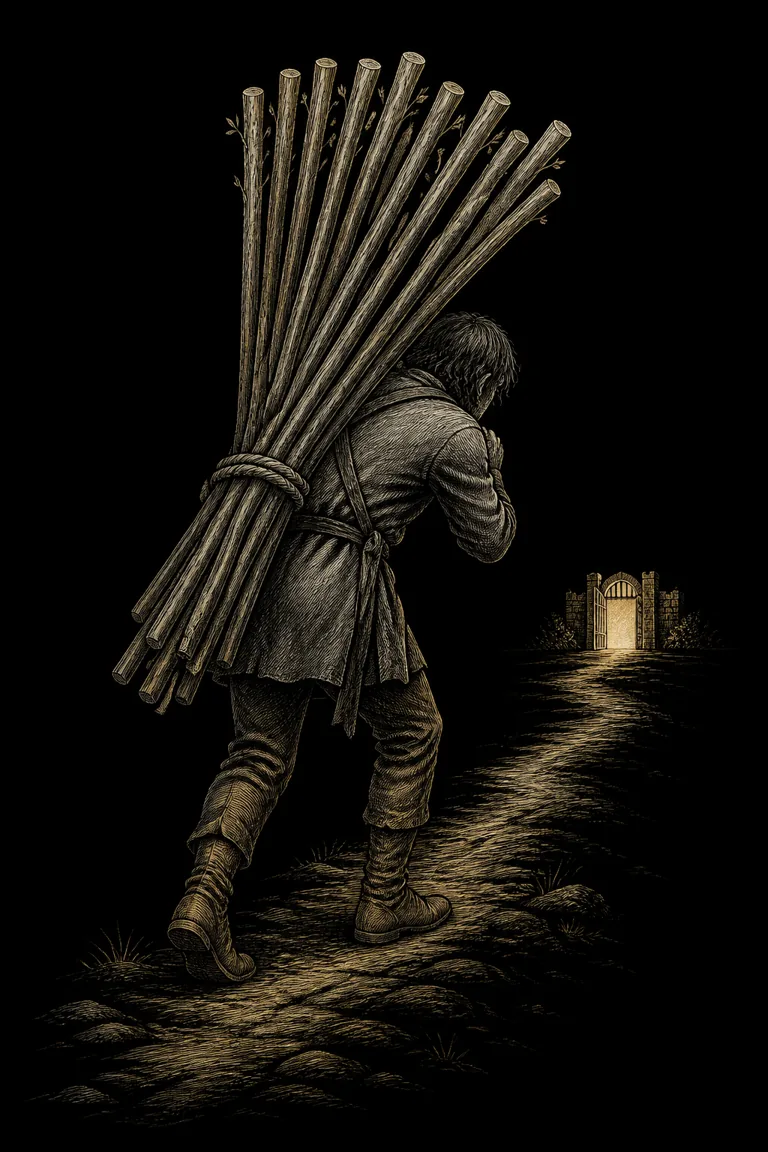
The Ten of Wands is a Tarot card of burden, responsibility, effort, and an approaching completion. In the Rider-Waite-Smith image, a figure carries ten staffs toward a town. The destination is visible, but the bundle blocks his view and forces an awkward posture. The work may have value, yet its current arrangement is costly.
In a reading, the card can describe a demanding final stage, too many commitments, invisible labor, or responsibility accepted without enough authority and support. It does not say that exhaustion proves devotion. Read the deadline, ownership, consequences, available help, and spread position before choosing to finish, delegate, renegotiate, or release the load.
Take the next insight with you
Explore personalized Tarot guidance in Veritas, available for iOS and Android.
 Scan with your phone
Ten of Wands meaning at a glance
Upright, the Ten of Wands can show sustained effort, duty, accumulated commitments, a final push, or overload. Reversed, it may describe releasing weight, delegating, dropping an obligation, poor load design, collapse, or avoiding a responsibility that still belongs to you. Both positions ask whether the burden has a clear purpose, owner, finish condition, and acceptable cost.
Read the burden in context
Open a Tarot reading in Veritas and compare the Ten of Wands with its spread position and neighboring cards before deciding what to carry or change.
Symbols in the Ten of Wands
The familiar figure holds all ten wands in one bundle while walking toward nearby buildings. Ten closes the numbered sequence of the suit, so the image combines completion with accumulated consequence. The visible town suggests that the effort may be finite. The obstructed view suggests a design problem: the carrier cannot easily see alternatives, hazards, or help. In another deck, notice who assigned the load, whether it can be set down, and whether the destination is chosen or assumed.
Upright Ten of Wands
Upright, the card often appears when every individual commitment once seemed reasonable but the combined load is no longer sustainable. A final push can make sense when the endpoint is close, the outcome matters, and recovery is scheduled. If the work has no boundary, the card favors redesign over heroic endurance. Clarify scope, remove duplicated effort, and give responsibility to people who also have the authority to act.
Reversed Ten of Wands
Reversed, the Ten of Wands can describe welcome relief through delegation, refusal, automation, or a smaller promise. It can also show a load dumped without a handover, an obligation denied until consequences grow, or a person too depleted to continue safely. Reversal does not automatically mean quitting. It asks whether release is responsible, whether support is real, and whether the system will simply return the same weight later.
Ten of Wands in love and relationships
In relationships, this card may point to uneven domestic work, emotional management, caregiving, scheduling, or financial pressure. Love does not make unspoken labor fair. Name the task, frequency, standard, owner, and constraint instead of debating who cares more. Reversed, a couple may redistribute work or one person may withdraw without agreement. Tarot cannot establish consent, diagnose a partner, or require someone to remain in an unsafe situation.
Ten of Wands as feelings
As feelings, the card can suggest pressure, duty, protectiveness, fatigue, or concern that connection requires more capacity than is available. It does not prove that someone is secretly committed because they seem burdened. Look at communication and conduct: do they name limits, make a realistic offer, keep agreements, and share repair? Another person remains the source for their own feelings and intentions.
Ten of Wands for career and money
At work, the card can mark scope creep, a deadline cluster, sole ownership of undocumented knowledge, or the final delivery of a difficult project. Convert invisible labor into a visible queue, then decide what stops, moves, or receives help. With money, it can reflect fixed obligations, debt pressure, or costs attached to maintaining an asset. Use verified balances, rates, deadlines, and professional advice where needed rather than treating strain as a prediction of failure.
Ten of Wands as advice
Do not ask only whether you can carry the load. Ask what outcome the load serves and whether the present method is necessary. Protect the one responsibility with the highest consequence, make the rest visible, and renegotiate before the deadline forces a worse choice. Completion is useful when it closes work. It is not useful when it silently renews the same overload.
Give every obligation a decision
Use Veritas to sort the current load into complete, delegate, renegotiate, and release, then define the next review point.
Ten of Wands timing
The Ten of Wands often describes a late stage, a final delivery, or delay caused by too many dependencies, but it cannot supply a reliable date alone. Define the event and inspect the actual schedule. With the Eight of Wands, speed may be adding more work than the landing can absorb. With the Nine of Wands, limited stamina and protection become part of the completion plan.
Ten of Wands in a yes or no reading
The answer is a conditional yes when the goal is worthwhile, the remaining work is finite, and the load can be carried without hiding its cost. It leans no or not this way when success depends on indefinite overwork, unowned risk, or obligations that should be shared. Ask what must be removed or reassigned for the commitment to become credible.
Useful card combinations
With the Nine of Wands, protect remaining stamina and define the finish. With the Eight of Wands, incoming activity needs triage before it becomes a burden. With the Four of Swords, recovery is required rather than optional. With the Emperor, examine authority, structure, and who assigned the responsibility. With the Devil, check whether obligation is reinforced by fear, dependency, or terms that can be challenged.
A practical load audit
- Name the destination
Define the concrete outcome and the date or condition that closes the work.
- List the full load
Include coordination, follow-up, emotional labor, maintenance, and hidden dependencies.
- Assign one decision to each item
Complete, delegate, renegotiate, defer, or release it, with an owner and consequence.
- Review capacity
Check time, money, attention, safety, and recovery before accepting the revised plan.
Common Ten of Wands mistakes
Do not romanticize burnout, assume every duty is yours, or call all release irresponsible. The card can describe meaningful effort without making suffering a requirement. Reversed does not excuse abandoning shared consequences, and upright does not promise that persistence will be rewarded. A clear reading distinguishes completion from repetition, ownership from control, and commitment from preventable overload.