Tarot Journal
Tarot for Decision Making: Comparing Two Paths Responsibly
A Tarot decision spread compares what two paths offer, cost, and require without asking the cards to choose for you or pretending uncertainty can disappear.
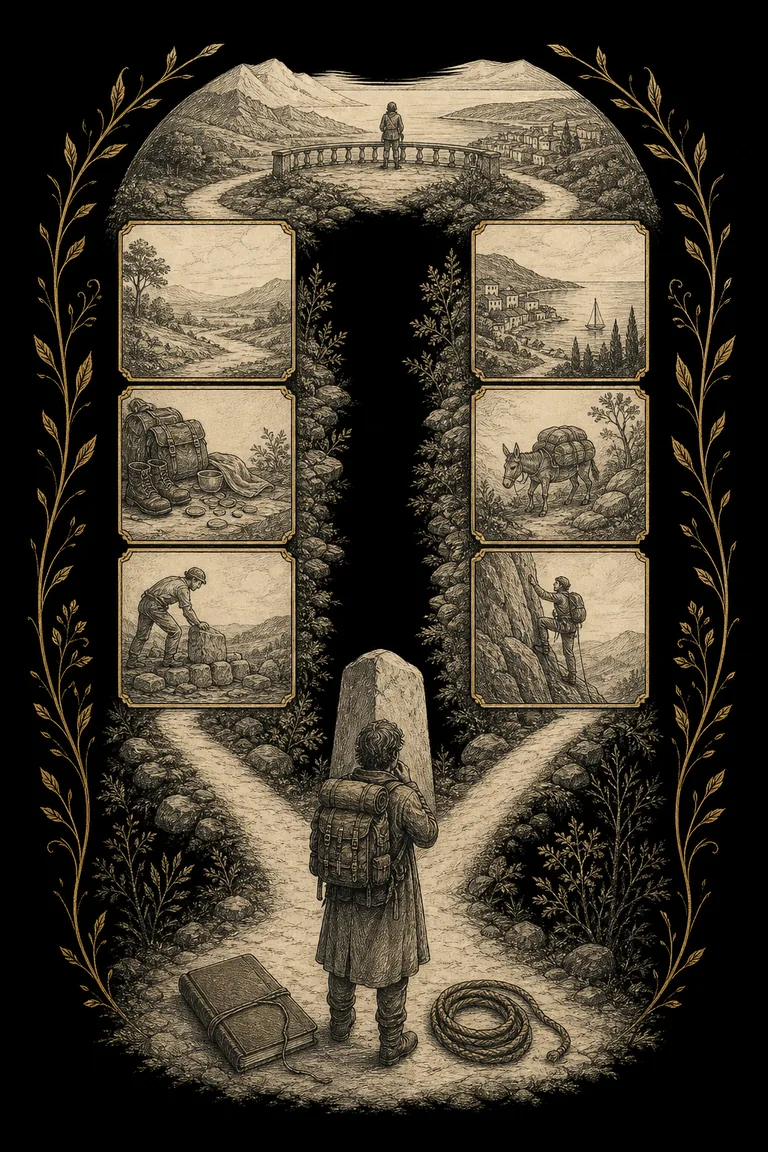
Tarot can support decision making when the layout gives both options equal attention. The aim is not to discover which future is guaranteed. It is to compare values, tradeoffs, demands, and missing information so that your own choice becomes more informed.
The nine-card spread below works best for two real options, such as staying or leaving, accepting or declining, or choosing between two plans. Define both paths before shuffling and keep the wording neutral. If one option is unsafe or impossible, practical evidence already matters more than symmetry.
Take the next insight with you
Explore personalized Tarot guidance in Veritas, available for iOS and Android.
 Scan with your phone
The nine-card decision spread
The real decision
What the choice is fundamentally about beneath the surface wording.
Path A offers
The value, opportunity, or experience available through the first option.
Path A costs
The time, energy, money, freedom, or opportunity this option may consume.
Path A requires
The skill, boundary, commitment, or condition needed to pursue it responsibly.
Path B offers
The value, opportunity, or experience available through the second option.
Path B costs
The time, energy, money, freedom, or opportunity this option may consume.
Path B requires
The skill, boundary, commitment, or condition needed to pursue it responsibly.
Shared unknown
Information or uncertainty that affects both options and should not be invented.
Useful experiment
A small reversible action that can improve the decision with real evidence.
Compare two paths without surrendering the choice
Open a Tarot reading in Veritas, give both options equal structure, and turn the final card into a practical experiment.
Define the options before you draw
Write Path A and Path B as actions, not emotional labels. “Renew the lease for one year” and “move when the lease ends” are clearer than “stay stuck” and “be free.” Loaded wording guarantees a loaded reading. Include the decision date and the facts that cannot be negotiated.
Lay out two equal columns
Place card one at the top center. Put cards two through four in a column on the left and cards five through seven on the right. Cards eight and nine sit below both columns. The mirrored structure prevents one attractive card from becoming a complete verdict.
Read offers as values, not promises
The Ace of Pentacles in “Path A offers” may show a tangible beginning, but it does not guarantee profit. The Six of Swords in “Path B offers” may support distance and transition, but it does not promise that moving will solve every problem. Translate the image into a value the option could realistically provide.
Costs reveal opportunity cost
Every meaningful option consumes something. The Hermit as a cost might mean less social contact or a period of solitary work. The Ten of Pentacles might indicate family expectations or the weight of maintaining a long-term structure. A cost is not automatically a reason to reject a path; it is something to budget honestly.
Requirements test feasibility
A path can offer exactly what you want and still require a resource you do not currently have. Strength might require patient self-regulation. Justice might require a contract, qualification, or clear agreement. The Three of Pentacles may require collaboration and feedback. Ask whether the requirement is available, learnable, negotiable, or absent.
Do not fill the unknown with a story
Card eight names the uncertainty both paths share. The Moon may point to incomplete information; the Wheel of Fortune may highlight conditions outside your control. Write the factual question behind the card. Who can answer it? What document, trial, conversation, or deadline would reduce the uncertainty?
Use the experiment card
Card nine should produce a reversible test rather than another prediction. A Page may suggest asking questions, making a prototype, or trying a beginner version. The Two of Pentacles could support a temporary schedule that samples both demands. Define what you will test and what result would change your view.
A short comparison example
Suppose Path A offers the King of Pentacles, costs the Eight of Swords, and requires Justice. Path B offers the Star, costs the Five of Pentacles, and requires the Magician. The first path offers stability but may preserve constraints and needs a fair agreement. The second offers renewal but risks financial strain and requires active resource building. Neither column wins automatically.
If the shared unknown is the Moon and the experiment is the Page of Pentacles, the next step may be to build a three-month budget and request concrete terms before deciding. The reading improves the comparison by exposing what must be learned.
Score practical criteria separately
After reading, compare both paths against the same real-world criteria: safety, affordability, values, time, reversibility, and effect on other commitments. Do this outside the Tarot layout. If the symbolic story and factual score disagree, investigate the disagreement rather than forcing either one to win.
When not to use the spread
Do not use a comparison spread to decide whether to seek emergency care, leave immediate danger, report abuse, meet a legal deadline, or accept financial risk you cannot evaluate. Qualified support and evidence come first. Tarot cannot establish consent or decide for another person.
Finish with ownership
Write one sentence for each option: “I would choose this because...” Then name the tradeoff you are willing to accept. If neither sentence feels honest, the spread may have revealed that the options were framed too narrowly. A third route, delay, or boundary may need consideration.
Tarot is a symbolic reflective practice, not a scientifically validated forecasting or decision-analysis method. Use it to organize attention while medical, legal, financial, safety, and relationship decisions remain grounded in evidence and appropriate advice.