Tarot Journal
Wheel of Fortune Tarot Meaning: Cycles, Timing, and Change
The Wheel of Fortune marks a change in conditions, timing, or position and asks how to respond when control is partial but meaningful choice remains.
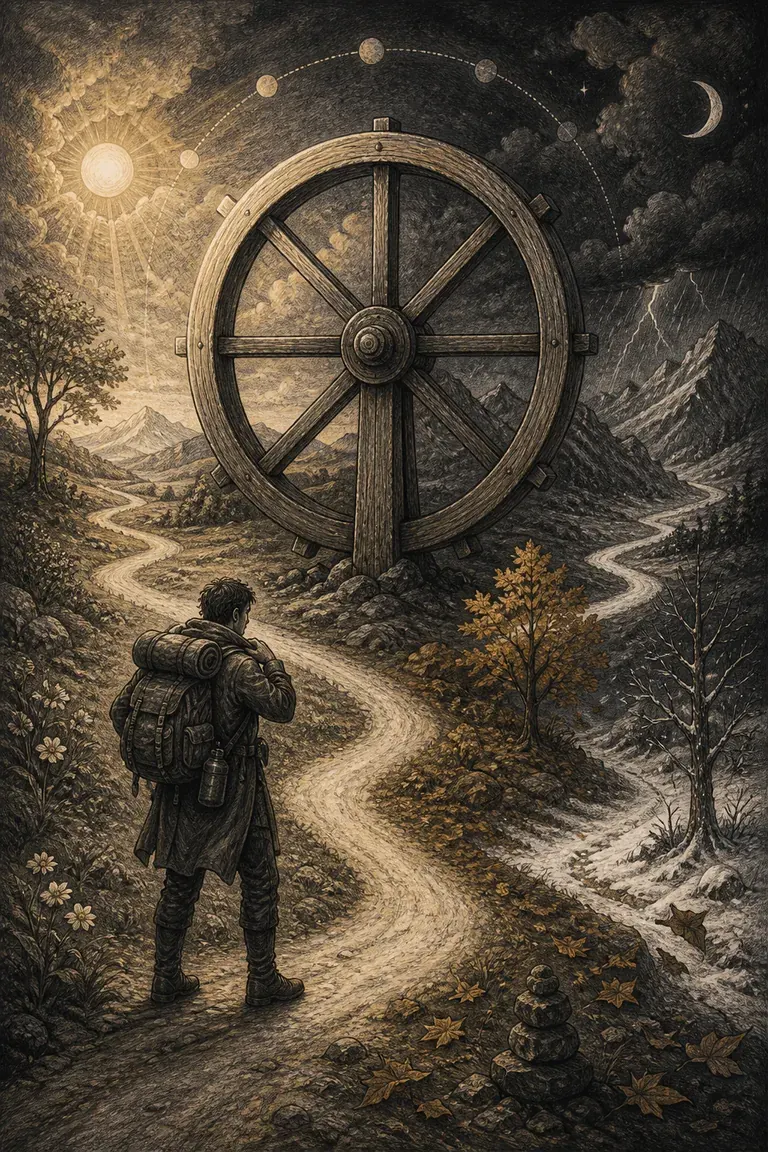
The Wheel of Fortune is the tenth card of the Major Arcana. Its turning image is often associated with cycles, timing, reversals, opportunity, and the larger conditions that move a situation beyond one person's control. In a reading, the card can mark a threshold where the old arrangement no longer explains what happens next.
A grounded interpretation does not promise a lucky break or claim that every setback was destined. The Wheel separates what is changing around you from what you can still observe, prepare, choose, and revise. It invites participation without pretending that effort controls chance, institutions, other people, or the full outcome.
Take the next insight with you
Explore personalized Tarot guidance in Veritas, available for iOS and Android.
 Scan with your phone
Wheel of Fortune Tarot meaning at a glance
The Wheel of Fortune can point to a turning point, a repeating cycle, changing circumstances, timing, chance, movement, or a shift in status. Its difficult expression includes passivity, gambling on rescue, repeating a pattern without review, trying to force timing, or blaming fate for choices that remain available.
Read the turning point in context
Open a Tarot reading in Veritas and explore what is changing, what remains within reach, and which response fits the present conditions.
What the turning wheel suggests
A wheel moves through rising, culmination, descent, and return. No position is permanent, but movement is not automatically improvement. The image asks where you are in a process and which forces are carrying it: season, policy, market conditions, health, relationship dynamics, accumulated choices, or simple chance. Naming the mechanism is more useful than calling everything destiny.
Wheel of Fortune upright
Upright, the Wheel can describe momentum, a new opening, a change of role, the return of a familiar theme, or conditions finally becoming movable. It may favor readiness and timely participation. Accept the opening, but verify what it requires. An opportunity can be real without being guaranteed, permanent, affordable, or right for you.
Wheel of Fortune reversed
Reversed, the card may show delay, an unwelcome turn, resistance to change, or a cycle that repeats because its structure has not been addressed. It can also describe the ordinary frustration of poor timing. Review assumptions, buffers, dependencies, and past responses before concluding that you are cursed or powerless. A smaller adjustment may restore room to act.
Love and relationships
In relationships, the Wheel can mark a transition in availability, commitment, distance, family demands, or the pattern a pair keeps revisiting. Change does not remove the need for consent and direct conversation. Ask what has actually shifted, what each person wants now, and whether the relationship can adapt without one person carrying all the uncertainty.
Career and work
At work, the Wheel may accompany a reorganization, new manager, changing market, promotion window, contract ending, or chance introduction. Prepare for movement by updating evidence of your work, clarifying terms, strengthening useful relationships, and keeping alternatives visible. The card cannot guarantee hiring, promotion, or business success.
Money and risk
For money questions, the Wheel highlights variability and exposure to conditions you do not set. It is not a signal to gamble, chase losses, or invest because luck is supposedly turning. Check cash flow, fees, downside, time horizon, diversification, and the possibility that favorable conditions will change. Use qualified financial advice for consequential decisions.
Timing without false precision
The card can say that timing matters without supplying a reliable date. Look for observable gates such as an application window, delivery milestone, season, review meeting, legal deadline, or the completion of a prior step. If no gate exists, define the next review point yourself rather than waiting indefinitely for a sign.
Cycles are patterns, not sentences
A repeated theme can reveal a system, habit, trigger, or unresolved agreement. It does not prove that repetition is inevitable. Compare this turn with the last one: what preceded it, which response intensified it, what shortened it, and what resources are different now? The comparison turns vague recurrence into information you can test.
Fortune, privilege, and unequal conditions
People do not meet chance from equal positions. Savings, citizenship, health, discrimination, care responsibilities, networks, and institutional power change the cost of a turn. Reading the Wheel responsibly means acknowledging those conditions. It should not blame someone for hardship or claim that positive thinking can cancel structural risk.
Wheel of Fortune as advice or obstacle
As advice, stay responsive: gather current information, keep a margin, and take the next reversible step while the opening exists. As an obstacle, the Wheel can expose passivity, superstition, or constant pivoting that prevents learning. Decide what deserves adaptation and what needs a stable commitment long enough to produce evidence.
Useful Wheel of Fortune combinations
With The Magician, changing conditions meet available skill and deliberate action. With The Chariot, momentum needs direction and pace. With Strength, adaptation requires regulated courage. With The Tower, a turn exposes structural weakness that must be addressed. With The Star, the new cycle needs patient repair rather than instant optimism.
A practical Wheel of Fortune review
- Name the turn
State what has changed in observable terms, including timing, people, rules, resources, or information.
- Sort control from influence
Separate what you decide, what you can influence, and what must be monitored or accepted.
- Find the recurring mechanism
If this feels familiar, compare triggers, responses, costs, and supports with the previous cycle.
- Choose an adaptable move
Take one proportionate action and set a date or condition for reviewing it.
A question the Wheel asks
Ask: “What has genuinely changed, and which response would help me participate without pretending I control the whole turn?”
Tarot is a symbolic reflective practice, not a scientifically validated forecasting method. The Wheel of Fortune cannot predict luck, timing, markets, health, legal outcomes, relationship decisions, or another person's behavior, and it cannot replace medical, legal, financial, mental health, workplace, relationship, or emergency support.